
Apollo to Artemis: A 50-Year Odyssey
It is over 50 years since the last human stepped foot on the moon, will it ever happen again?

Apollo 17, which occurred in 1972, marks the end of our manned moon landing program. NASA has recently announced that they are preparing to send astronauts back to the moon, and this project is called Artemis. Artemis will also include the first ever woman on the lunar surface. Currently, NASA has a budget of billions of dollars and they have many goals they need to achieve while dealing with budgetary constraints. When you look at it this way, it is clear that NASA needs to be very good at budgeting in order to accomplish all their objectives.
But it's not just about money. The moon itself comes with some serious challenges. To begin with, its surface is full of holes and big rocks, making it a tough place to land. Then, there's the moon dust, or regolith if you want to use the scientific term. This stuff was formed over many years from rocks hitting the moon. It's really tough and sticks to everything. This dust can quickly harm spacesuits, vehicles, and equipment. And living on the moon is no walk in the park either. The moon doesn't have a protective air layer, so for 14 days, it's exposed to strong sun rays. Then, there are two weeks of total darkness. These big temperature swings are something we humans aren't used to.
But fear not, there are options; NASA is developing spacecraft and spacesuits that are resistant to dust and sunlight. Even more intriguing is that they're working on a device that may provide electricity during those moonlit evenings and, after we arrive to Mars, could also be useful there. Consider the fact that NASA has to recruit extremely intelligent individuals for its initiatives. There are other people who can help too because in recent years it hasn't just been NASA who has been involved in space exploration. NASA landed 12 people on our spacecraft in total; it was undoubtedly one of the most extraordinary events in NASA's history, if not the best, and those astronauts did incredible things up there. They made science projects, took pictures, brought back pebbles, and even left flags behind. All of these Apollo missions' significant moments should not be confused with the Apollo missions' original goal, which was to establish a lunar space station.
It's only reasonable considering the moon is just a three-day journey from Earth. This means we can afford some small mistakes without ruining the entire project. Moreover, we've gained valuable knowledge from previous space endeavors before we venture further into the cosmos. Establishing a base on the moon could serve multiple purposes. It could be a refueling station for deep space missions, a convenient location for launching telescopes into space, and a stepping stone in our quest to make Mars suitable for human habitation. Additionally, a lunar space station could enhance our understanding of the moon's origins. There's even potential for lunar tourism, which could generate income.
Let's not forget the immense effort put into the Apollo Moon program. Not everything went perfectly; two notable setbacks included a fire incident at the launch pad of Apollo 13 and an oxygen tank malfunction during the mission that caused significant issues. An integral part of the project was the Saturn V, which, to this day, remains the most powerful rocket ever successfully flown, towering 36 stories high. Thanks to Saturn V, NASA executed 13 missions, which carried 24 astronauts to the moon, with half of them having the opportunity to walk on its surface. Now, the Artemis project has entered the scene. It's a program overseen by NASA to ensure its success. NASA conducted a preliminary test with Orion, an unmanned spacecraft that orbited the Moon and returned to Earth – think of it as an automated test drive.
All these upcoming projects prompt curiosity about what life on the moon will entail. Some envision moon dwellings resembling cozy hobbit holes from fairy tales, as living underground may be a necessity due to extreme temperatures, lack of oxygen, meteorite risks, and continuous radiation. Various transportation companies, both large and small, are striving to create the perfect lunar transport. According to current estimates, a particular type of moon taxi might be operational as early as 2024. These space taxis won't face the challenges of re-entering Earth's atmosphere, making multiple round trips more manageable. To support lunar living, dedicated areas for space taxis to safely take off and land will be crucial. These next-generation vehicles will provide a controlled environment, eliminating the need for spacesuits while inside. However, if you wish to step out of your space ride, you'll still need to don a spacesuit.
Okay, so we've taken care of our housing and transportation, but what about fuel? This is where the moon comes to our rescue. The moon's lower gravity means we don't require as much energy to escape its pull. Additionally, the moon has ice, which is incredibly valuable. We might be able to convert this ice into rocket fuel. Afterward, robotic helpers on the lunar surface would process this ice into fuel and deliver it to a space refueling station. If successful, rockets on their way to Mars could make a pit stop for a quick refuel before continuing their journey.
About the Creator
Keep reading
More stories from Nayson Murona and writers in Futurism and other communities.
From Moon Bases to Mars Colonies: The Future of Human Expansion
In the modern age, the boundaries of human exploration are expanding beyond Earth's confines. The concept of establishing Moon bases and Mars colonies has shifted from science fiction to a tangible reality. This article embarks on a captivating journey into the future of human expansion, where the modern age is poised to witness extraordinary developments that will redefine our cosmic footprint.
By Nayson Murona2 years ago in Futurism
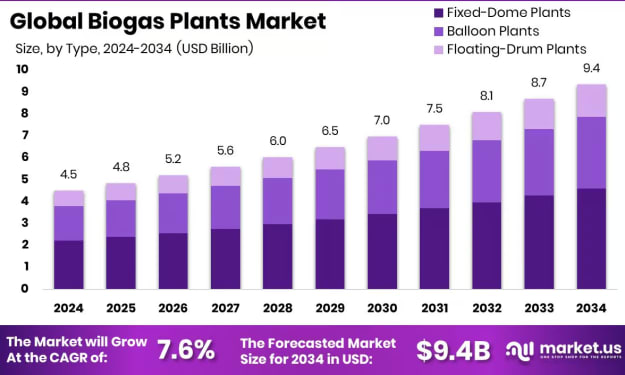
Biogas Plants Market To Reach USD 9.4 Billion by 2034 at 7.6% CAGR
Overview The Biogas Plants Market is projected to experience steady growth over the coming decade, driven by increasing demand for renewable energy and sustainable waste management solutions. The market is expected to be worth around USD 9.4 billion by 2034, up from USD 4.5 billion in 2024, growing at a compound annual growth rate (CAGR) of 7.6% from 2025 to 2034. Biogas plants convert organic waste such as agricultural residues, food waste, and animal manure into renewable energy in the form of biogas, which can be used for electricity generation, heating, and transportation fuel.
By Hayden Kulasa day ago in Futurism
Thermal Paper Market: POS Receipt Demand, Retail Digitization & Industry Growth Outlook
According to IMARC Group's latest research publication, The global thermal paper market size was valued at USD 4.7 Billion in 2025. Looking forward, IMARC Group estimates the market to reach USD 6.9 Billion by 2034, exhibiting a CAGR of 4.22% during 2026-2034.
By sujeet. imarcgroup2 days ago in Futurism



Comments
There are no comments for this story
Be the first to respond and start the conversation.