
Antimatter: The Scientific Quest for the Universe's Elusive Counterpart
Dirac’s prediction was revolutionary because it not only expanded the scope of particle physics but also suggested that the universe was more complex than previously thought. Antimatter became a topic of fascination, giving rise to questions about its properties and its potential role in the cosmos. Scientists began to wonder: if antimatter exists, could entire regions of the universe be made of it? What happens when matter and antimatter collide?

Antimatter, long a staple of science fiction, is far more than just a futuristic concept; it is a profound mystery that continues to captivate scientists around the world. From its theoretical underpinnings to its potential applications, antimatter has been the focus of intense research and speculation, shaping our understanding of the fundamental nature of the universe.
The Birth of the Idea
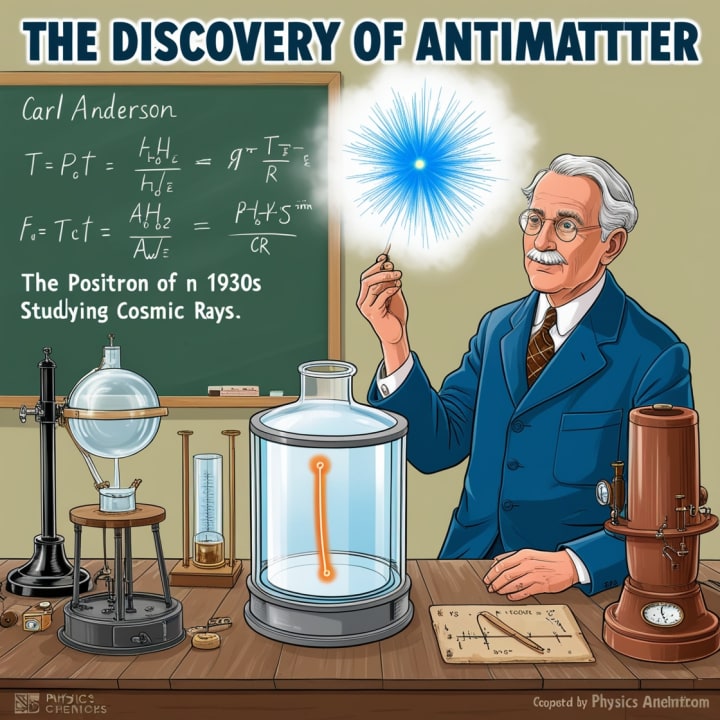
The concept of antimatter originated in the early 20th century when physicist Paul Dirac developed an equation that combined quantum mechanics and special relativity. His groundbreaking work in 1928 predicted the existence of particles that were identical to electrons but carried a positive charge. This theoretical framework led to the discovery of the positron by Carl Anderson in 1932, marking the first direct observation of an antiparticle. This breakthrough confirmed that every particle of ordinary matter has an antimatter counterpart with opposite properties, creating a foundation for further exploration.
Matter vs. Antimatter: The Great Imbalance
One of the greatest puzzles in physics is why the observable universe is overwhelmingly composed of matter, even though the Big Bang should have produced equal amounts of matter and antimatter. If both had been created in equal parts, they would have annihilated each other, leaving behind a universe filled only with photons. The fact that matter exists at all suggests that some unknown process tipped the balance in favor of matter over antimatter.
Scientists are actively exploring this asymmetry through a variety of methods. One major research hub is CERN’s Large Hadron Collider (LHC), where high-energy particle collisions aim to replicate the conditions of the early universe. By observing the interactions of particles and antiparticles in controlled settings, physicists hope to understand why matter gained the upper hand. Experiments involving neutrinos and their behavior in relation to antimatter may also offer clues, as recent studies suggest that neutrino oscillations might have contributed to this cosmic disparity.
This asymmetry, known as baryon asymmetry, remains one of the most significant unsolved problems in physics. If scientists can uncover why matter predominates over antimatter, it would mark a monumental shift in our comprehension of the universe’s formation and evolution. The solution to this enigma could reveal new physics beyond the current Standard Model, opening the door to revolutionary ideas about the forces and particles that govern the cosmos.
Applications and Challenges
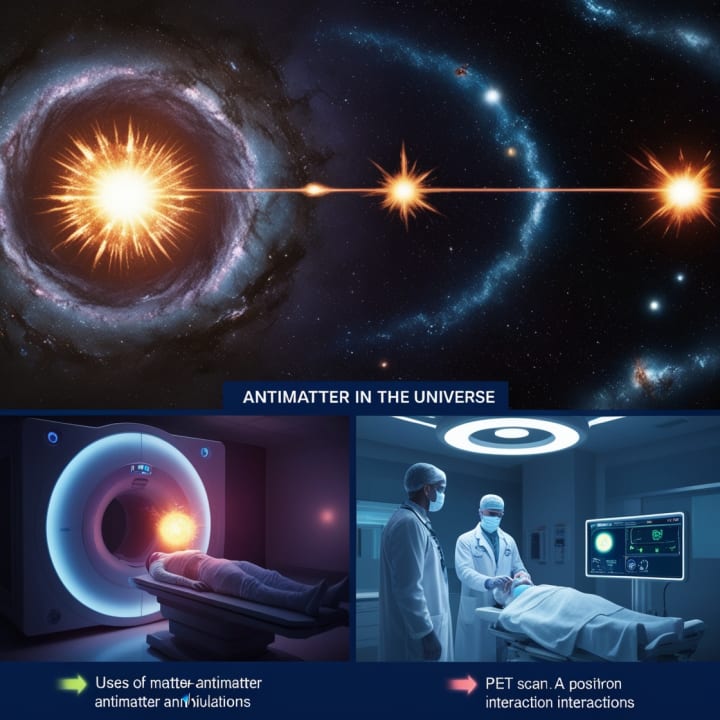
Antimatter holds immense potential for practical applications, particularly in the fields of energy production and space travel. When matter and antimatter meet, they annihilate each other, releasing energy according to Einstein’s equation, E=mc^2. This makes antimatter an incredibly dense energy source. Theoretically, a gram of antimatter could produce an energy output equivalent to that of a large nuclear explosion, enough to power entire cities or propel spacecraft to unprecedented speeds.
However, these grand ideas are far from being realized due to the significant challenges associated with antimatter production and containment. Creating antimatter requires particle accelerators, which use vast amounts of energy to produce only minute quantities of antiparticles. The production of just a few nanograms of positrons costs millions of dollars, making large-scale production impractical with current technology.
Containment is another monumental challenge. Antimatter cannot come into contact with any regular matter—including the walls of its storage container—without annihilating. Thus, scientists use sophisticated magnetic and electric fields to keep antimatter suspended in a vacuum. These containment methods, while effective for small-scale experiments, are not yet feasible for storing the larger quantities that would be needed for energy production or propulsion systems.
The Future of Antimatter Research
Despite these challenges, the study of antimatter continues to push the boundaries of modern physics and holds promise for future technological advancements. Understanding why matter dominates the universe could provide profound insights into the earliest moments after the Big Bang and help refine existing theories about the fundamental forces of nature.
In addition to advancing theoretical physics, antimatter research may one day lead to technology that currently exists only in the realm of science fiction. Antimatter propulsion systems, for instance, have been considered for interstellar travel. A spacecraft powered by antimatter would achieve speeds far exceeding those of current propulsion technologies, making human exploration of distant star systems more attainable. Such advancements would represent a giant leap forward in space exploration and might redefine humanity’s place in the cosmos.
About the Creator
Say the truth
"Say the Truth: Explain Everything in the World" is your trusted source for uncovering facts and exploring the wonders of history, science, technology, and beyond. We simplify complex ideas and reveal truths to inspire curiosity .
Keep reading
More stories from Say the truth and writers in Futurism and other communities.
Antimatter: Unlocking the Universe's Mirror Image
Antimatter: The Abstruse Mirror of Accustomed Matter Antimatter is one of the best alluring and abstruse concepts in avant-garde physics. Though it sounds like article out of a science fiction novel, antimatter is a well-documented allotment of the accustomed universe, arena a acute role in the abstraction of axiological particles and energy. Understanding antimatter helps scientists delving some of the better questions in physics, including the origins of the creation and why the creation is bedeviled by bulk rather than antimatter.
By Say the truth about a year ago in Futurism
About Binding Prometheus
I want to start actively advocating on behalf of my own work, and the most valuable part of my canon is, without a doubt, Binding Prometheus, the play I have been working on since 2019 and only finished in 2023 as part of my MA. The play itself is an amalgamation of a million different inspirations. On one end, it evokes the Ancient Greek myth-play, deriving its own title from the earliest extant work of Western drama we have, Aeschylus’s Prometheus Bound. On the other end, it borrows significantly from the sci-fi bulwarks from over the years, namely Mary Shelley’s Frankenstein and Karel Capek’s Rossum’s Universal Robots. The play could be an episode of Black Mirror, I fear. I don’t know. I’ve only ever seen one episode of Black Mirror.
By Steven Christopher McKnight17 days ago in Futurism
Top-12 AI Agents Development Services in the 2026
AI agents are no longer experimental tools. In 2026, they sit at the core of how modern companies automate workflows, support customers, analyze data, and make decisions at scale. Autonomous customer support agents and multi-agent enterprise systems coordinate complex operations. Businesses actively seek partners capable of designing, building, deploying, and maintaining production-ready AI agents.
By CEO A&S Developers5 days ago in Futurism


Comments
There are no comments for this story
Be the first to respond and start the conversation.