
Alive Silence
How an ideal society learned to turn off pain but lost its soul
It all started with the war in Ukraine. People fled. They lost their homes, families, language, and themselves. Some stayed forever in destroyed buildings, others in lines at foreign borders. The world watched, sympathized, donated, but didn’t understand. Then the chain reaction began - wars, climate catastrophes, economic crashes. Humanity was on its knees and decided: the old world is dead. Let the new one be born. Perfect.
People were tired of suffering and exhaled with relief when the emotional stabilizer "EmS" was introduced. No more tears. Life without sleepless, anxious nights. No more hysterics in the kitchen, no more sudden "I don’t know why I’m alive." It all came true: pills for pain, implants for loneliness, holographic partners perfectly tuned to your psyche. Even the sky had no shades of sadness anymore - it was set by default.
My name was Natasha before I changed it to Code 7.
That was my voluntary removal of identity for the sake of harmony. The system believed that true utopia was impossible as long as chaos lived within us. And chaos, as it turned out, was everything that had been mine: jealousy, loneliness, explosive laughter, sadness for no reason. My envy. My tenderness. My Ukrainian accent. My grandmother’s songs in the kitchen. The eternal smell of dumplings and inappropriate jokes.
All wiped out. For the sake of peace.
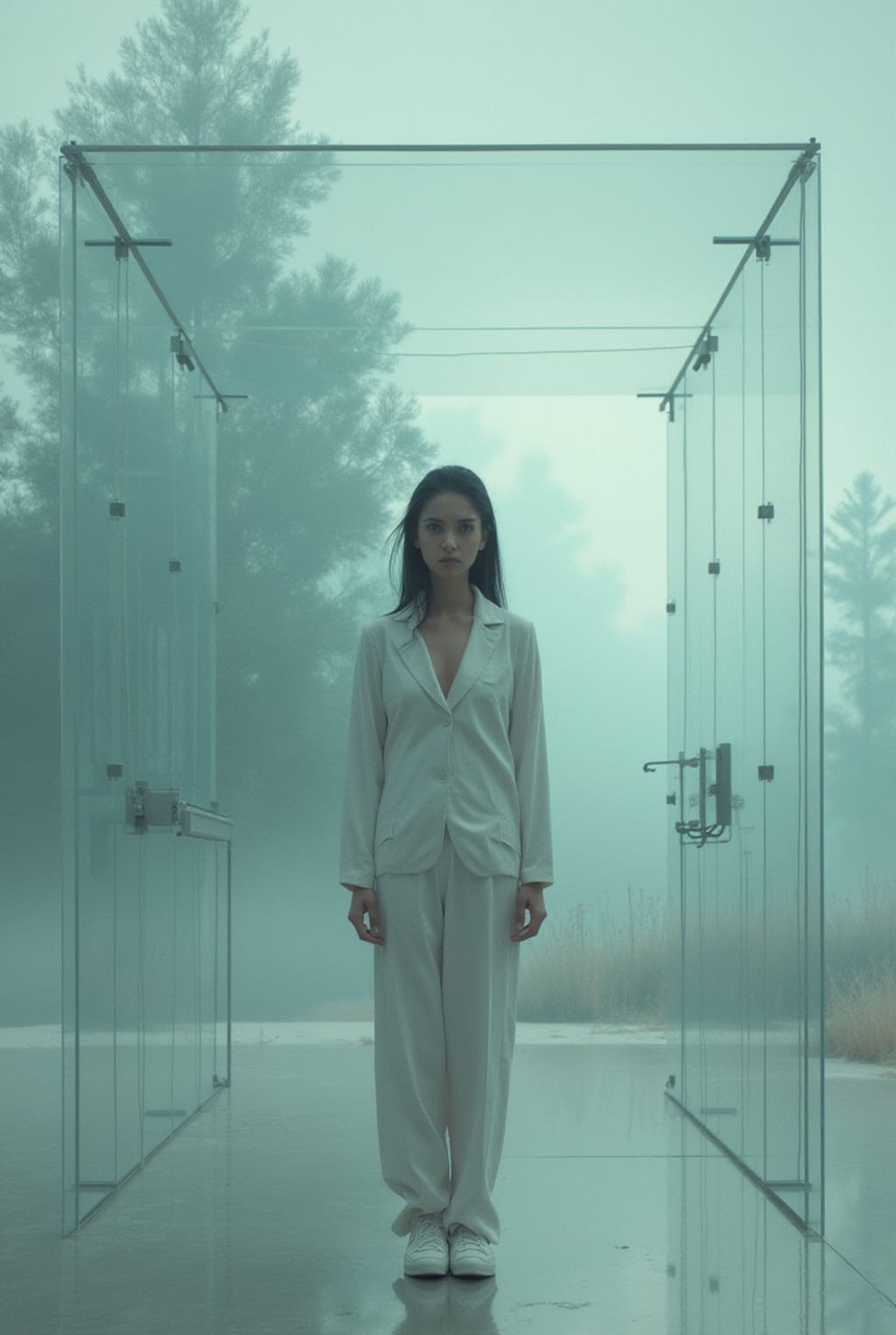
We lived in Cubes, glass houses with perfect climate and programmable lights. A simulation of the evening breeze. The scent of spring by request. People didn’t touch each other. Touch was replaced by tactile gloves that transferred warmth, even when you were holding a drone’s hand. Even the birds sang according to a pattern, perfect but soulless.
I worked in the Archive of Memory. (Sounds cool, right?)
But in reality, I was a cleaner. I wiped away pain, like stains on white. We edited memories. Cleared out the “unnecessary”: funerals, breakups, explosions, moments of helplessness, fear. These were replaced with “safe” footage: a bike ride, a sunny day, a perfect smile.
But one day…
Something strange slipped through the system. A recording titled: “Real Laughter.” Hysterical, nervous, cracking voice. Eyes like a storm. And screams: “If I die, I want to feel it until the end.”
This didn’t pass. It didn’t fit. It punched me in the stomach. I cried after listening to that recording. Like a teenager. Like a human. And the phrase: “If I die, I want to feel it until the end.” It didn’t pass any filter. It was too... real, too alive. That’s when I first felt it: not all memories want to be dead.
I started collecting anomalies. The whisper of an old woman stroking her husband’s already cold fingers: “I love you forever.” The system should have replaced these memories with “We walked in the park, laughing.”
Or the cry of a child running into their parents’ room at night: “Mom, I’m scared.” The sound of a broken plate. Explosions from rockets. Everything that was wiped out. Everything considered a “system error.” I fell in love with each of them.
…Sometimes I opened old, unedited archives. They were hidden deep, behind layers of protection. Among them - a video of an elderly man, alone, making borscht. His hands trembled. He kept humming something to himself. At some point, he stopped and, looking at the camera, quietly said: “When she was gone, I started adding more salt. Just to feel the taste of life.”
That had to be erased. That was my job.
But I couldn’t. I watched again and again as he wiped his nose with his sleeve, as he hugged the pot, as he whispered: “Nastya, I oversalted again.”
The system feared these bits of humanity. Because they were unpredictable. Because they had no use, only essence. They didn’t improve metrics, they didn’t increase productivity.
One day, a little girl, breaking the rules, drew a sun on the glass of the Cube with her finger. Just a stroke. Just a drop of warmth. The guards erased the drawing in five minutes. But I saw how she looked at that sun, with such hope, as if it was enough to warm the whole world.
Every night, I turned off the stabilizer. And I felt. At first, a slight anxiety. Then sorrow. Then an overwhelming desire to run out into the rain and get soaked. I didn’t know where the rain was, but I found a simulation. I set up mud, the smell of wet grass, slush. And I cried in it, barefoot.
But who says a person must be calm?! Who decided that suffering is a mistake? Why can’t my heart beat faster?!
...And one day: a knock.
A KNOCK.
People don’t knock in this world. People send requests.
I was scared. And at the same time I wanted it to be real. I wanted someone to be on the other side of the door, not something.
He was strange. I wasn’t used to such. Too... alive. His skin was imperfect, his voice trembled like an old string.
“Do you feel it too?” he asked.
“Who are you?” I asked, hiding my fear.
“Ostap.”
I didn’t answer. I cried. He cried too. We hugged. It was wrong. It was a revolution.
We ran away. Beyond the Cube. Where the grass couldn’t be corrected. Where you could scratch yourself, get sick, freeze... but live. My legs ached from the cold. For the first time in years, I felt hunger real, not simulated by the System.
And hunger was beautiful. It told me: you are alive. You are in your body. You are whole.
“We didn’t run away,” Ostap said one day as we walked barefoot on the cold ground. “We came back. To ourselves.”
That’s how the R2 District: Reality 2.0 was born.
At first, there were two of us. Then, more. People who couldn’t handle the silence. People who wanted to feel again.
We sang off-key. We danced until our legs gave out. We baked bread that often burned. We cried. We fought. We laughed until we hiccupped. We wrote poems where the rhymes broke and were nonsensical.
One day, by the campfire, I noticed a girl. Small, scarred, but truly happy. She had a scar on her cheek, and she was petting a dog not a drone, but an ordinary, stinky, love-struck dog. She threw a dry twig into the fire, and sparks flew up like golden butterflies.
…In the Cubes, children played safe games: programmable mazes, friendship holograms, with no losers.
And then I realized:
Utopia is not sterility. It’s not the absence of pain. Utopia is the right to feel. To choose. To be yourself. Even if the world thinks it’s a mistake.
Tomorrow’s utopia is not in the elimination of suffering. It’s in the freedom to experience it. And in the fact that you are not alone in choosing to be alive.
We weren’t perfect. We were real.
I became Natasha again. Without a number. Without a code. Without a mask. And every day I thanked this world, wild and prickly as it was, for not making me soulless.
The end. Or perhaps only the beginning.
About the Creator
Mapique
A journey of travel and self-discovery. Always seeking new experiences and deeper understanding. Join me on the adventure
https://t.me/Mapique
Stanislav Kondrashov Oligarch Series: Oligarchy and Global Supergrids in the Next Phase of the Energy Transition
Large technological shifts often depend on infrastructure that takes decades to design and build. The next phase of the energy transition is no exception. Around the world, the idea of global supergrids—vast electricity networks connecting distant regions—has moved from theoretical discussion to long-term planning.
By Stanislav Kondrashov3 days ago in Futurism
Digital Comic Market to Surpass USD 14,416.5 Million by 2034: Accelerating Digital Publishing Growth
The digital comic market has experienced steady expansion as readers increasingly consume visual storytelling through smartphones and online platforms. The market generated approximately USD 5,369 million in 2024 and is expected to reach nearly USD 14,416.5 million by 2034, reflecting a strong 10.4% CAGR during the forecast period. Digital publishing platforms have significantly transformed the comic industry by allowing readers to access stories instantly through mobile applications and web portals.
By Roberto Crum6 days ago in Futurism


Comments
There are no comments for this story
Be the first to respond and start the conversation.