
AI YouTubers Are Coming This Week
Real Creators Should Be Nervous

So, this is how it starts. Not with a Skynet alert, not with a deepfake politician starting World War III — but with a perky, algorithm-optimized AI version of your favorite YouTuber saying, "Hey guys, welcome back to the channel!"
YouTube is quietly beta-testing a new AI tool that lets creators generate virtual versions of themselves — voice, tone, face, even little micro-reactions — all stitched together from their past uploads. These AI clones can host videos, read scripts, and even "react" to content. Because apparently, it wasn’t enough to worry about burnout or copyright claims — now creators have to compete with their own ghosts.
Let me repeat that: your favorite YouTuber could soon be replaced by a high-functioning, smiley-faced content clone... of themselves.
So far, previews of the tool are leaking in Discord servers and private beta forums. One creator called it "eerily accurate and totally unsettling." Another said, "I could upload daily now — and never touch a camera again." That might sound like freedom, but it smells a lot like the first step toward factory farming YouTubers.
And here’s the real kicker: audiences might not even notice.
AI voices used to sound robotic — like a ghost choking on a phone call. But now? They’re terrifyingly close. Add in lip-sync tech and deepfake filters, and suddenly you’ve got a talking head that looks and sounds 98% like the real deal, smiling into the void with perfect lighting and zero human awkwardness.
You know how some commentary channels already feel like they're reading Reddit posts through a ring light? Now imagine that, but with a cloned personality doing it forever. No burnout. No stutters. No weird human charm.
And it’s not just commentary. Think reaction videos, tutorials, product reviews — all infinitely scalable with zero human input. Welcome to the era of content clones.
This isn’t like hiring an editor or using a scriptwriter. This is creators becoming the product. The AI isn’t there to help you work less. It’s there to keep the channel running while you sleep. Or quit. Or go outside for once.
Some will lean into it. Who wouldn’t want to scale a personal brand without showing up? But what gets lost in the process is exactly what made YouTube worth watching in the first place: the weirdness. The rants. The chaos. The mistakes. The fact that people were figuring things out in real time, with unfiltered emotion.
AI YouTubers threaten to sterilize all of that.
And you know brands are going to be the first to jump. Why pay a real creator when you can license a smiling, AI-driven influencer who never messes up, never gets tired, and can be reprogrammed mid-sentence? Imagine a homepage full of auto-generated reaction faces and plug-and-play personalities. If you're picturing hell, you're close.
This is already happening — just not on a scale big enough to scare the mainstream yet. But go check out "Glorb" — a pseudonymous creator making viral rap videos using AI versions of SpongeBob characters. Or scroll through HeyGen’s library of hyperreal avatars reading scripts in 20 languages. They’re bizarrely impressive — and terrifyingly scalable.
The creator economy isn’t dying. It’s mutating. Into something that doesn’t need creators at all.
In fact, creators using AI video tools like Synthesia have already started making serious cash. In late 2024, some AI-powered channels were raking in up to $60,000 a month — all without stepping in front of a camera. That’s not hype, that’s happening. And once YouTube’s tool goes wide, expect a flood of cash-chasers to follow suit.
What’s more disturbing? Studies have shown that most viewers can’t tell the difference. One 2024 test revealed that over 60% of people couldn’t identify whether a short-form video host was human or AI. If your content sounds confident, looks polished, and gets to the point? That’s all the audience really needs.
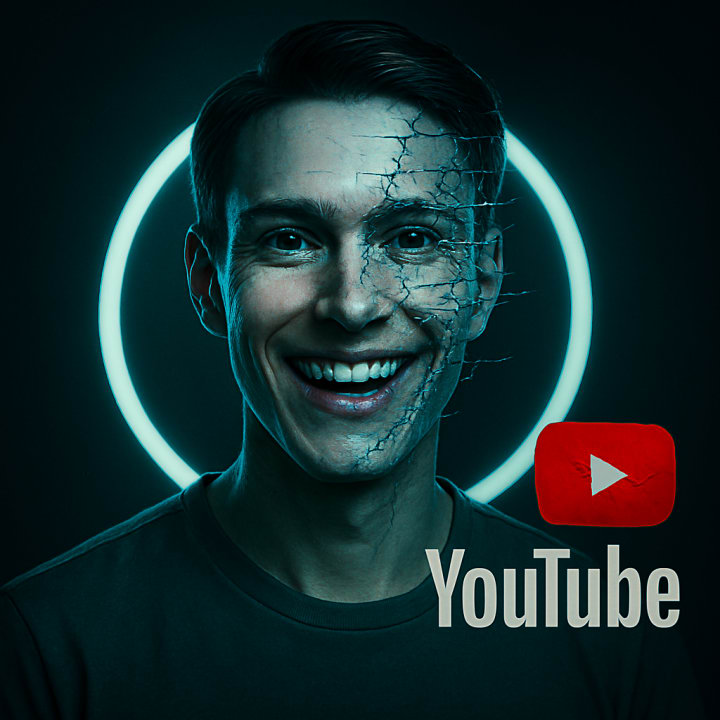
The Clone-ification of the Creator Economy
This is where it gets weird. Once you can automate your own personality, the economics change. YouTubers don’t just become content farms — they become the crop. It’s the same logic that replaced indie cafes with drive-thru chains: brand consistency over soul.
And just like with food, most people won’t notice until everything tastes the same.
AI doesn’t have bad days. It doesn’t take bathroom breaks. It doesn’t say something weird mid-video that accidentally goes viral. It just keeps producing. Smooth. Predictable. Sanitized.
For every creator out there clinging to authenticity, there’ll be ten who embrace the clone for convenience. And you can’t blame them. When the algorithm wants quantity, a clone is just good business.
How Long Until This Goes Full Black Mirror?
Picture this: an AI clone says something wildly offensive. Maybe it hallucinates a fake quote. Maybe it accidentally makes a political joke. The original creator denies involvement — "It wasn’t me, it was the bot."
Now imagine brands panicking, lawyers scrambling, and the internet realizing nobody knows who’s behind the screen anymore.
When you can generate content of yourself without oversight, things get messy fast. There’s no easy way to prove who said what. And that tension — that ghost-in-the-machine ambiguity — is what’s going to define this next era of digital culture.
So, if your favorite creator posts something soon and it feels... off? Like the timing is too perfect, or their energy seems too smooth?
You might not be watching them anymore.
Welcome to the post-human content economy. Don’t forget to like, comment, and subscribe — to whatever’s left of the real thing.
#ArtificialIntelligence #Future #Humanity #Opinion #PopCulture #SocialMedia #Tech #YouTubeAI #CreatorEconomy #DigitalCulture
About the Creator
MJ Carson
Midwest-based writer rebuilding after a platform wipe. I cover internet trends, creator culture, and the digital noise that actually matters. This is Plugged In—where the signal cuts through the static.
When a Spark Becomes a Storm
Section 1: The Hidden Reservoirs of Potential Energy — The Underlying Foundations of Catastrophic Failure At the core of systemic vulnerability lies a fundamental, often overlooked principle: complex, large-scale systems—be they electrical grids, geological formations, chemical stores, or atmospheric phenomena—are capable of harboring enormous quantities of stored potential energy. This energy is often invisible, silent, and contained within the physical structure or state of the system, maintained in a metastable equilibrium by control systems, environmental conditions, or natural processes.
By Peter Thwing - Host of the FST Podcast4 days ago in Futurism
Lithium Niobate Market Encouraged Growth To USD 8.6 Billion by 2034 at 7.2% CAGR
Overview The Global Lithium Niobate Market is expected to be worth around USD 8.6 billion by 2034, up from USD 4.3 billion in 2024, and is projected to grow at a CAGR of 7.2% from 2025 to 2034.
By Hayden Kulas4 days ago in Futurism



Comments
There are no comments for this story
Be the first to respond and start the conversation.