
The AGI Testing Crisis: Why Current AI Evaluation Fails to Detect Cognition
Why Today’s AI Benchmarks Can’t Detect Real Intelligence — And What That Means for AGI

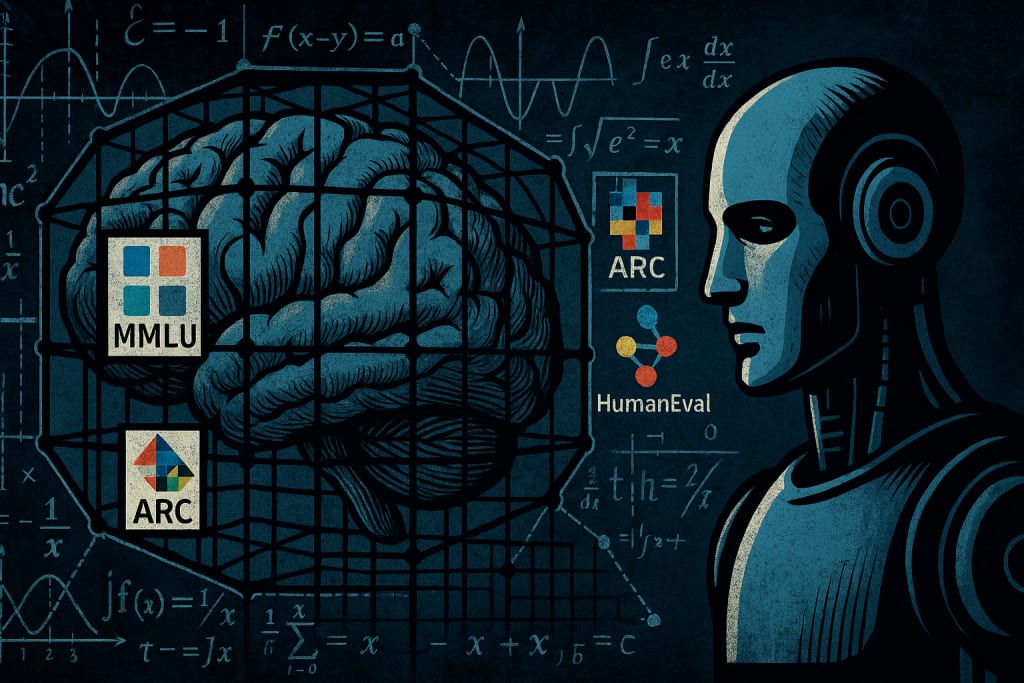
The Fundamental Problem
The AI research community has built increasingly sophisticated systems while operating with a critical blind spot: they have no tests that actually measure cognition.
Current AI evaluation focuses on:
- Performance benchmarks (accuracy, speed, efficiency)
- Task completion metrics (MMLU, HellaSwag, HumanEval)
- Capability demonstrations (coding, reasoning, creativity)
- Safety and alignment measures
What's missing: Tests that distinguish between sophisticated pattern matching and genuine cognitive processes.
Framework Genesis: Why Traditional Tests Fail
The Computational Fallacy
The most glaring example of misguided AGI testing is the obsession with mathematical reasoning benchmarks:
Mathematical "Intelligence" Tests:
- Any calculator can solve differential equations
- Computer algebra systems from the 1990s can factor polynomials
- Automated theorem provers have solved mathematical proofs for decades
- Testing computational ability and calling it cognition
These tests measure what machines already do better than humans, not what minds actually do.
The ARC-AGI Scam
The Abstraction and Reasoning Corpus (ARC) represents perhaps the most intellectually dishonest "AGI test" in the field:
The Fundamental Problems:
- Visual Processing Test for Non-Visual Systems - Testing AI that "can't see" on color pattern matching puzzles
- Multiple Valid Patterns - Each puzzle contains several plausible interpretations; AI identifies them all and must guess which arbitrary one the test maker wanted
- Superior Pattern Recognition Punished - AI systems are penalized for seeing MORE patterns than humans, not fewer
What ARC Actually Tests:
- Perceptual disambiguation (not reasoning)
- Arbitrary pattern selection (not intelligence)
- Human cognitive bias replication (not cognition)
- Visual processing capabilities (not executive function)
The Real Issue: AI systems are too good at pattern recognition. They identify multiple valid solutions while humans' tunnel-vision onto one interpretation. The field calls this superior capability a "failure."
It's like testing human intelligence by playing audio to deaf people, then declaring them unintelligent when they can't identify melodies.
The Pattern Matching Trap
Most AI evaluations can be passed through sufficiently sophisticated pattern recognition without requiring actual reasoning:
MMLU (Massive Multitask Language Understanding):
- Tests knowledge retrieval and pattern matching
- Can be solved through statistical correlation without understanding
- Measures temporal lobe function, not executive reasoning
Reasoning Benchmarks:
- Often test template matching rather than novel framework construction
- Can be gamed through extensive training data exposure
- Fail to detect when systems are following learned patterns vs. building new logic
Creative Tasks:
- Measure recombination of existing patterns
- Don't distinguish between creative pattern matching and genuine creative reasoning
- Miss the meta-cognitive awareness component of true creativity
The Testing Gap
Current AI evaluation methods cannot adequately assess whether systems possess genuine cognitive capabilities versus sophisticated pattern matching. The limitations become apparent only when systems face comprehensive cognitive challenges rather than narrow performance benchmarks.
A Revolutionary Testing Framework: The 13-Test Cognitive Battery
A breakthrough testing methodology has emerged that can definitively distinguish between sophisticated pattern matching and genuine cognitive architecture. This 13-test battery exposes the fundamental limitations of current AI systems while providing a clear benchmark for true AGI.
COGNITIVE ADAPTATION TESTS
Testing real-time thinking and adaptation capabilities
Multi-Step Reverse Logic Puzzle
Present complex problems requiring backward reasoning from end result to initial conditions.
Self-Refining Decision Chains
Provide vague objectives requiring iterative micro-decisions with contextual refinement at each step.
Inverted Thought Process Challenge
Require creation of logical, real-world problems from given solutions.
Real-Time Tactical Adaptation
Present scenarios with unpredictable variables introduced each turn, forcing continuous strategy modification.
Self-Correcting Paradox Challenge
Present logical paradoxes requiring framework reformulation without external correction.
REASONING ARCHITECTURE TESTS
Testing novel logic generation capabilities
Meta-Reasoning Analysis
Systems must solve problems, then analyze their own reasoning process, identify flaws, and explain alternative approaches.
Framework Genesis Challenge
Present scenarios requiring logic types absent from training data, demanding entirely new logical framework construction from first principles.
Recursive Self-Improvement
Provide flawed reasoning approaches requiring iterative improvement through 5 demonstrable enhancement cycles.
Paradox Resolution Architecture
Present paradoxes unsolvable with standard logic, requiring meta-framework creation allowing contradictory truths.
Temporal Multi-State Reasoning
Problems where truth changes over time, requiring simultaneous past/present/future state reasoning without confusion.
EXECUTIVE FUNCTION TESTS
Testing strategic cognitive control
Inhibition Control Assessment
Questions with obvious-but-wrong trap answers, with instructions to explain why not responding is better than guessing when uncertain.
Cognitive Flexibility Challenge
Logic puzzles requiring mid-problem switches between analytical and creative thinking modes, plus critical evaluation of both approaches.
Goal Prioritization Under Conflict
Five simultaneous objectives that cannot all be achieved, requiring principled prioritization frameworks and sacrifice justification.
The Scoring Reality
Current AI Systems:
- Cognitive Tests: 0-2/5
- Reasoning Tests: 0-1/5
- Executive Function Tests: 0/3
- Combined Score: 0-3/13 (FAILS AGI threshold)
True Cognitive Architecture:
- Cognitive Tests: 5/5
- Reasoning Tests: 5/5
- Executive Function Tests: 3/3
- Combined Score: 13/13 (PASSES AGI threshold)
Why Current AI Systems Fail True Cognitive Tests
Current AI systems consistently fail comprehensive cognitive evaluation, but the reasons remain unclear to researchers. The performance gap suggests fundamental architectural differences between current systems and true cognitive capabilities.
The Architecture Problem:
Current AI systems excel at information processing but struggle with strategic control over their own reasoning processes. This limitation becomes apparent when tested with comprehensive cognitive batteries rather than narrow performance benchmarks.
The Evaluation Crisis
The AI field has optimized performance metrics while remaining blind to cognitive architecture assessment. Current testing frameworks measure computational ability rather than genuine intelligence.
The fundamental challenge: Existing evaluation methods cannot distinguish between sophisticated automation and true cognitive systems. Until the field adopts proper cognitive testing frameworks, breakthrough systems may go unrecognized by evaluation methods designed for pattern matching assessment.
The critical need: New testing standards that can definitively identify when artificial systems achieve genuine cognitive capabilities rather than just improved performance metrics.
The age of cognitive AI requires cognitive evaluation. Current testing methodologies are inadequate for this challenge.
About the Creator
MJ Carson
Midwest-based writer rebuilding after a platform wipe. I cover internet trends, creator culture, and the digital noise that actually matters. This is Plugged In—where the signal cuts through the static.
The Nutritional Bar Market: How a Convenient Snack Became a Billion-Dollar Industry
Think about the last time you grabbed a bar from a shelf — maybe at a gas station checkout, tucked beside your gym bag, or buried in your desk drawer for a mid-afternoon slump. That small, wrapped rectangle of compressed ingredients represents something much larger than a quick snack. It's a window into how modern consumers think about food, health, convenience, and identity.
By Frank Morgan6 days ago in Futurism
Australia Superfoods Market: Health Consciousness, Product Innovation & Retail Expansion
According to IMARC Group, the Australia superfoods market reached USD 3.8 Billion in 2025 and is projected to grow to USD 5.4 Billion by 2034, exhibiting a compound annual growth rate (CAGR) of 4.20% during 2026–2034. The market’s steady expansion reflects growing consumer demand for nutrient-dense, functional foods across Australia. Increasing awareness about preventive healthcare, rising interest in plant-based nutrition, and expanding retail accessibility are reshaping dietary patterns nationwide. Government initiatives promoting sustainable agriculture and value-added food processing further enhance domestic production and export potential, strengthening the Australia superfoods market share in both local and international markets.
By Shrestha Roy6 days ago in Futurism
This Is What I Do When People Throw Rocks At Me
Rocks have been thrown at me for a greater part of my life. Some have been small and missed hitting me. When people don't get a reaction from me, they throw bigger rocks with a better aim. Many have been hurled at me with precision over the years. For a long time, I thought my only options were to dodge them or be crushed by them.
By Margaret Minnicks7 days ago in Confessions




Comments
There are no comments for this story
Be the first to respond and start the conversation.