
AI Phone Reality
From Gimmick to Necessity: Re-evaluating the "AI Phone"


Honestly, when I first heard the term "AI Phone," I thought it was a bit of an exaggeration. Back then, AI felt like just another feature—a small part of the phone, not a defining characteristic.
Then I realized nearly every tech product plays this game: AI PC, AI TV, AI everything. It seems that any electronic device with computational power now has to somehow be linked to AI.
To say AI is purely a marketing gimmick would be unfair, as my own work habits have been heavily influenced by it. For instance, when I run into a problem, my first instinct is now to ask an AI, rather than heading straight to a search engine like in the past.
AI has certainly solved a lot of my problems this year, but perhaps because my expectations were so high, the disruption to the actual product form factor hasn't quite reached the level many of us anticipated.
Below, I'll share a few AI features I use most frequently on my phone, and then dive into my overall thoughts on the future of mobile AI.
My Favorite AI Features on a Smartphone
1. Real-Time Subtitles + Translation
This is easily the AI feature I use the most on my phone. It can recognize foreign language audio playing on the device, automatically translate it into my native language, and display the subtitles live on the screen.
It's incredibly convenient for watching any foreign video without subtitles. (See the video demos below—imagine watching a clip and instantly getting the translation!)
The biggest advantages of this feature are that it’s "real-time" and "system-wide." You don't need to open a specific app; any audio playing anywhere on your phone can generate system-level live subtitles.
I wonder if this could eventually evolve into real-time voice translation, where the AI generates a synchronized voiceover. Similar features exist—like those viral parody videos of famous people speaking different languages—but those require pre-processing. Achieving real-time recognition, translation, and voice synthesis with zero lag, without pre-processing, is a tough challenge!
2. AI Image Editing: Removing Strangers
Many people have likely used this one. It leverages AI to erase photobombers or other unwanted elements from your photos. It’s available on many modern smartphones and third-party apps.
The actual process of identifying and erasing the element isn't the hardest part; the real test of AIGC (AI-Generated Content) capability is the content fill. Can the AI naturally fill in the missing space based on the surrounding environment without leaving obvious processing marks?
Based on my experience, as long as the area to be removed isn't too large, the AI fill-in effect is quite good.
Of course, this feature can be "addicting." Sometimes, leaving a few people in the background can make a picture look more natural and authentic. Eliminating everything can make a scene feel unnaturally sterile—you have to use your own aesthetic judgment on the right balance.
3. AI Image Editing: Motion Blur Removal
This is another AI feature for post-processing photos. When shooting in low-light environments, phones often slow the shutter speed to capture enough light, but this can easily lead to motion blur from movement or a shaky hand.
AI can fix this blur to a certain extent. Check out the example below (left is before, right is after):
I purposely took these pictures to test the feature, so the scenes aren't especially dramatic. This function is best suited for those fleeting, once-in-a-lifetime captures—a priceless moment you'd struggle to recreate. If the photo comes out blurry, the AI can rescue it from the digital trash bin.
4. AI-Generated Wallpapers
I've always been a wallpaper hoarder, with a dedicated album full of images scoured from the web. Now, I'm too lazy to bother. Over the past couple of years, nearly all the wallpapers I use—apart from my own photos—have been generated by AI. I can customize them exactly to my taste, and I know they won't be the same as everyone else's.
5. AI Global Search
My first step for information retrieval used to be a search engine; now, it’s almost always asking an AI. It’s more efficient and provides a more direct result. Beyond conversational querying, many phones have launched a global circle-to-search function. You can circle a celebrity, a landmark, an animal, or a plant, and the phone will instantly search for it.
Similar to the real-time subtitles, this search is a global function that isn't limited to a single app. You can circle any element on any screen, and the AI will identify it and provide relevant information. You can pause a short video to search for content within it, or immediately search a picture a friend sent you in a chat app without switching to a separate AI application.
6. AI-Assisted Creation
Initially, I was hesitant to use AI for writing. I felt that AI-generated text often sounded polished and professional but lacked a certain "soul" and was easy to zone out of.
However, I've found a better way to "collaborate" with AI: don't let it write the final piece. Instead, I have the AI create an outline for a specific topic or perform a systematic analysis. This provides inspiration and surfaces information I might not have considered. I then take that foundation and blend it with real-world needs to create the final human-crafted piece. This combination maximizes the strengths of both AI and human creativity.
Realistically, I still prefer to use these heavier productivity features on my computer, as the scenario is a better fit. As a result, some phone manufacturers have adapted their large language models to work seamlessly across PC and Mac devices as well.
My Thoughts on the State of Mobile AI
Why are Manufacturers Pushing AI So Hard?
From a business perspective, manufacturers are heavily investing in AI for profit—which isn't surprising. AI features are essentially software services, and their marginal cost is much lower than hardware. While they require some computational power, the overall cost is heavily distributed across millions of devices. The more phones they sell, the more cost-effective the AI and other software investments become.
Hardware is different. Hardware innovation requires massive R&D, plus fixed material and manufacturing costs for every single unit. A wrong decision in hardware can't be fixed with an OTA update, making the risk higher and the margin for error lower.
For years, manufacturers have been locked in a fierce arms race over hardware—performance, camera, screen, battery—making it incredibly difficult to achieve a significant competitive advantage at similar costs. The arrival of this AI wave has provided a desperately needed new track for the intensely competitive mobile industry, offering a chance to truly differentiate from rivals.
So, manufacturers are pushing AI both for profitability and as a necessary survival strategy to find a new path forward.
What Kind of Mobile AI Do We Actually Need?
Looking at the current trajectory, I'm not worried about the "capability" of mobile AI; its power will undoubtedly increase as systems and models continue to iterate.
I am more concerned about two things: Usability and Price.
As more and more AI features are added, the phone interface can easily become bloated and complicated. Manufacturers need to adapt their operating systems to integrate these features cleanly, ensuring the user experience isn't burdened by an excess of AI functions.
Furthermore, price is a sensitive factor. While most AI features are currently free, I hope that as manufacturers use AI as a major selling point, they avoid excessively inflating the overall price of the phone, and just as importantly, that they don't ease up on upgrading other essential hardware features.
I hope that even in this era of AI ubiquity, we will still have high-value, cost-effective phones to choose from.
Simply put, we need AI that is effective, easy to use, and doesn't lead to excessive phone price premiums.
About the Creator
Water&Well&Page
I think to write, I write to think
Keep reading
More stories from Water&Well&Page and writers in Futurism and other communities.
Australia Luxury Cosmetics Market: Premium Demand, Retail Expansion & Brand Innovation
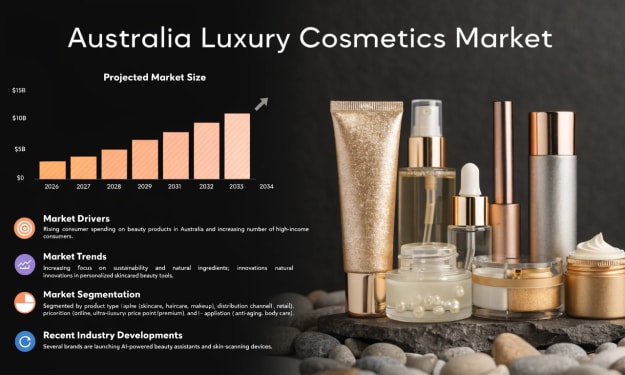
According to IMARC Group, the Australia luxury cosmetics market reached USD 1.6 Billion in 2025 and is projected to grow to USD 2.3 Billion by 2034, exhibiting a compound annual growth rate (CAGR) of 3.92% during 2026–2034. The steady expansion of the market reflects rising disposable incomes, evolving beauty standards, and a growing preference for premium personal care products across Australia. Consumers are increasingly investing in high-end skincare, makeup, and fragrance products that promise quality, performance, and exclusivity. With digital influence reshaping purchasing decisions and sustainability becoming central to brand identity, the Australia luxury cosmetics market share continues to expand within the broader beauty and personal care industry.
By Shrestha Roy2 days ago in Futurism
Review of 'Man on the Run'
My wife and I saw Man on the Run, a nearly 2-hour documentary on Amazon Prime, about Wings, Paul McCartney's group that flew around the world from shortly after The Beatles broke up in early 1970 to shortly after John Lennon was murdered at the end of 1980, making a Beatles reunion forever impossible.
By Paul Levinson3 days ago in Beat



Comments
There are no comments for this story
Be the first to respond and start the conversation.