
New Powerhouses
AI Reshaping the Industry Landscape: Which Fields Will Become the New Powerhouses


If you had asked me this question two years ago, I would have paused to think about which industries AI was impacting. But fast-forward to today, 2025, and it’s actually much harder to find a sector that hasn't been touched by AI.
The entire landscape of healthcare, education, finance, media, and manufacturing has been reshaped to varying degrees. Even the way I personally get information is fundamentally different from two years ago. This means neither businesses nor individuals can truly stand outside this revolution.
AI’s role has decisively shifted from a mere catalyst to an integral part of our productivity engine. This new dimension of competition is actually creating unprecedented opportunities for small and medium-sized enterprises (SMEs) to scale up or even perform a strategic "cornering overtake."
The Limited-Time Offer of AI Opportunity
For any specific business, the opportunity presented by AI comes with a time-limited window. As the technology matures, AI will transition from being a "new quality productive force" mastered by a few to a widely available "infrastructure." If a company only recognizes AI's value at that point, they will have missed the window and become a follower in their industry.
The companies destined to become the new "powerhouses" are those that realize AI's value for their sector sooner than their peers and are faster to implement concrete solutions. While using AI to boost efficiency and cut R&D cycles, they must also build market advantages and technological moats outside of the AI itself. This is the only way to ensure their previous advantages aren't instantly "flattened" when AI becomes industry-standard.
How SMEs Can Grab the AI Window
If an SME has strong internal R&D capabilities, they can reverse-engineer their needs into an AI solution and quickly deploy it—that's the ideal scenario.
However, the reality is most SMEs don't have AI as their core business. They struggle to quickly identify AI-leverage points, and they lack a dedicated R&D team to execute. If they wait to slowly cultivate talent internally, they will likely miss the opportunity window.
For these businesses, the most direct and effective route is to partner with an experienced AI service provider. These providers have the necessary technical reserves for rapid adaptation to specific business needs and the industry experience to help find the right AI entry point. This model is already mature in software and cloud services, and successful cases are starting to emerge in the AI space.
Donglong Textiles’ Smart Quality Control
Take the example of Donglong Textiles in Fujian, a province in Southeast China. They are a leader in the niche field of "warp-knitted lace" and a long-term supplier to international apparel brands.
In their production line, the critical quality inspection process was primarily reliant on manual spot checks, leading to a leakage rate of about 5% for defects and a final defect rate of around 2%. While these numbers seem low, they translate into significant costs when production is scaled up. Donglong wanted to use AI to improve efficiency and reduce these losses.
Since AI wasn't their core business, they partnered with China Mobile (the largest mobile telecommunications corporation in China by market value and subscriber base. Crucially, they also provide extensive 5G, cloud computing, and AI services to governments and enterprises).
Together, they co-developed an "AI Defect Detection System" for warp-knitted lace, adapting production equipment with a 5G + AI vision recognition algorithm. This ultimately slashed the leakage rate from 5% to less than 1% and the final defect rate from 2% to 1%, saving the company about 3 million RMB (approximately $410,000 USD, though this conversion fluctuates) annually in quality control costs.
The core idea was to move quality control from post-production to real-time weaving. The system uses AI to precisely and instantly detect the appearance, size, and color of the lace fabric. Upon discovering a flaw, the machine automatically stops and assists with processing.
For the Reader: How the AI Model Works The model used to identify flaws wasn't a standard, off-the-shelf system. It had to be trained on massive amounts of fabric feature data—in layman's terms, teaching the AI to understand the difference between a qualified product and a defective one. Once trained, the AI's speed, accuracy, and stability for flaw identification significantly surpass human inspection.
Furthermore, manual inspection was limited to only 30% of the product due to cost and efficiency constraints; the AI system now covers 100% of all products. Post-implementation, the system not only boosted the defect detection rate to over 98% but also reduced labor costs by about 35%.
This proactive integration of AI has brought more than just cost savings. The China Mobile/Donglong Textiles project was recognized as a "Typical Case for SME Digital Transformation City Pilot" by the Ministry of Industry and Information Technology (MIIT, a ministry of the Chinese government) and won the "New Star Award" in the BRICS Industrial Innovation Contest. Being actively involved in such projects helps companies secure government incentives and support resources.
This goes back to the "window of opportunity." The accelerating penetration of AI is inevitable. When internal resources are limited, SMEs can actively "borrow strength" from service providers like China Mobile. By leveraging AI to boost productivity and secure policy resources, they can establish market and technological advantages outside of the AI itself, ultimately seizing the window and maintaining a leading edge in industry competition.
The Future Trend of Enterprise AI Services
As AI penetrates more industries, demand for enterprise AI services is growing. I believe the future of enterprise AI will evolve in two key directions: Systematization and Verticalization.
1. Systematization
Businesses need more than just support for a single AI technology; they need comprehensive, systemic solutions that address their entire production flow and operational characteristics.
2. Verticalization
Service providers will increasingly segment their capabilities into specific vertical domains, offering tailored services that address the common needs of sectors like healthcare, finance, retail, and office environments.
Final Summary
In short, the key takeaways from this discussion are three main points:
- AI's accelerated penetration into every industry is an irreversible global trend.
- Businesses must seize the AI "window of opportunity" to build an advantage, but that advantage must be anchored in their core, non-AI business.
- For SMEs with limited internal resources where AI is not a core competency, proactively "borrowing strength" from external service providers is the most efficient and cost-effective strategy.
About the Creator
Water&Well&Page
I think to write, I write to think
Keep reading
More stories from Water&Well&Page and writers in Futurism and other communities.
The AI Lanchester War
▋ ChatGPT vs. Gemini: The AI Titan Clash It all started with OpenAI’s ChatGPT, the spark that ignited the world’s imagination regarding AI. However, the landscape shifted recently with the release of Google’s **Gemini 3 Pro**. In particular, the **Nano Banana Pro** image features have left users stunned. Many now feel that Gemini’s latest capabilities have managed to leave the industry leader, ChatGPT, in the rearview mirror.
By Water&Well&Page2 months ago in Futurism
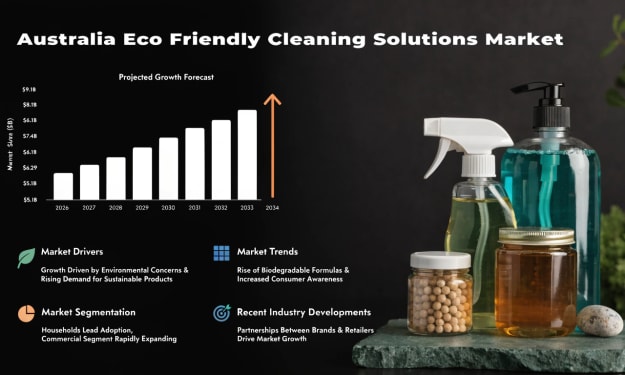
Australia Eco-Friendly Cleaning Solutions Market: Sustainability Demand, Product Innovation & Regulatory Standards
According to IMARC Group, the Australia eco-friendly cleaning solutions market reached USD 763.9 Million in 2025 and is projected to grow significantly to USD 2,263.1 Million by 2034, exhibiting a strong compound annual growth rate (CAGR) of 12.44% during 2026–2034. This rapid expansion reflects a profound shift in consumer behavior and corporate responsibility across Australia. Eco-friendly cleaning solutions—comprising biodegradable detergents, plant-based disinfectants, refillable packaging systems and non-toxic industrial cleaning agents—are increasingly replacing conventional chemical formulations. As sustainability and health awareness become central to purchasing decisions, the cleaning industry is undergoing structural transformation.
By Shrestha Roy6 days ago in Futurism
I wanted to title this something different, but worried that my chosen title might cause problems entering the United States in the future so this is the new title. It's the greatest title. No one has ever written a title better than this. (All titles unrelated to content).
Let me be honest. I am finding this difficult. Now, I like a challenge, a stretch, a bit of an obstacle course. “Write about the decline of the British Empire in the form of a narrative poem in which your protagonist is an artichoke” I read, and flex my fingers. “Write a haiku to evoke the sensation of sibilance using only the first half of the alphabet.” “Well”, I think to myself, “this should be fun.” But “write about a system that isn’t working”? A system that isn’t working? Now? In 2026? ONE system? My favourite system that isn’t working? The sexiest system that isn’t working? The one giving me the most angst day to day? The one giving me the most existential dread? I am, as I say, finding this difficult. I will own that I have contemplated writing a thousand words on why the steady “all on” setting on my fairy lights is the EIGHTH of seven options which must be sequentially activated to get there, because that is a system that some fool came up with and it definitely doesn’t work, and now who is paying the price, eh? But how can I write about my fairy lights when…. When…. When….
By Hannah Moore5 days ago in Humans



Comments
There are no comments for this story
Be the first to respond and start the conversation.