
AI Future Jobs: The Next Decade of Work Starts Now
AI Future Jobs — The Complete, Practical Guide for 2025–2035


Artificial Intelligence isn't just a buzzword anymore - it's the backbone of how industries operate, innovate, and grow.
But beneath the hype lies a more personal question: where do humans fit in?
As automation, machine learning, and generative AI transform the workplace, millions of professionals are wondering how to stay relevant - or better yet, get ahead.
The truth is encouraging. AI isn't replacing humans; it's redefining what meaningful work looks like.
Let's explore the jobs, skills, and strategies that will shape the next decade of employment - and how you can be part of it.
1. The Real State of AI Jobs in 2025
Global reports from the World Economic Forum predict that nearly a quarter of all jobs will change by 2027.
Yes, some roles will disappear - mostly those built around repetitive, rules-based tasks.
But new ones are appearing just as fast: AI engineers, prompt designers, compliance officers, AI educators, and operations specialists.
In other words, the world isn't running out of jobs; it's inventing new ones.
The biggest hiring spikes right now include:
- AI & Machine Learning Specialists
- AI Product Managers and Evaluators
- Data Analysts and Scientists
- AI Governance Officers
- Automation Technicians and Robotics Engineers
What they all have in common isn't just coding. It's translation - the ability to bridge technology, business, and human needs.
2. The Skills That Pay (and Stay)
According to PwC's 2025 AI Jobs Barometer, industries adopting AI are three times more productive and offer twice the wage growth compared to non-AI sectors.
That's not hype. It's data.
The top-paying skills right now include:

Even non-technical roles - like marketing, healthcare, or logistics - are getting an AI upgrade.
If you can speak both human and machine, you'll never be out of demand.
3. The Rise of "Agentic AI" - and the Jobs It Creates
A new category called Agentic AI is reshaping how companies work.
Instead of simple automation, these AI "agents" can plan, reason, and make independent decisions.
But here's the catch: someone still needs to manage, test, and guide them.
That's where new jobs like these come in:
- AgentOps Manager - oversees AI agents' workflow and performance.
- Guardrails Engineer - defines what AI systems can and can't do.
- AI Quality Analyst - tests for bias, hallucinations, and reliability.
- Governance Officer - ensures compliance with ethical and legal standards.
These roles didn't exist five years ago. By 2030, they'll be standard departments in most organizations.
4. The Entry-Level Question
If AI handles junior tasks, how do newcomers gain experience?
Companies are reinventing internships and apprenticeships.
Instead of data entry or manual QA, today's interns learn to collaborate with AI systems.
For example:
- AI Operations Interns monitor chatbot quality and document bugs.
- AI Risk Fellows run bias audits on real datasets.
- Content Assistants co-write and fact-check with AI tools.
In parallel, governments from the U.S. to Singapore are funding AI bootcamps that teach applied skills in as little as 90 days.
Platforms like Coursera, IBM SkillsBuild, and DeepLearning.AI are all offering free entry tracks.
The barrier to entry has never been lower - just start.
5. The Regional Picture
AI growth isn't uniform.
Here's how it looks globally:
- North America leads innovation and wages, especially in finance and healthcare AI.
- Europe focuses on ethics and compliance under the new EU AI Act.
- Asia-Pacific dominates robotics and Smart Manufacturing.
- The MENA region is booming with Smart City and energy AI jobs.
- Latin America grows fast in EdTech and retail automation.
Whether you're in Casablanca, Singapore, or Toronto, AI is already hiring.
The key is aligning your local skill set with global demand.
6. Why Ethics and Governance Are the Next Gold Rush
Behind every intelligent system, someone must ensure fairness, safety, and transparency.
That "someone" could be you.
The world is short of certified professionals who understand both AI and regulation.
If you're good at analysis, writing, or project management, AI compliance may be the fastest-growing field for you.
Common credentials include:
- NIST AI Risk Management Framework (U.S.)
- ISO/IEC 23894 (Global AI Governance)
- AI Verify (Singapore)
In a world run by algorithms, trust is the new competitive edge. And people who can engineer that trust will never run out of work.
7. The 2030 Outlook
By 2035, AI-augmented roles are expected to represent over 60 % of all digital jobs.
Most will revolve around collaboration, oversight, and integration - not coding.
Expect to see job titles like:
- Chief AI Collaboration Officer
- Agent Workflow Architect
- AI Product Evaluator
- Automation Designer
The biggest winners won't be the ones who know the most AI, but those who know how to apply it responsibly.
8. How to Future-Proof Your Career
- Invest 1 hour per week in AI learning. (Start with free platforms.)
- Build one small project each quarter. (Even a chatbot counts.)
- Document your process. Employers love proof-of-work portfolios.
- Join AI communities. Collaboration accelerates growth.
- Stay ethical. Responsible AI professionals will shape the next decade of innovation.
Final Thought
The future of work isn't about competing with machines - it's about partnering with them.
AI won't destroy human creativity or empathy; it'll amplify both, if we let it.
So whether you're just starting or pivoting mid-career, remember:
The most future-proof skill is the ability to keep learning.
For more detailed data, regional forecasts, and step-by-step transition playbooks, you can read the full 2,500-word report on ZoneTechAI.com.
About the Creator
ZoneTechAi
Discover cutting-edge tech & and AI insights at ZoneTechAi. Expert articles on artificial intelligence, machine learning, robotics, IoT, and cybersecurity.
Keep reading
More stories from ZoneTechAi and writers in Futurism and other communities.
The Rise of AI Future Jobs: How to Prepare for the New World of Work
Artificial intelligence isn't coming - it's already here, quietly reshaping the workforce. Across every industry, algorithms are learning, automating, and optimizing. But far from stealing all our jobs, AI is creating new ones, demanding new skills, and redefining what "work" really means.
By ZoneTechAi3 months ago in Futurism
About Binding Prometheus
I want to start actively advocating on behalf of my own work, and the most valuable part of my canon is, without a doubt, Binding Prometheus, the play I have been working on since 2019 and only finished in 2023 as part of my MA. The play itself is an amalgamation of a million different inspirations. On one end, it evokes the Ancient Greek myth-play, deriving its own title from the earliest extant work of Western drama we have, Aeschylus’s Prometheus Bound. On the other end, it borrows significantly from the sci-fi bulwarks from over the years, namely Mary Shelley’s Frankenstein and Karel Capek’s Rossum’s Universal Robots. The play could be an episode of Black Mirror, I fear. I don’t know. I’ve only ever seen one episode of Black Mirror.
By Steven Christopher McKnight11 days ago in Futurism
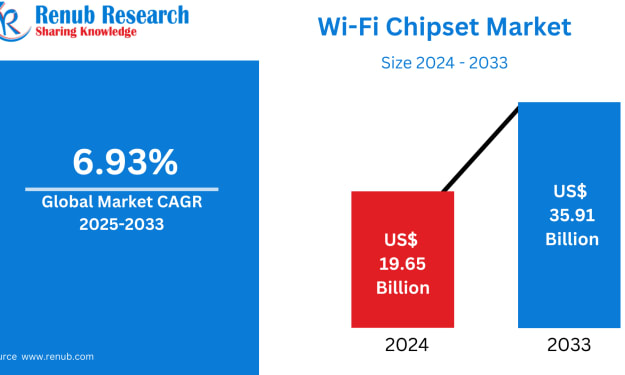
Wi-Fi Chipset Market Size and Forecast 2025–2033
Introduction: Wi-Fi Chipsets at the Heart of the Connected World Wireless connectivity has become as essential as electricity in the modern digital economy. From smartphones and laptops to smart homes, industrial automation, and connected vehicles, seamless internet access underpins everyday life. At the core of this connectivity ecosystem lies the Wi-Fi chipset—a fundamental semiconductor component that enables devices to communicate over wireless networks.
By Aaina Oberoi5 days ago in Futurism



Comments
There are no comments for this story
Be the first to respond and start the conversation.