
The Rise of AI Future Jobs: How to Prepare for the New World of Work
AI isn’t replacing humans — it’s redefining how we work, learn, and lead. Here’s how to future-proof your career in the age of intelligent machines.

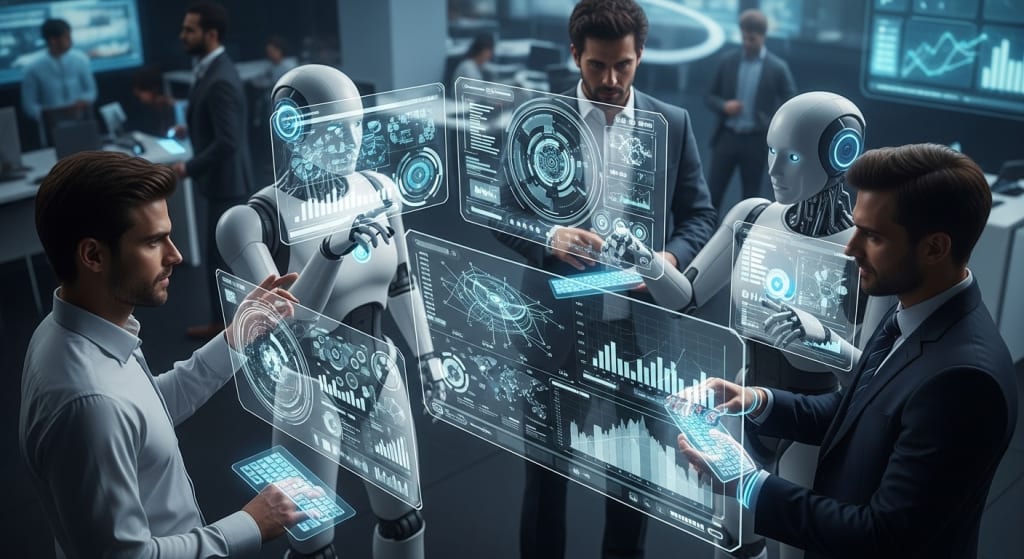
Artificial intelligence isn't coming - it's already here, quietly reshaping the workforce. Across every industry, algorithms are learning, automating, and optimizing. But far from stealing all our jobs, AI is creating new ones, demanding new skills, and redefining what "work" really means.
If you're wondering how AI will impact your career - and what you can do to stay ahead - this guide breaks down the key trends, sectors, and skills shaping the next decade of employment.
1. AI Won't Replace You - Someone Using AI Might
The most successful professionals of the next decade won't necessarily be data scientists or coders. They'll be people who know how to work with AI - who can use it to make smarter decisions, move faster, and innovate more creatively.
Think of AI as your coworker, not your competitor. In healthcare, algorithms now help radiologists detect tumors faster. In finance, machine learning models assist analysts in spotting risk patterns humans might miss. In marketing, AI predicts customer behavior, letting creative teams focus on storytelling instead of spreadsheets.
AI amplifies human potential - if you know how to collaborate with it.
2. Industries Are Changing - But Not in the Same Way
AI isn't transforming every field equally. Here's what's happening sector by sector:
Healthcare is seeing a revolution in diagnostics and administration. Doctors use AI to interpret scans and predict diseases, freeing time for patient care. The new jobs? AI healthcare specialists and medical data analysts.
Finance relies on AI for risk assessment, fraud detection, and automated trading. Expect growth in AI-finance consulting, compliance analytics, and data governance.
Education is moving toward adaptive learning. Teachers use AI to personalize lessons, track progress, and identify learning gaps. New roles like learning experience designers and AI curriculum coordinators are emerging.
Manufacturing is adopting predictive maintenance and intelligent supply chains. Robots are taking on repetitive tasks, while AI engineers and robotics supervisors maintain and improve the systems.
Everywhere, the theme is the same: AI automates the routine so humans can focus on the creative, relational, and strategic.
3. Ethics Matters as Much as Efficiency
AI raises difficult questions: Who's accountable when an algorithm makes a bad call? How do we prevent bias in automated systems? What happens when AI replaces tasks faster than workers can retrain?
Ethical AI isn't a buzzword - it's a necessity. Companies are forming AI ethics committees, auditing algorithms, and ensuring transparency. Governments are catching up, too. The European Union's AI Act and the growing wave of national frameworks signal a shift toward accountability.
If you work in or lead an organization, learning about AI ethics, fairness, and governance will soon be as essential as learning Excel once was.
4. The Global Picture: Not One-Size-Fits-All
While the United States and Europe are leading in automation and research, emerging markets are finding creative ways to use AI for development.
In India, AI tools predict crop yields and help farmers plan better. In parts of Africa, startups use machine learning to expand access to microloans. These innovations show that AI can be a tool for inclusion - not just disruption.
Yet the digital divide remains real. Access to reliable internet, education, and data infrastructure determines who benefits most. Closing that gap will define whether AI becomes a global equalizer or a new form of inequality.
5. Entry-Level Jobs and Gig Work Are Evolving
Many fear AI will wipe out entry-level opportunities. In reality, it's changing them. Routine tasks - data entry, scheduling, customer support - are being automated. But that's freeing newcomers to focus on higher-impact work: problem-solving, creativity, and relationship-building.
Meanwhile, the gig economy is expanding into AI-powered opportunities. Freelancers train algorithms, label data, or moderate AI-generated content. Platforms use AI to match gig workers with the right projects faster and more accurately.
The catch? Workers must build AI literacy - understanding how algorithms influence visibility, pricing, and opportunities on digital platforms.
6. The Skills That Will Keep You Relevant
Technical skills matter, but they're only half the equation. The future belongs to those who combine AI fluency with timeless human strengths.
Technical skills: Data analysis, AI fundamentals, programming (Python, R), and automation tools.
Cognitive skills: Critical thinking, complex problem-solving, and creativity - areas where humans still outperform machines.
Interpersonal skills: Empathy, communication, and leadership - especially in AI-driven teams.
Continuous learning: Online courses, micro-credentials, and mentorship are the new norm.
In short, your ability to learn faster than AI changes will be your greatest advantage.
7. Organizations Must Transform, Too
Companies can't simply buy AI tools and expect magic. They need a clear strategy, clean data, and a workforce ready to adapt.
Forward-thinking organizations are:
- Auditing processes to find where AI adds the most value.
- Training employees in AI fundamentals and data literacy.
- Promoting an open culture where experimentation is encouraged.
- Establishing ethics boards to oversee responsible use.
When leaders treat AI adoption as a human transformation, not a tech upgrade, productivity and morale both rise.
8. The Future Outlook: Human + AI Wins
So, what does the future hold? Expect hybrid roles - teachers using AI lesson plans, engineers supervising self-optimizing systems, marketers interpreting AI insights.
AI will continue to automate routine work, but it will also create new professions we can't yet name. Ten years ago, "prompt engineer" and "data ethics officer" didn't exist. In ten years, there will be hundreds more like them.
The winners will be those who see AI not as competition, but as collaboration.
9. Preparing for What Comes Next
Here's a simple roadmap for individuals and businesses:
For individuals:
- Learn the basics of AI and data.
- Stay curious - experiment with tools like ChatGPT, Notion AI, or Jasper.
- Combine human creativity with machine speed.
For organizations:
- Invest in employee training.
- Build AI ethics into company policy.
- Focus on outcomes, not hype - use AI where it genuinely solves problems.
The Bottom Line
AI isn't eliminating work - it's evolving it. The "AI future job" isn't a single role; it's a mindset. One that values curiosity, adaptability, and continuous growth.
The best way to future-proof your career isn't to fear the algorithm. It's to learn to lead it.
If you found this useful, share it on Medium or connect it to your publication.
About the Creator
ZoneTechAi
Discover cutting-edge tech & and AI insights at ZoneTechAi. Expert articles on artificial intelligence, machine learning, robotics, IoT, and cybersecurity.
Keep reading
More stories from ZoneTechAi and writers in Futurism and other communities.
AI Code Assistant for Beginners: Start Coding Smarter
If you've ever stared at your screen wondering why your code won't compile, or spent hours debugging a single function, you've probably wished for a mentor who could sit beside you 24/7. In 2025, that wish is a reality - it's called an AI code assistant.
By ZoneTechAi3 months ago in Futurism
About Binding Prometheus
I want to start actively advocating on behalf of my own work, and the most valuable part of my canon is, without a doubt, Binding Prometheus, the play I have been working on since 2019 and only finished in 2023 as part of my MA. The play itself is an amalgamation of a million different inspirations. On one end, it evokes the Ancient Greek myth-play, deriving its own title from the earliest extant work of Western drama we have, Aeschylus’s Prometheus Bound. On the other end, it borrows significantly from the sci-fi bulwarks from over the years, namely Mary Shelley’s Frankenstein and Karel Capek’s Rossum’s Universal Robots. The play could be an episode of Black Mirror, I fear. I don’t know. I’ve only ever seen one episode of Black Mirror.
By Steven Christopher McKnight11 days ago in Futurism
Let's Don't Do This
"I just can't do this anymore..." "Do what?" What can't you do? Put gas in your own car? I swear to God you make me take care of everything, don't you? You know I'm on my way to work right now but that never stops you from bothering me, does it?"
By Shirley Belk6 days ago in Fiction


Comments
There are no comments for this story
Be the first to respond and start the conversation.