
A Record-Breaking System: The Exoplanet Family Racing Through the Galaxy
Space

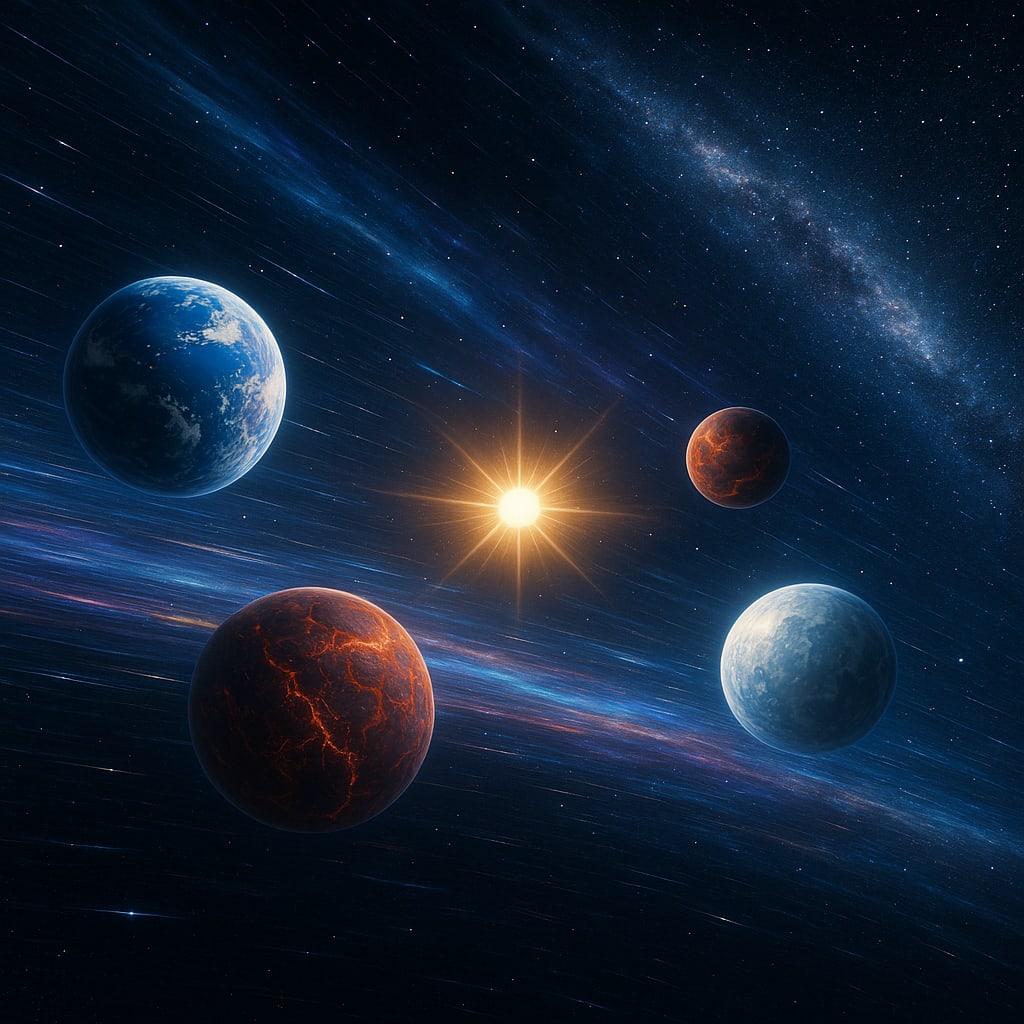
Astronomy has a way of surprising us, even when we think we’ve seen it all. We’re used to hearing about new stars, exoplanets, or distant nebulae lighting up the cosmic stage. But sometimes, discoveries are so striking that they make us pause and reimagine what’s possible in the universe.
One such discovery involves an exoplanetary system — not just a star, but a whole family of planets orbiting it — moving at a mind-bending speed around the Milky Way. This stellar system is racing along its galactic orbit at nearly 1.2 million miles per hour (about 2 million kilometers per hour).
For context, our own Solar System is no slouch: it orbits the center of the Milky Way at roughly 514,000 miles per hour (828,000 km/h). And yet, this newly observed system leaves us far behind, smashing records and raising fascinating questions about how it got so fast.
Just How Fast Is That?
Numbers this big can be hard to grasp, so let’s put them into perspective.
Imagine boarding a “cosmic express train” inside this runaway system. At its current speed, you could travel the distance from Earth to the Moon — about 239,000 miles (384,000 km) — in just seven minutes. By comparison, Apollo astronauts in the 1960s and 70s took about three days to cover that distance.
Even the fastest spacecraft humans have ever built, such as NASA’s Parker Solar Probe, which can reach around 430,000 miles per hour, look like bicycles next to this galactic bullet train.
The sheer speed is breathtaking — but it doesn’t mean the planets within the system are being torn apart. Instead, everything stays neatly bound to the star, moving together as if strapped in for the ride.
The Mystery of Cosmic Acceleration
So how does a star system end up hurtling through the galaxy at such outrageous velocity? Astronomers have several ideas, all linked to the powerful force of gravity.
Gravitational slingshots. Just as spacecraft use flybys of planets to gain speed, stars can get “slingshotted” by encounters with massive neighbors. If this system once passed near a heavy star cluster or even a black hole, it could have been kicked into overdrive.
Born in a high-speed environment. Some stars form in dense galactic regions where orbits naturally move faster. If this system was “born” in one of those hot spots, it may have simply inherited its incredible pace.
Influence of the galactic center. The closer a star is to the Milky Way’s heart, where gravity is strongest, the faster it must move to maintain its orbit. If the system came from, or still orbits near, the galactic core, its record speed may be a natural consequence of location.
What About the Planets?
If you lived on one of these planets — assuming there are oceans, mountains, or perhaps even life forms — would you notice the speed? Surprisingly, no.
Here’s why: planets orbiting a star are like flies buzzing inside a speeding car. The car might be racing down the highway at 150 kilometers per hour, but the fly doesn’t care — it just keeps zipping around the cabin. Similarly, planets remain comfortably in orbit around their sun, unaffected by the system’s galactic dash.
The only way you’d “notice” is by looking out the window of the car — or, in cosmic terms, by studying the stars around you and realizing you’re blazing past them at phenomenal speed.
Why It Matters
At first glance, this discovery might seem like a quirky astronomical footnote. But in fact, it offers scientists valuable clues about the structure and history of our galaxy.
Galactic dynamics. High-speed systems help astronomers understand how stars move, interact, and sometimes collide within the Milky Way.
The search for life. If planets can thrive in such extreme conditions, it broadens the scope of where we might look for habitable worlds.
Cosmic history. A runaway system may point to rare, dramatic events — like close encounters with black holes or violent star cluster interactions — that shaped the Milky Way over billions of years.
The Great Galactic Marathon
Think of the Milky Way as a vast marathon. Every star is a runner circling the track, each moving at its own pace. The Sun, steady and dependable, jogs along at a respectable speed. But this exoplanetary system is the sprinter — a blur that leaves most competitors in the dust.
And perhaps, somewhere on one of its worlds, intelligent beings are looking up at their night sky, wondering about their place in the cosmos — unaware that their entire home system is a record-breaking racer in the great galactic race.
The discovery reminds us that the universe is not just vast, but dynamic, surprising, and filled with stories that stretch the limits of imagination.
About the Creator
Keep reading
More stories from Holianyk Ihor and writers in Futurism and other communities.
The Mysterious “Dark Beads” Above Saturn’s Pole: JWST Unveils a Cosmic Puzzle
Saturn has always been one of the most enigmatic worlds in our solar system. Known for its dazzling rings, its golden-hued atmosphere, and its bizarre six-sided polar storm, the gas giant is a favorite subject of astronomers. Yet just when we think we’ve learned most of its secrets, Saturn surprises us again. Recently, NASA’s James Webb Space Telescope (JWST) captured something utterly unexpected in the planet’s northern atmosphere: a string of strange, dark structures scientists are calling “mysterious dark beads.”
By Holianyk Ihor4 months ago in Futurism
About Binding Prometheus
I want to start actively advocating on behalf of my own work, and the most valuable part of my canon is, without a doubt, Binding Prometheus, the play I have been working on since 2019 and only finished in 2023 as part of my MA. The play itself is an amalgamation of a million different inspirations. On one end, it evokes the Ancient Greek myth-play, deriving its own title from the earliest extant work of Western drama we have, Aeschylus’s Prometheus Bound. On the other end, it borrows significantly from the sci-fi bulwarks from over the years, namely Mary Shelley’s Frankenstein and Karel Capek’s Rossum’s Universal Robots. The play could be an episode of Black Mirror, I fear. I don’t know. I’ve only ever seen one episode of Black Mirror.
By Steven Christopher McKnight16 days ago in Futurism
Business Information Market Size to Surpass USD 85.9 Billion by 2033 Driven by Digital Intelligence & Enterprise Demand
Increasing data-driven decision-making, rising regulatory complexity, and growing need for competitive intelligence are accelerating demand for business information solutions, supported by digital transformation, expanding enterprise analytics adoption, and greater reliance on real-time insights across industries. According to IMARC Group's latest research publication, global business information market size reached USD 53.3 Billion in 2024. Looking forward, IMARC Group expects the market to reach USD 85.9 Billion by 2033, exhibiting a growth rate (CAGR) of 5.18% during 2025-2033.
By Suhaira Yusuf3 days ago in Futurism


Comments
There are no comments for this story
Be the first to respond and start the conversation.