
A Planet with a “Double Atmosphere”: A New Cosmic Mystery
Space

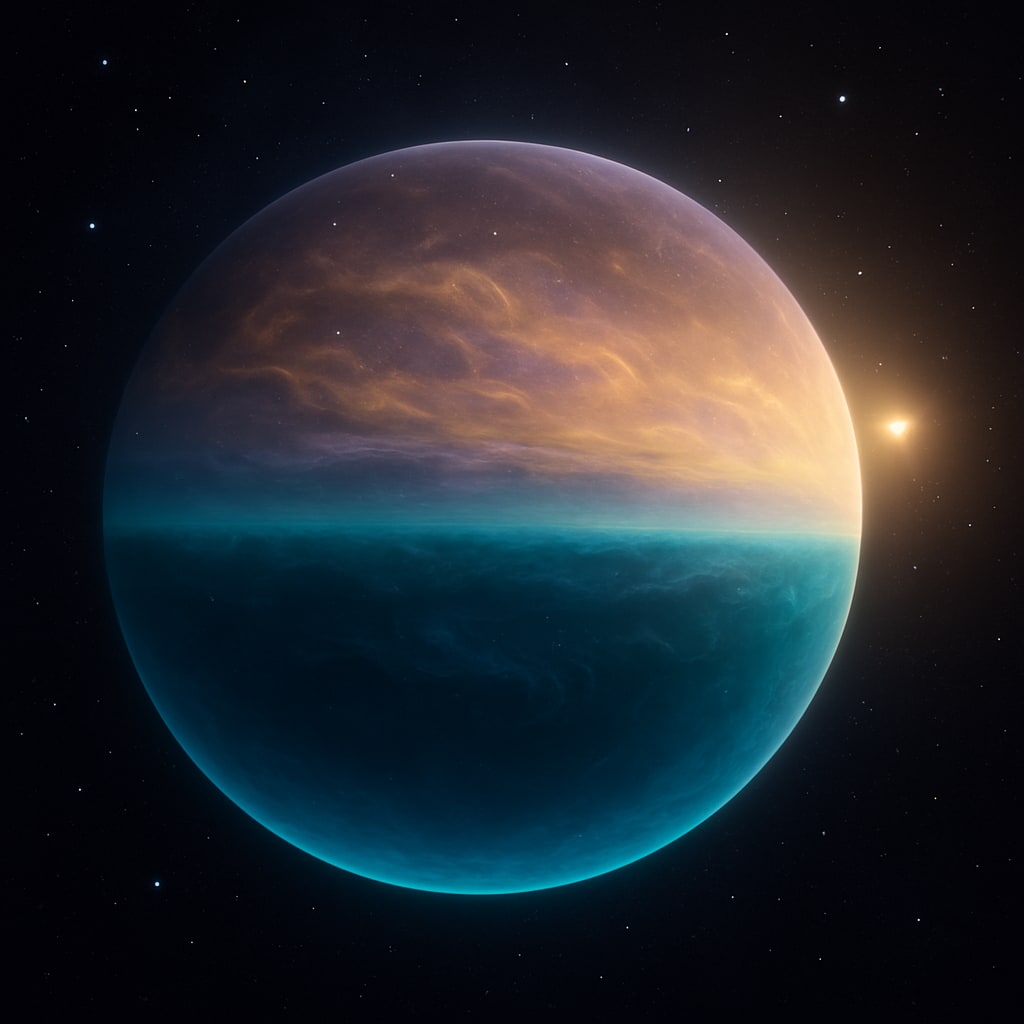
The universe never ceases to surprise us. With each new discovery, astronomers expand the boundaries of what we thought possible. Recently, researchers announced the detection of an exoplanet with a truly peculiar feature: it possesses not one but two distinct layers of atmosphere — a heavy one below and a lighter one above. This rare find may open a new chapter in our understanding of how planets form, evolve, and perhaps even sustain life.
Atmospheres as Planetary Fingerprints
An atmosphere is often described as a planet’s fingerprint. It tells the story of its history, climate, chemistry, and sometimes its potential habitability. On Earth, our delicate balance of nitrogen and oxygen makes life possible. Venus, with its suffocating blanket of carbon dioxide, has become a hellish greenhouse. The gas giants Jupiter and Saturn hide their mysterious cores under immense envelopes of hydrogen and helium stretching thousands of kilometers deep.
In most cases, planetary atmospheres are relatively uniform. Gases mix together, creating a more or less blended composition. But this newly discovered exoplanet breaks that rule, offering scientists a unique glimpse into a layered world where the heavy and the light coexist in sharply separated regions.
Two Layers, Two Worlds
According to initial observations, the lower atmosphere of this exoplanet is packed with heavier molecules such as carbon dioxide, water vapor, and methane. This dense blanket clings close to the planet’s surface, regulating temperature and pressure. Floating above it is a second, much lighter layer composed primarily of hydrogen and helium. These gases, being far less dense, drift outward into space, creating an extended, ethereal shroud.
It is almost as if the planet wears two masks: one resembling the atmospheres of rocky, Earth-like worlds, and another echoing the gaseous envelopes of Neptune or Jupiter. Such a clear division is rare, making the planet a kind of cosmic hybrid — part terrestrial, part giant.
How Could It Have Formed?
Astronomers are puzzling over the origin of this unusual structure. Several leading hypotheses have emerged:
- A relic of its birth. The planet may have originally formed as a “mini-Neptune,” enveloped in a massive hydrogen-helium atmosphere. Over time, heavier molecules condensed below, creating the dense secondary layer.
- Volcanic activity. Intense volcanic eruptions could have injected huge amounts of water vapor, methane, or carbon dioxide into the atmosphere, producing a heavier stratum beneath the original gases.
- Stellar erosion. Radiation from the host star might have stripped away parts of the upper atmosphere. Instead of losing everything, however, the planet retained a fragile hydrogen-helium layer hovering above a denser base.
Each explanation carries profound implications for planetary science. Was this world born unusual, or did it evolve into its strange state over billions of years?
Why This Matters
The discovery of a “double atmosphere” is more than just a curiosity. It challenges existing models of planetary evolution and demands a rethinking of what planetary atmospheres can look like.
From a climate perspective, a layered atmosphere could act like a thermal filter. The upper hydrogen-helium layer might block or scatter stellar radiation, while the lower, heavier layer would regulate surface conditions. Depending on the chemistry, this could create stable pockets of warmth and pressure — the very ingredients life needs.
Though the idea may sound speculative, it’s worth remembering that Earth itself has distinct atmospheric layers — troposphere, stratosphere, mesosphere, and so on — each with its own role. On this exoplanet, the layering is far more dramatic, suggesting an entirely new planetary class.
The Tools of Discovery
Much of what we know comes from analyzing starlight as it filters through a planet’s atmosphere during transit. Telescopes like the James Webb Space Telescope (JWST) have revolutionized this technique. By breaking light into spectra, scientists can identify chemical signatures — water, methane, carbon dioxide, hydrogen. The more advanced our instruments become, the more layers of complexity we uncover.
Future telescopes may reveal even more planets with dual or multi-layered atmospheres, hinting that this world is not an outlier but part of a broader population of exotic hybrids.
Looking Ahead
What excites astronomers most is the possibility that such atmospheres could host habitable niches. If the heavier lower layer contains water and stable conditions, it could, at least in theory, shelter primitive life forms. Even if no life exists there, studying these planets helps refine our understanding of habitability itself.
The discovery also underscores the importance of patience in science. Just decades ago, the idea of detecting exoplanetary atmospheres at all seemed like science fiction. Today, we are not only identifying them but teasing apart their intricate layers, one spectrum at a time.
Conclusion
The planet with a “double atmosphere” is more than a scientific oddity; it’s a reminder that the universe is endlessly inventive. Somewhere out there, worlds are writing their own rules, crafting atmospheres that defy our expectations. As technology sharpens our vision, we are certain to encounter even stranger planetary architectures — and perhaps, one day, the unmistakable chemical fingerprints of life.
About the Creator
Keep reading
More stories from Holianyk Ihor and writers in Futurism and other communities.
The First “Cosmic Lightning” in Saturn’s Atmosphere
When we think of lightning, we usually picture dramatic flashes streaking across Earth’s stormy skies—illuminating thunderclouds and shaking the air with booming thunder. But lightning is not confined to our home planet. Recently, scientists confirmed that powerful electrical storms also erupt in the swirling skies of Saturn. This extraordinary discovery has been described as the first detection of “cosmic lightning,” an otherworldly display of electrical energy under conditions far more extreme than anything we know on Earth.
By Holianyk Ihor4 months ago in Futurism
About Binding Prometheus
I want to start actively advocating on behalf of my own work, and the most valuable part of my canon is, without a doubt, Binding Prometheus, the play I have been working on since 2019 and only finished in 2023 as part of my MA. The play itself is an amalgamation of a million different inspirations. On one end, it evokes the Ancient Greek myth-play, deriving its own title from the earliest extant work of Western drama we have, Aeschylus’s Prometheus Bound. On the other end, it borrows significantly from the sci-fi bulwarks from over the years, namely Mary Shelley’s Frankenstein and Karel Capek’s Rossum’s Universal Robots. The play could be an episode of Black Mirror, I fear. I don’t know. I’ve only ever seen one episode of Black Mirror.
By Steven Christopher McKnight15 days ago in Futurism
United States Automotive Lighting Market Size and Forecast 2025–2033
Market Snapshot The United States Automotive Lighting Market is projected to grow from US$ 10.41 billion in 2024 to US$ 17.24 billion by 2033, registering a compound annual growth rate (CAGR) of 5.76% during the forecast period 2025–2033. This growth is being driven by rising vehicle production, rapid advancements in LED and adaptive lighting technologies, increasing demand for energy-efficient systems, and a strong regulatory focus on road safety.
By Aaina Oberoiabout 4 hours ago in Futurism


Comments
There are no comments for this story
Be the first to respond and start the conversation.