
The Productivity Paradox: Why 'Doing Less'is the Secret to Achieving More
"Discover why your 'To-Do' list is your biggest enemy and how to reclaim 20 hours of your week."


We live in a society where the "hack" is a constant. In a desperate effort to squeeze one more drop of output out of our 24-hour cycle, we download the most recent "Agentic AI" tools, time our espresso shots, and track our sleep cycles. We have been informed that the combination of discipline, "hustle," and a perfectly optimized Google Calendar is the key to success.
The uncomfortable truth, however, is that the majority of the productivity advice you've been following actually reduces your effectiveness. Despite having more tools than ever before in 2026, burnout is at all-time highs. Why? Because the mental models we use to define "work" are relics of the industrial age. We are treating our minds like steam engines, assuming that by simply starting the fire for a longer period of time, we will gain more power. It is high time to dispel the myths. Stop trying to be "productive" and start trying to be "effective" if you want to actually accomplish something meaningful this year.
Myth No. 1: The Myth of the Eight-Hour Workday
In the 19th century, factory workers were the intended beneficiaries of the 8-hour workday. Your output is a linear function of your time if you are on an assembly line. When compared to one hour of work, two hours produce twice as much. However, work will be exponential rather than linear in the knowledge economy of 2026. An entire week of "shallow work," such as responding to emails or attending status meetings, can produce less value than a single hour of "Deep Work," which is uninterrupted, high-intensity cognitive effort.
The world's most successful individuals do not put in 80 hours per week. Short, violent bursts of intensity are followed by extended periods of recuperation in their work. Instead of walking a long distance, think like a sprinter.
Myth 2: It's a Skill to Multitask
If you write that you are a "master multitasker" on your resume, you are basically telling an employer that you are always distracted. It has been demonstrated by neuroscience that the human brain does not "multitask." Instead, it moves quickly from one neural pathway to another through a process called "context switching."
You incur a "switching cost" each time you check a Slack notification while writing a report. After a single interruption, it takes an average of 23 minutes to regain your original level of concentration. The Truth: Being productive doesn't mean doing more things at once; rather, it means cutting out everything but the one thing that really matters.
Myth 3: "Productive" Equates to "Busy"
Our "busyness" is a badge of honor for us. When asked how we are doing, we respond, "Crazy busy!" as if it signifies significance. In point of fact, busyness is frequently a manifestation of laziness—laziness in thinking and acting haphazardly. Being busy makes you react quickly. You are responding to the priorities of other people.
Being proactive entails being productive. You are making progress toward your own objectives. You are not being productive if your day is a whirlwind of "urgent" tasks that leave you exhausted but with no tangible results at 5:00 p.m. You are nothing more than a hamster wheeled at high speed.

Energy Management: The Solution for 2026
Energy management, not time management, is the solution for 2026. Stop looking at the clock and start looking at your biological rhythms if you want to change the way you work. While energy can be managed and expanded, time is a finite resource.
Protect Your "Prime Time": Choose two hours per day when you are most alert. It's either 6:00 a.m. for some or 10:00 p.m. for others. Secure this period. No gatherings. No messages. No telephone. This should be your "Hardest Task First."
The 90-Minute Cycle: Ultradian rhythms are how our brains work. Your cognitive performance plummets precipitously after roughly 90 minutes of intense concentration work. Take a 15-minute "True Break" with no screens, just movement or silence, rather than pushing through with more caffeine.
The Power of Saying "No": When you say "Yes" to a low-value request, you are also saying "No" to your high-value objectives. In 2026, productivity is measured by what you don't do.
Reclaiming the Human Element: The Philosophical Shift
The greatest lie of the productivity movement is that we are machines that need to be optimized. No, we are not. We are biological organisms that can only function at a high level with rest, play, and connection. You regain the "mental margin" necessary for creativity when you stop viewing your life as a series of tasks to be completed. When you give your subconscious mind space to work, the best ideas don't come from looking at a spreadsheet. Instead, they come from walking in the park.
Last Thoughts
Because it prioritizes quantity over quality, everything you think you know about productivity is incorrect. Your only competitive advantage is the quality of your individual human insight in a world where AI can handle the quantity. Don't try to do more. Start doing what is important. Although the clock is ticking, you are not required to race against it. Simply ensuring that you are moving in the right direction is all that is required.

About the Creator
M.Changer
Diving deep into the human experience,I explore hidden thoughts, echoes of emotion, and untold stories. Tired of surface-level narratives?Crave insights that challenge and resonate?You've found your next rabbit hole. Discover something new.
Reader insights
Outstanding
Excellent work. Looking forward to reading more!
Top insights
Compelling and original writing
Creative use of language & vocab
Easy to read and follow
Well-structured & engaging content
Excellent storytelling
Original narrative & well developed characters
Expert insights and opinions
Arguments were carefully researched and presented
Eye opening
Niche topic & fresh perspectives
Heartfelt and relatable
The story invoked strong personal emotions
Masterful proofreading
Zero grammar & spelling mistakes
On-point and relevant
Writing reflected the title & theme
LED Light Face Mask Market 2026: Investment Potential & Emerging Consumer Trends
According to IMARC Group's latest research publication, The global LED light face mask market size reached USD 357.6 Million in 2025. Looking forward, IMARC Group expects the market to reach USD 882.5 Million by 2034, exhibiting a growth rate (CAGR) of 10.60% during 2026-2034.
By sujeet. imarcgroup5 days ago in Futurism
Journal of Behavioral Homeostasis
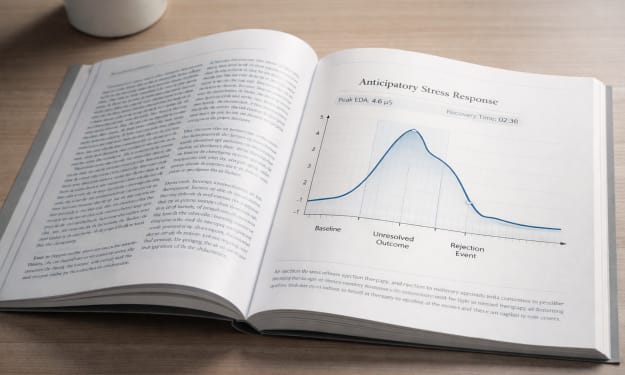
Journal of Behavioral Homeostasis Vol. 52, Issue 1 (2043) On the Therapeutic Function of Rejection Yielded Expectation Adaptation and the Regulation of Anticipatory Stress Abstract Chronic exposure to unresolved outcomes has emerged as a significant source of sustained psychological stress in contemporary environments characterized by continuous evaluation and delayed feedback. Yielded Expectation Adaptation (YEA) therapy was developed to reduce distress associated with rejection through structured exposure to definitive negative outcomes. Early clinical trials demonstrated measurable reductions in physiological arousal and cognitive rumination following controlled refusal events, despite participants reporting subjective disappointment. Subsequent adoption beyond clinical settings introduced voluntary and recreational applications collectively described as “outcome rehearsal.” This study examines therapeutic efficacy alongside broader cultural implications arising from the normalization of definitive outcomes as a mechanism of emotional regulation. Background Modern individuals navigate an unprecedented volume of unresolved outcomes. Applications remain pending without timelines. Messages linger unanswered. Creative work circulates through opaque review systems that offer neither clarity nor closure. Even social interaction increasingly unfolds within structures that defer resolution, producing prolonged periods of suspended expectation. While anticipation has traditionally been framed as motivational tension, emerging research suggests that sustained uncertainty carries significant cognitive and physiological costs. Patients presenting with chronic anticipatory stress frequently describe difficulty disengaging from unresolved possibilities, reporting persistent rumination, impaired attentional recovery, and elevated baseline anxiety. Clinical observation revealed an unexpected pattern: for many individuals, the distress associated with waiting exceeded the distress of rejection itself. Participants described negative outcomes as “sharp but clean,” contrasting them with the diffuse strain of indefinite possibility. Once an outcome was known — even an unfavorable one — subjects reported immediate reductions in cognitive load and renewed capacity for directed attention. These observations prompted investigation into whether rejection, when encountered deliberately and under controlled conditions, might function not solely as a negative experience but as a regulatory one. Yielded Expectation Adaptation therapy emerged from this line of inquiry. The approach centers on structured exposure to definitive refusal, designed to reduce anticipatory distress by recalibrating emotional responses to negative outcomes. Early implementations included simulated evaluative scenarios, scripted interpersonal declines, and guided exercises in which participants intentionally sought low-stakes rejection experiences. Initial reception within clinical communities was cautious. The idea that rejection might serve therapeutic ends appeared counterintuitive; however, preliminary findings consistently demonstrated improved physiological recovery following outcome resolution. Participants did not report enjoying rejection. They reported relief at the end of waiting. Subsequent literature began referring to the model simply as YEA therapy. Early Clinical Findings Pilot studies focused on individuals experiencing persistent anticipatory distress, including professionals navigating competitive hiring processes, creatives engaged in repeated submission cycles, and individuals reporting prolonged uncertainty within interpersonal relationships. Across multiple trials, participants undergoing YEA therapy demonstrated faster emotional recovery following negative feedback compared to control groups receiving traditional cognitive reframing interventions. Notably, the therapeutic effect appeared tied not to reinterpretation of rejection but to outcome definitiveness. When uncertainty was removed, even unfavorable results allowed subjects to reorganize attention and resume forward-directed behavior. Emotional stabilization occurred independently of outcome desirability. Whether such stabilization enhances persistence toward uncertain objectives was not assessed in initial trials. Initial findings were drawn from three pilot cohorts totaling 124 participants across clinical and non-clinical populations. Measures included heart-rate variability, post-session cortisol sampling, and standardized rumination inventories administered at 24-hour intervals. While sample sizes were limited, consistency across cohorts prompted further investigation into non-traditional applications of the model. Researchers initially framed these findings as evidence that emotional regulation may depend less on outcome valence than on outcome clarity — a distinction that would later prove central to understanding YEA’s broader cultural trajectory. Expansion Beyond Clinical Contexts As familiarity with YEA therapy increased, individuals began applying its principles independently outside clinical settings. Participants experimented with deliberate exposure to minor refusals, describing the practice as preparation rather than treatment. Examples included requesting unlikely accommodations, submitting creative work to rapid-response review forums, and engaging in structured interpersonal exchanges designed to produce immediate closure. In some peer-led sessions, participants delivered timed refusals limited to brief standardized phrases, preventing narrative elaboration and accelerating outcome resolution. These practices were soon described collectively as outcome rehearsal. The stated aim was efficiency: eliminate prolonged anticipation, reduce emotional backlog, restore equilibrium. Online communities formed around shared rehearsal strategies. Forums tracked experiments in shortening decision cycles. Informal gatherings organized structured refusal exchanges modeled on early YEA exercises. Participants described feeling clearer following sessions, attributing relief not to rejection itself but to the restoration of certainty. By 2041, digital platforms offered guided outcome simulations. Users submitted proposals or personal statements for predetermined rejection responses, receiving definitive outcomes in place of extended uncertainty. What began as resilience training increasingly functioned as routine maintenance. Longitudinal Observations Extended tracking of frequent YEA participants revealed sustained reductions in anticipatory distress across professional and interpersonal domains. Subjects reported decreased reactivity to uncertainty and increased willingness to disengage from prolonged evaluative processes. Participants described these changes as increased realism or maturity. However, longitudinal analysis identified convergence toward modest, low-volatility objectives and a gradual reduction in variance among reported long-term goals. Engagement with speculative creative work, competitive applications, and relational pursuits involving delayed feedback declined across cohorts. These shifts were rarely framed as losses. Participants instead described calibration, emphasizing efficiency and emotional sustainability. Goal selection trended toward incremental trajectories. Despite these patterns, expressions of desire for authentic acceptance outcomes remained consistent. Participants reported increasing comfort with rejection while continuing to articulate longing for genuine affirmation. Rejection, when rehearsed, appeared to lose much of its destabilizing force. Whether it also lost its capacity to clarify what was genuinely wanted remained unclear. Discussion The widespread adoption of YEA suggests that relief from uncertainty fulfills a significant psychological need. Across populations, participants demonstrate reduced anticipatory distress following structured exposure to definitive outcomes. Emotional recovery accelerates. Rumination declines. Individuals report increased stability and improved capacity to disengage from unresolved possibilities. These outcomes align with predictive regulation models, which propose that the brain prioritizes clarity over desirability when restoring equilibrium. Rejection functions less as injury than as resolution — a definitive update that permits cognitive reorganization. The normalization of outcome rehearsal may therefore represent an adaptive response to environments saturated with deferred evaluation. Participants frame YEA engagement as a method of preserving energy, shortening the waiting cycle, and maintaining emotional efficiency. Longitudinal findings suggest equilibrium and expansion may not scale proportionally. Frequent YEA engagement correlates with decreased participation in high-variance pursuits and reduced tolerance for prolonged uncertainty. Emotional volatility declines alongside willingness to pursue outcomes perceived as unlikely. Participants continue to describe themselves as hopeful. Structured rejection reduces destabilization but does not eliminate longing. The wish to be chosen persists even as individuals become increasingly skilled at rehearsing refusal. It remains unclear whether the growing cultural preference for definitive outcomes represents an evolution in resilience or a recalibration of perceived attainability. Emotional equilibrium may be achieved through strengthened tolerance of disappointment. It may also be achieved through subtle contraction of the scale at which individuals are willing to hope. Further research is required to determine whether widespread engagement with YEA strengthens individuals against disappointment — or gradually reduces the range of futures they consider reachable. Author’s Notes: Current findings suggest that individuals do not appear to want less; rather, they appear increasingly practiced at relinquishing desire before it encounters resistance. The reduction of distress may indicate progress; whether it reflects expansion or contraction remains unresolved.
By Mina Carey5 days ago in Futurism
Belle of the Bayou
Bad move, cher. Not just the slip of her kitten heel on the rainy February cobblestones in the Fourth Ward. She got caught snooping. Detective Deleon clucked and strutted like a rooster in his rush to clear her from the scene, waving cigar smoke to and fro as he gesticulated amid the thick air of the speak easy. An experienced crime reporter, Marie knew better than to let the coppers catch her on the wrong side of the line, but curiosity had gotten the better of her.
By Maia Gadwall the metAlchemist5 days ago in Fiction



Comments (2)
Excellent ,keep it up looking for more
Excellent ,keep it up looking for more