
A brand new black hole will appear!
Hubble captures a blue giant that looks strange as it destroys

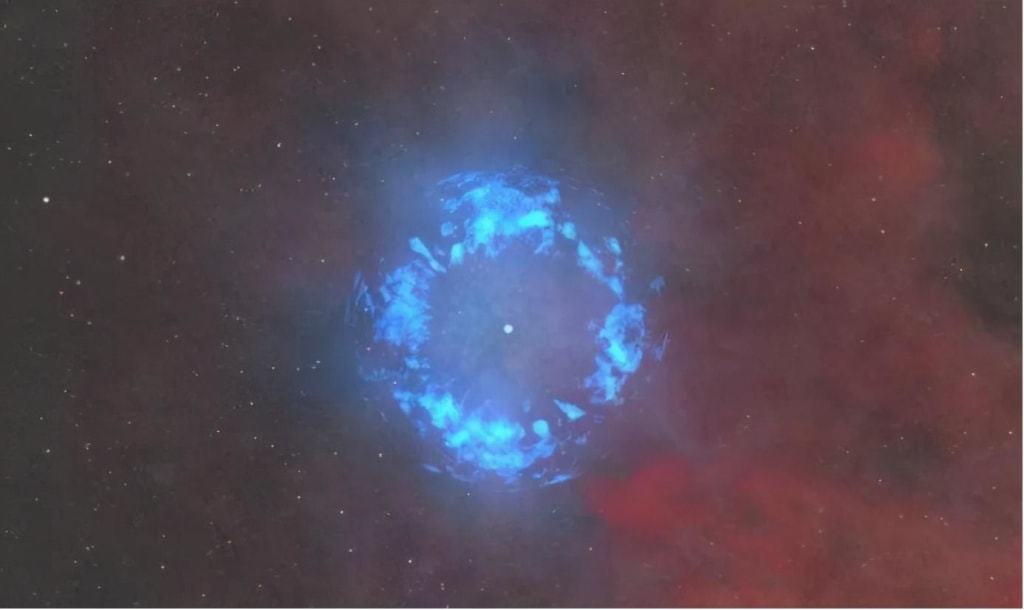
We all know that there are many black holes in the universe. In addition to supermassive black holes, primordial black holes, and newly discovered intermediate-mass black holes, which are not yet known exactly why they form, massive stars also become stellar-class black holes after collapsing at the end of their lives.
Some time ago, NASA's Hubble Space Telescope, discovered a blue giant in the universe that is about to become a stellar black hole. As a supermassive star, its short life span is coming to an end, and at the same time, it will release at least millions of times the energy of the Sun.
What is a blue giant?
Blue giants are supermassive stars in the universe that lives between a few million and tens of millions of years because their cores are so large that their internal nuclear reactions are very fast, and naturally, their entire evolutionary cycle is like pressing the "accelerator" button.
In terms of brightness, the minimum brightness of a blue giant is 500 times brighter than that of the Sun, which is a kind of yellow dwarf, and there are orange and red dwarfs in the universe that are much smaller than the Sun.
In today's universe, there are very few blue giants, and research suggests that blue giants were mainly concentrated shortly after the Big Bang, and because they are so massive, they have a very short evolutionary period, which allowed the universe to quickly have a large number of material elements early on through the internal nuclear reactions of blue giants.
This time, the blue giant discovered by the Hubble Space Telescope is about 20,000 light years away from Earth. Naturally, even if it is even bigger and releases more energy, the Earth is safe because of the distance, which allows researchers to get a good glimpse of it on Earth.
A blue giant star on the verge of destruction
Researchers say that today this blue giant, is in the self-destruction stage, of course, this stage will also take a long time to complete, first, its internal radiation pressure, as well as its gravity, will be an interesting contest between the competition, and in the process, it will also continue to expand and contract, until the final side has won a decisive victory, after which, it will be like a volcanic eruption, began to eject a large amount of material, and then in a little bit to stabilize.
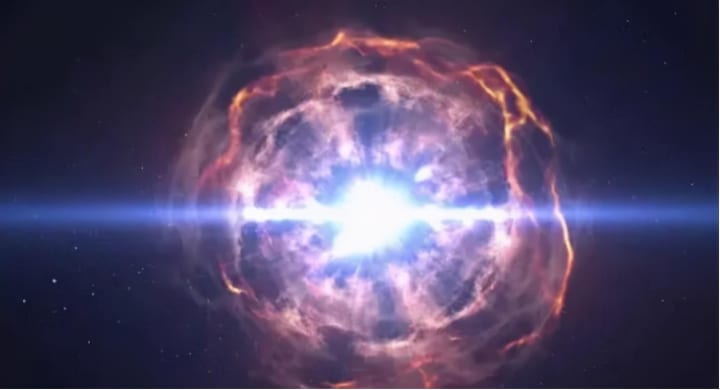
Of course, this is not its final destination, in the process of turning from a blue giant into a stellar black hole, it will continue to repeat the above behavior until it completely collapses into a black hole, and before that, it will also experience a terrible supernova explosion, after which a large number of material elements will be produced, and the surrounding space will become rich.
Will all stars eventually become black holes?
In short, the answer is no, because what kind of object a star will eventually become at the end of its life needs to be determined by its mass.
Simply put, if the mass is large enough, it has a chance to become a stellar black hole, otherwise, it will become a neutron star or a white dwarf. Generally, stars above 7 times the mass of the Sun will only become black holes when they experience supernova explosions when the end of their life comes.
In contrast, a star that is generally above 3 times the mass of the Sun and below 7 times the mass of the Sun becomes a neutron star at the end of its life. It follows that the Sun, as a mass reference, will end up as a white dwarf.
The average lifetime of the Sun, which is not a massive star, is about 10 billion light-years, while orange and red dwarfs, which are smaller than the Sun, generally have masses between tens and hundreds of billions of light-years.
Today, the Sun is halfway through its life, and in about 5 billion years, it will reach the end of its life and then go through a red giant phase before eventually collapsing into a white dwarf.
However, a white dwarf is not the final destination of the Sun. Generally speaking, the life span of a white dwarf is also around several billion years, after which the white dwarf will evolve again and become a black dwarf at the end of its life.
In short, when the Sun becomes a white dwarf, it will still be able to shine, although its light and mass will be dull and smaller, when it becomes a black dwarf, it will no longer be able to shine!
It is believed that the universe will reach the end of its life when no new stars are born in the future and all the stars evolve and become black holes, neutron stars, or even black dwarfs.
However, as of now, scientists have never found the existence of black dwarfs in the universe, which means that there is a sense of black dwarfs and the end of the universe of conjecture, currently can not be confirmed, of course, can not found black dwarfs, but also with the universe is still very young, together with the wait and see!
About the Creator
Sue Torres
Is there any other reason to live to change the world?
Keep reading
More stories from Sue Torres and writers in Futurism and other communities.
Zodiac signs with unpleasant personalities
People with strong personalities always think that what they do is right, a "world only I" posture, open mouth is "I think what is right" and "you have to listen to me to do ", frankly speaking, this character is very unpleasant, it is easy to make problems with others, and they are indeed difficult to get along well with others. They are too self-centered, always think from their point of view, but also look like they think they are great, but he did not consider whether the other party to accept his "good intentions", perhaps in other people's view is not only superfluous or a problem, so that everything or have to consider each other's feelings to do, so like this zodiac sign who have it? Who are these signs?
By Sue Torres3 years ago in Futurism
Australia Mobile Cloud Market: Enterprise Mobility, Digital Transformation & 5G Integration
According to IMARC Group, the Australia mobile cloud market was valued at USD 1,807.15 Million in 2025 and is projected to expand to USD 6,757.36 Million by 2034, exhibiting a strong compound annual growth rate (CAGR) of 15.78% during 2026–2034. This rapid growth highlights the accelerating convergence of cloud computing, mobile technologies and next-generation connectivity across Australia. Mobile cloud computing enables data storage, processing and application access via cloud infrastructure optimized for smartphones, tablets and connected devices. As enterprises embrace hybrid work models and 5G networks expand nationwide, mobile cloud solutions are becoming integral to digital business strategies.
By Kevin Cooper7 days ago in Futurism




Comments
There are no comments for this story
Be the first to respond and start the conversation.