
2070: Alone on Earth – Day Three
The Broadcast Begins, and Silence Answers Back

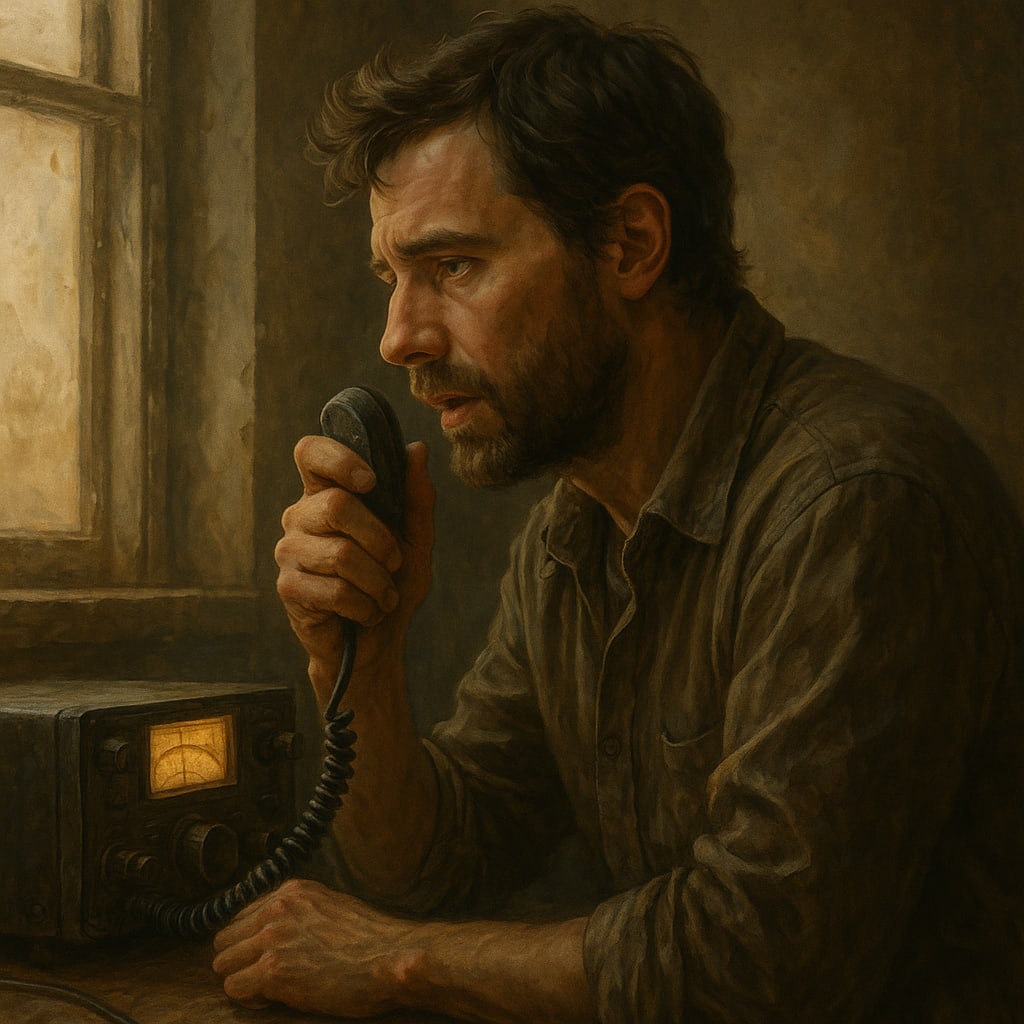
The third day arrives with pale light filtering through cracked blinds. I sit at the edge of my bed longer than usual. My muscles are sore, my mind quieter. It’s the first morning that feels less like an emergency and more like an existence. There’s a strange comfort in the routine—the knowledge that I survived another night. That I can still decide how to shape the day ahead.
I begin the day by logging the essentials: water pressure remains stable, electricity still on. The small indicators of continuity are comforting. I cross-reference notes from Day One and Day Two. The systems that sustained humanity continue, for now. But I know nothing lasts without maintenance. Eventually, I’ll need to understand how to keep the grid alive—or learn to live without it. That thought sticks with me. Living without electricity would be a different kind of solitude.
I skip breakfast to focus on my first true mission: the radio.
Yesterday, I assembled a makeshift broadcast station using equipment salvaged from the old local station. I checked wires, voltage, signal range. I rehearsed what I wanted to say. Today, I speak.
The microphone smells of dust and age. I press the transmit button and hear the slight click and static hum that confirms it's live. My heart races.
"This is Day Three. If you can hear this... you're not alone. I’m here. My name is Alex. I’m in what used to be downtown Chicago. I’ve survived. I don’t know what happened to the rest of the world—but I’m here. And I’ll keep broadcasting every morning."
I pause, breathing into the silence.
"If you're alive... answer. Send anything—your voice, a pulse, a sound. I’ll listen."
I release the button.
The radio crackles gently. Then—nothing.
I sit there for a while, listening. Hoping. It’s irrational to expect a reply so soon. But still, the silence stings more than I anticipated. I try to convince myself it’s too early for an answer. That patience is another form of survival.
To ease the disappointment, I distract myself by returning to the greenhouse. The first seedlings haven’t sprouted, but I spend time adjusting light angles and testing the humidity. I flip through pages of the gardening manual I annotated yesterday. The routine is calming. There’s something about nurturing life—even if it’s just plants—that makes me feel more human.
At midday, I head out again. My target today: a museum. Not for food or gear, but for memory. For meaning. Civilization wasn’t just about survival. It was about art, stories, dreams. I need a reminder of that.
Inside, dust veils the exhibits. Statues and artifacts stand in solemn silence, untouched by the collapse. A time capsule of civilization, preserved by absence. My footsteps echo down empty marble halls. I run my fingers along stone carvings, admire brushstrokes on oil paintings. These things outlasted the artists. Now, they outlasted their audience too.
I walk past sculptures, paintings, fossils. I pause at a large installation titled “The Tree of Humanity”—a wall-length timeline of human progress. I take out my notebook and begin copying it by hand. It feels important. If the world ended, someone should remember how far we came. How we dreamed of stars, of machines, of peace. Even if I’m the last witness, I want to remember.
On the way back, I hear something strange—distant clattering.
I freeze. My heartbeat surges. I crouch behind a car wreck and listen again. Silence. Maybe wind knocked something loose. Or maybe...
The idea of another survivor sends conflicting waves of hope and fear. What if it's not human? What if it is? After days of silence, even possibility becomes overwhelming. I search for signs, tracks, movement—but find nothing. I mark the location and make plans to revisit it tomorrow with more caution. If it was real, I’ll find it.
Back home, I record a second message on the radio—shorter, steadier.
“Still here. Still listening.”
Then I cook dinner. The canned beans taste metallic, but warm food soothes me. I light candles even though I have power—something about their flicker makes the room feel more alive. I place one near the window, in case someone is out there looking.
I read poetry tonight. Something by Mary Oliver. The line that stays with me: “Tell me, what is it you plan to do with your one wild and precious life?” It doesn’t feel like a question anymore. It feels like a challenge.
It echoes in my mind as I drift into uneasy sleep, ears still straining for an answer in the night. I dream of cities full of people again. I wake with tears on my cheeks, but also a strange sense of readiness.
Day Three ends with unanswered questions. But also—new signs. Possibility. A whisper in the static. A sound in the distance. A flicker in the dark.
Tomorrow, I’ll search the sound. I’ll follow the clatter. I’ll speak again. I’ll listen harder.
Tomorrow, maybe, I won’t be alone.
About the Creator
Ahmet Kıvanç Demirkıran
As a technology and innovation enthusiast, I aim to bring fresh perspectives to my readers, drawing from my experience.
Keep reading
More stories from Ahmet Kıvanç Demirkıran and writers in Futurism and other communities.
2070: Alone on Earth – Day Two
The sun rises again, and with it, so do I. For the first time in my life, I awaken without a single external obligation—no deadlines, no meetings, no news cycles. Only the haunting silence of a world once teeming with motion.
By Ahmet Kıvanç Demirkıran7 months ago in Futurism
About Binding Prometheus
I want to start actively advocating on behalf of my own work, and the most valuable part of my canon is, without a doubt, Binding Prometheus, the play I have been working on since 2019 and only finished in 2023 as part of my MA. The play itself is an amalgamation of a million different inspirations. On one end, it evokes the Ancient Greek myth-play, deriving its own title from the earliest extant work of Western drama we have, Aeschylus’s Prometheus Bound. On the other end, it borrows significantly from the sci-fi bulwarks from over the years, namely Mary Shelley’s Frankenstein and Karel Capek’s Rossum’s Universal Robots. The play could be an episode of Black Mirror, I fear. I don’t know. I’ve only ever seen one episode of Black Mirror.
By Steven Christopher McKnight15 days ago in Futurism
Saudi Arabia E-Commerce Market: Rising Online Adoption, Digital Payments & Demand Growth
According to IMARC Group's latest research publication, Saudi Arabia e-commerce market size reached USD 222.9 Billion in 2024. The market is projected to reach USD 708.7 Billion by 2033, exhibiting a growth rate (CAGR) of 12.8% during 2025-2033.
By Suhaira Yusuf4 days ago in Futurism
The Ritual of Winter Challenge Winners
Welcome to the Winners Announcement for The Ritual of Winter challenge. This prompt focused on winter rituals and the meaning that settles into them over time. The top pieces stay grounded in ordinary acts and repeated routines, letting winter shape the work through pace, attention, and restraint.
By Vocal Curation Team7 days ago in Resources


Comments (1)
Poetry reading is good to occupy the mind ♦️♦️♦️♦️