
100,000 Humanoid Robots by 2028
US reveals secret plan against China

Figure AI's Breakthrough
Imagine going into a factory where humanoid robots work alongside people, moving with roughly the same speed and precision. This vision is quickly becoming a reality, with Figure AI announcing a ground-breaking cooperation to deploy 100,000 humanoid robots over the next four years. This historic breakthrough not only represents a significant advancement in industrial automation, but it also marks a new chapter in the worldwide competition for robotics dominance.
The Next Industrial Revolution
Figure AI's recent announcement of a partnership with one of America's largest companies marks a watershed moment in robotics history. While specific details about the client remain confidential, CEO Brett Adcock's LinkedIn update reveals ambitious plans that promise significant cost reductions and accelerated AI data collection capabilities.
This isn't Figure AI's first major partnership. The company already counts BMW among its clients, following a contract signed in late 2023. What sets this new agreement apart is its unprecedented scale – 100,000 robots represent the largest planned deployment of humanoid robots in history.
Industry Impact: This deployment could reduce operational costs by up to 30% while increasing production flexibility, according to industry analysts. Companies adopting this technology early will likely gain significant competitive advantages in their respective markets.
Technical Evolution: From Figure 1 to Figure 2
Figure AI's rapid development pace has produced remarkable results in just 31 months. Their evolution tells a compelling story of technological advancement:
Figure 1: The Foundation
The company's first humanoid robot operated at 17% of average human walking speed, establishing baseline capabilities for industrial applications. While modest by current standards, Figure 1 proved the viability of AI-driven humanoid robots in controlled environments.
Figure 2: The Game Changer
The second generation brought dramatic improvements:
- Movement speed increased sevenfold
- Achieves 1.2 meters per second (4.3 km/h)
- Nearly matches the average human walking speed (4.5-5 km/h)
- Enhanced dexterity and task adaptation capabilities
These improvements weren't just incremental – they represented a fundamental leap in robotics capability. Figure 2's performance approaches human-level metrics in several key areas, making it suitable for a wider range of industrial applications.
AI Integration: The Brain Behind the Brawn
At the heart of Figure AI's success lies its innovative approach to artificial intelligence. Rather than relying on pre-programmed responses, these robots employ neural networks for end-to-end learning. This approach enables:
- Autonomous adaptation to new situations
- Continuous improvement through environmental learning
- Real-time problem-solving capabilities
- Enhanced task flexibility
Technical Note: Traditional robots require explicit programming for each task variation. Figure AI's neural network approach allows robots to generalize learned skills to new situations, similar to human learning patterns.
Global Competition: The Race for Robotics Dominance
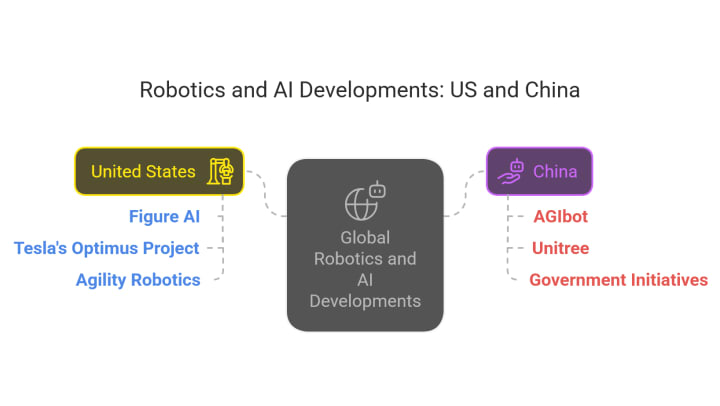
The announcement of 100,000 robots hasn't gone unnoticed in the global arena. Major players in the humanoid robotics space include:
United States
- Figure AI
- Tesla's Optimus project
- Agility Robotics
China
- AGIbot (1,000 robot production capacity)
- Unitree
- Government-backed initiatives targeting 2027 deployment
Other Notable Competitors
- Sanctuary AI
- Boston Dynamics
- Eptronic
This competition has sparked a technological race between the United States and China, with each nation pushing for dominance in the humanoid robotics sector. China's strategy to incorporate humanoid robots into industrial settings by 2027 has now been met with this ambitious U.S. response.
Future Applications and Implications
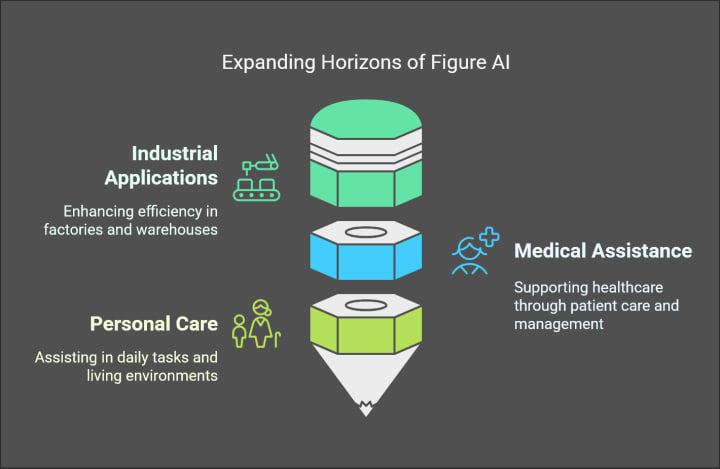
The implications of Figure AI's advancement extend far beyond manufacturing:
- Industrial Applications
- Manufacturing assembly lines
- Warehouse operations
- Hazardous environment operations
- Medical Assistance
- Patient care support
- Rehabilitation assistance
- Medical supply management
- Personal Care
- Assisted living support
- Home care assistance
- Daily task automation
Perhaps most exciting is the potential for brain-controlled interfaces, offering hope for people with tetraplegia to regain autonomy through these advanced robots.
Practical Considerations for Implementation
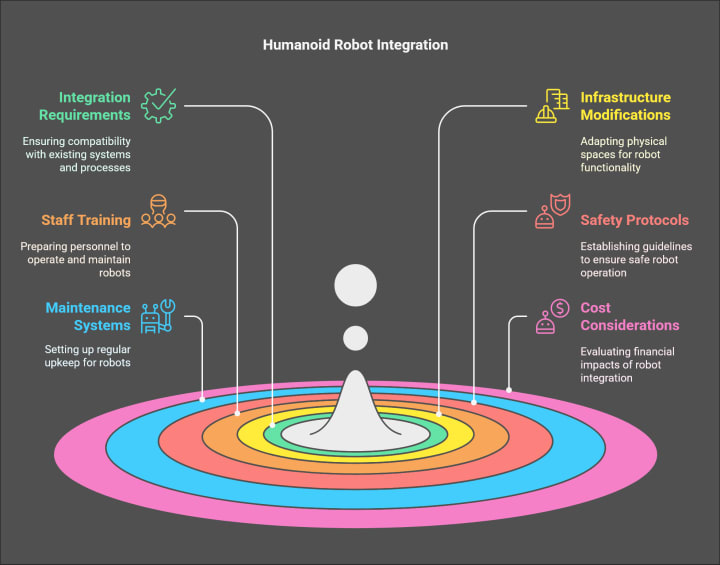
For organizations considering humanoid robot integration, several factors require careful consideration:
- Integration Requirements
- Infrastructure modifications
- Staff training needs
- Safety protocols
- Maintenance systems
- Cost Considerations
- Initial investment
- Operational costs
- Training expenses
- Expected ROI timeline
Warning: Organizations must conduct thorough risk assessments and develop comprehensive safety protocols before deploying humanoid robots in any setting.
Looking Ahead: The Road to 2028
As Figure AI moves forward with its ambitious deployment plan, several key developments are expected:
- Accelerated AI learning from real-world applications
- Enhanced human-robot interaction capabilities
- Expanded use cases across industries
- Improved safety and reliability metrics
Frequently Asked Questions
Q: How do Figure AI's robots compare to human capabilities? A: Figure 2 achieves near-human walking speeds (4.3 km/h) and can perform various complex tasks, though human dexterity and problem-solving still exceed robot capabilities in many areas.
Q: What industries can benefit most from humanoid robots? A: Manufacturing, logistics, healthcare, and hazardous operations stand to gain the most immediate benefits from humanoid robot deployment.
Q: How does the AI learning system work? A: The robots use neural networks for end-to-end learning, allowing them to adapt to new situations and improve performance through environmental interaction rather than explicit programming.
Q: What safety measures are in place? A: Multiple safety systems, including advanced sensors, emergency stops, and AI-driven collision avoidance, ensure safe human-robot interaction.
Conclusion
Figure AI's commitment to deploying 100,000 humanoid robots by 2028 represents more than just a technological milestone – it signals the dawn of a new era in human-robot collaboration. As these systems continue to evolve and improve through real-world application, we're likely to see unprecedented advances in productivity, safety, and capability across multiple industries.
For organizations looking to stay competitive in this rapidly evolving landscape, now is the time to begin understanding and planning for the integration of humanoid robots into their operations. The future of human-robot collaboration isn't just approaching – it's already here.
About the Creator
Francisco Navarro
A passionate reader with a deep love for science and technology. I am captivated by the intricate mechanisms of the natural world and the endless possibilities that technological advancements offer.
Keep reading
More stories from Francisco Navarro and writers in Futurism and other communities.
The Eye’s Hidden Mistery
A recent study, performed by University Malaysia Computer Science & Engineering and Al-Azhar University researchers, captured curiosity—and a scientific paradox—by confirming that artificial intelligence (AI) can accurately identify an individual’s gender via retinal photos. The astonishing fact? Even experts can’t say for definite why AI succeeds, with no discerned variation in male and female structures in human retinas.
By Francisco Navarroabout a year ago in Futurism
Why AI Website Builders Are Transforming Elementor Workflows in 2026
Website development has entered a new phase in 2026 as artificial intelligence becomes deeply integrated into the design process. Once known primarily for its drag-and-drop simplicity, Elementor is now evolving into an AI-assisted design platform. With the introduction of tools like Elementor AI, the way designers, developers, and businesses build WordPress websites is rapidly changing.
By Shane Smith2 days ago in Futurism
Vinyl Record Market Trends: Music Collectibles, Analog Revival & Forecast to 2034
Vinyl is no longer a relic of the past — it's one of the most exciting growth stories in the global music industry. Fueled by nostalgia, the enduring appeal of analog sound, and a passionate collector community, the global vinyl record market is on a firm upward trajectory. According to IMARC Group's latest research, the global vinyl record market size reached USD 2.1 Billion in 2025. Looking ahead, IMARC Group expects the market to reach USD 3.6 Billion by 2034, exhibiting a CAGR of 6.50% during 2026-2034. Asia Pacific currently dominates the global market, driven by growing middle-class spending, flourishing indie music scenes, and strong collector culture across the region.
By Suhaira Yusuf7 days ago in Futurism



Comments
There are no comments for this story
Be the first to respond and start the conversation.