
Sri Lanka's Rare Jewels Worth up to $1600+
Deadly Underground Mining
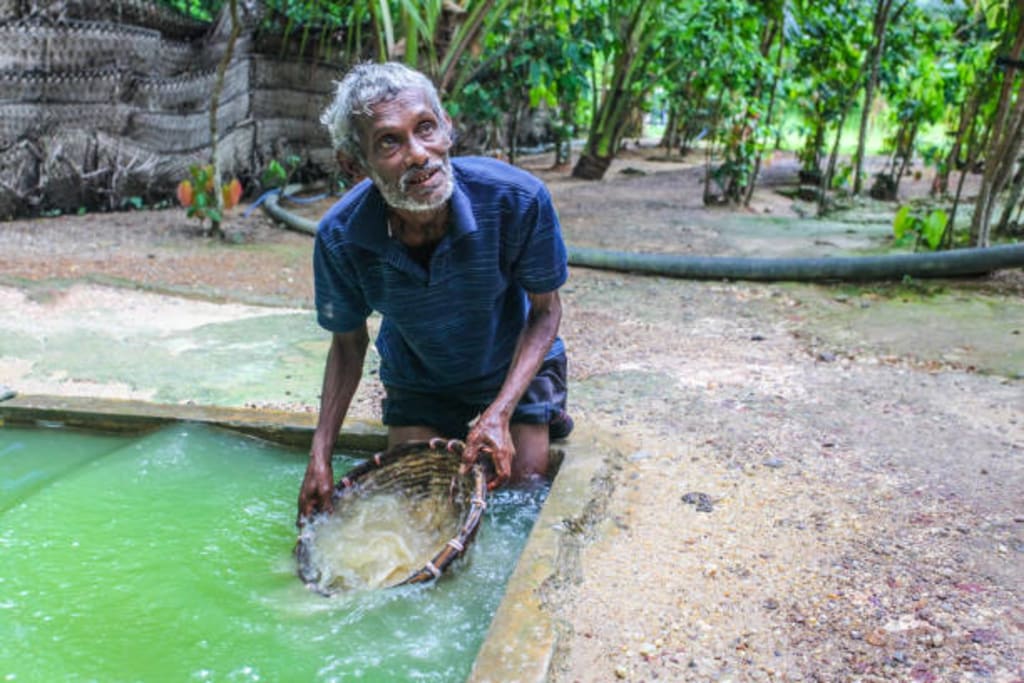
In the heart of Sri Lanka lies a wealth of valuable gemstones concealed within deep pits. These miners risk their lives daily, venturing into precarious tunnels supported merely by logs and leaves, vulnerable to sudden collapses caused by seeping sand and water. Among them is Samaranayakege Telakaratna, a seasoned gem miner with almost five decades of experience, searching for treasures such as blue sapphires, rubies, garnets, and topaz.
Sri Lanka's gemstone industry boasts an impressive heritage, dating back approximately 2,500 years. Skilled artisans continue to employ ancient techniques to refine these precious stones, which command millions of dollars in the global market. However, the prosperity of the industry seldom reaches the miners themselves, who endure the challenges of surviving in a country recently plagued by its worst-ever economic crisis.
Ratnapura, known as the "city of gems," is home to Samaranayakege, where he starts his day preparing betel leaf and tobacco, a stimulating ritual adopted by miners to sustain energy throughout their arduous workday. Descending 40 feet into the pit, the nearby river poses a constant threat, bringing in sand, soil, and water that can lead to catastrophic tunnel collapses. Tragically, similar incidents have claimed lives in Ratnapura in the past.
To reinforce the mines, miners utilize logs from local rubber trees, even though the peeled bark traps moisture, causing the wood to rot. Additionally, they employ a local fern called kekilla to support the unstable underground structures. Sri Lanka houses approximately 6,000 active mines, privately owned but requiring licenses from the National Gem and Jewelry Authority. Extracting all the gems from a single pit can take over a year, and the cramped conditions in the tunnels with limited oxygen necessitate the use of air pumps for ventilation.
Despite their strenuous efforts, the majority of the recovered gemstones prove worthless. Miners like Samaranayakege earn meager salaries, around 1,200 rupees per week (approximately $3), hardly enough to make ends meet in Sri Lanka. When they unearth valuable gems, they must surrender them to mine owners who then sell the precious finds to middlemen.
The geological foundation of Ratnapura creates an abundance of gemstones. Underground rocks undergo intense heat and pressure, resulting in the formation of valuable gems. The gems' movement due to heavy rains, landslides, and rivers prompts miners to search for stones in the Kalu Ganga. To extract gems from riverbeds, they employ scaffolding and diving or use blades attached to wooden poles, which raises environmental concerns and calls for stricter regulation from the gem authority.
Beyond the environmental impact, miners' practices sometimes lead to accidents. Native vegetation is cleared during mining, and some pits remain unfilled after operations conclude. Despite these issues, the gem industry employs a significant portion of Sri Lanka's population, providing jobs to approximately 100,000 individuals. The gems find their way to wholesale markets, where workshops like Chaminda Athuraliyagamage's are busy cutting and polishing gems using both modern and traditional methods.
A one-carat blue sapphire from Sri Lanka can fetch anywhere from $450 to $1,600, depending on its color, cut, clarity, and carat weight. The most remarkable discovery was the Star of Adam, the world's largest star sapphire, found in Ratnapura in 2016, and valued at an astonishing $300 million. Despite growing global demand, the refinement process remains deeply rooted in tradition. For instance, Sunil at a Ratnapura workshop practices a centuries-old technique of enhancing gem color and clarity using intense heat.
Sri Lanka's gem-mining industry boasts a rich history, with gem-adorned thrones of Sri Lankan royalty dating back to 540 BC. These jewels were often exchanged with foreign lands to foster trade and diplomatic relations, as chronicled by Venetian explorer Marco Polo in his journals.
However, the gem industry now faces challenges due to political and economic crises, which prompted widespread protests leading to the ousting of President Gotabaya Rajapaska. Inflation surged, impacting food and fuel prices, and directly affecting the livelihoods of miners like Samaranayakege and his family. Despite their hardships, Samaranayakege's wife, Piyaseeli Ihalage, remains hopeful, even though the gem-mining life is unpredictable. Her wish is for a different path for their only child, steering them away from the dangerous world underground.
About the Creator
Keep reading
More stories from Shari Caldwell and writers in Filthy and other communities.
4 of The World's Priciest Sea Food
While exploring the world's most expensive items, we have unearthed a collection of hidden ocean treasures, ranging from stone crab claws to sea urchins, Japanese eels, and gooseneck barnacles. Join us as we delve into what makes these seafood delicacies so exorbitantly priced.
By Shari Caldwell2 years ago in Feast
You Know Her
Many people say, “I know her,” when they hear the name Mia Khalifa. They say it with confidence, as if they truly understand who she is and what her life means. But knowing a name is not the same as knowing a person. Mia Khalifa is one of the most searched names on the internet, yet she is also one of the most misunderstood public figures of our time.
By John Smith5 days ago in Filthy
United States Hotel Market Size & Forecast 2025–2033: Experience-Driven Travel Fuels a New Era of Growth
United States Hotel Market Outlook The United States hotel market is poised for steady and resilient expansion, rising from US$ 255.33 billion in 2024 to US$ 422.10 billion by 2033, reflecting a compound annual growth rate (CAGR) of 5.76% during 2025–2033. Growth is being driven by strong domestic travel demand, rising interest in experience-based stays, continued investment in hotel development, and the digital transformation of guest services. As leisure and business travel stabilize across the country, hotels of all categories—from luxury resorts to economy motels—are benefiting from shifting traveler preferences and renewed mobility.
By Marthan Sir4 days ago in Filthy



Comments
There are no comments for this story
Be the first to respond and start the conversation.