

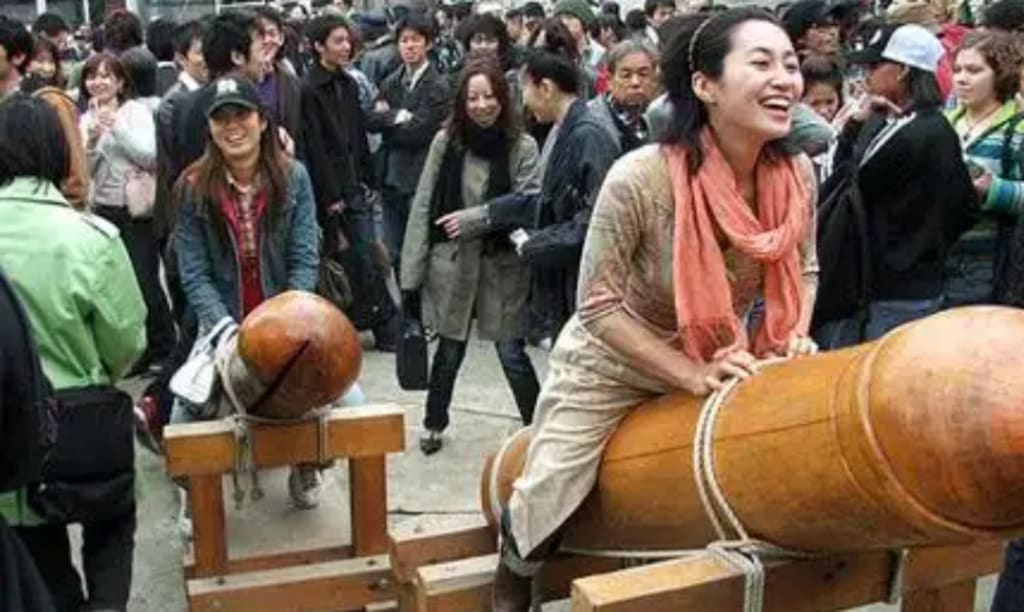
On the first Sunday of April each year, Kawasaki, Japan, transforms into a hub of activity for the Kanamara Matsuri, or Iron Phallus Festival. The streets buzz with an energy that's both infectious and unique, drawing crowds of locals and tourists alike. This festival is a cultural phenomenon, centered around a towering, bright-pink phallus sculpture that's paraded through the city's bustling streets. It's impossible not to be drawn in by the spectacle—a monument that stands tall and proud, capturing the attention of everyone in its path. The statue is encircled by layers of people: devotees with expressions of reverence, sightseers with cameras in hand, and parents holding up curious children whose wide eyes mirror the wonder of discovery.
The vendors, seizing the moment, set up stalls brimming with phallus-themed merchandise. There are candies molded into phallic shapes, sweet and colorful; vegetable carvings that showcase artistic skill and creativity; ice pops that offer a refreshing coolness; and even phone charms shaped like phalluses—quirky souvenirs that add a touch of humor to the occasion. These items, though unconventional, fit perfectly into the festival's lively atmosphere.
What's truly remarkable is how this seemingly bold display doesn't disrupt the festival's harmonious vibe. People weave through the crowds with smiles on their faces. For some, it's a deeply spiritual experience; for others, it's a chance to celebrate and have fun. In this environment, the phallus becomes more than just a symbol—it's a representation of health, strength, and fertility, a testament to the vitality of life itself.
This Japanese festival is just one example in a long history of phallus worship that spans across cultures and centuries. Ancient Greece's Dionysia festival was a lively celebration where phallus symbols were embraced as gifts from the gods, sources of joy and vitality. In Rome, the Venusia festival saw women making wishes at phallic shrines, hoping for prosperous marriages and healthy children. These historical parallels reveal a universal theme of reverence for the reproductive power that sustains life.
In early human societies, reproductive worship often focused on the female form. After all, it was the mother who gave birth, and so the female reproductive organs were celebrated as the cradle of life. However, as understanding grew, the focus began to shift. Men realized their essential role in reproduction, and the male phallus gradually rose to prominence, becoming a symbol of authority and power.
In primitive societies, women were selective in their choice of mates. They looked for signs of strength and vitality in men, traits that would ensure the health and survival of their offspring. To attract partners and pass on their genes, men would adorn their bodies, particularly their phalluses, in various ways. This practice was not just about attraction; it was also about protection. In an age when magic and ritual were integral to daily life, decorating the phallus was believed to ward off evil spirits and safeguard against misfortune. Thus, the phallus took on a sacred, religious significance, becoming a talisman for the prosperity and continuity of the community.
From a psychological perspective, Sigmund Freud offered his insights into phallus worship. He posited that children, in their early years, are unaware of gender differences. As they grow older and discover these distinctions, boys may experience "castration anxiety," while girls may develop "penis envy." According to Freud, this envy stems from cultural perceptions of male superiority rather than a literal desire for the phallus itself. This theory, however, has faced its share of criticism. Some scholars argue that girls' admiration for males may actually be a response to the social status and privileges often associated with men, rather than the phallus alone.
Despite the passage of time and the evolution of social norms, the male phallus continues to hold a place of importance in many men's minds. This focus on the phallus can be seen as an unconscious continuation of ancient traditions. In modern society, the phallus is more than just a body part—it has become a symbol of masculinity, potency, and identity.
From Japan's Kanamara Matsuri to ancient Greek and Roman festivals, the worship of the phallus has been a recurring theme throughout human history. It reflects our deep-seated reverence for the reproductive power that sustains life. The phallus, once a simple biological organ, has evolved into a powerful symbol of authority and strength. This evolution reveals the complexity of human psychology and the enduring influence of cultural attitudes toward masculinity.
About the Creator
Jane Li
A sharer of a beautiful life~
United States Hotel Market Size & Forecast 2025–2033: Experience-Driven Travel Fuels a New Era of Growth
United States Hotel Market Outlook The United States hotel market is poised for steady and resilient expansion, rising from US$ 255.33 billion in 2024 to US$ 422.10 billion by 2033, reflecting a compound annual growth rate (CAGR) of 5.76% during 2025–2033. Growth is being driven by strong domestic travel demand, rising interest in experience-based stays, continued investment in hotel development, and the digital transformation of guest services. As leisure and business travel stabilize across the country, hotels of all categories—from luxury resorts to economy motels—are benefiting from shifting traveler preferences and renewed mobility.
By Marthan Sir2 days ago in Filthy


Comments
There are no comments for this story
Be the first to respond and start the conversation.