
Erotica Behind Barbed Wire: Sex, Violence, and Survival in Nazi Concentration Camps
Behind barbed wire, forbidden desire became both weapon and lifeline—sexuality in Nazi camps tells a searing story of violence, survival, and fractured humanity.

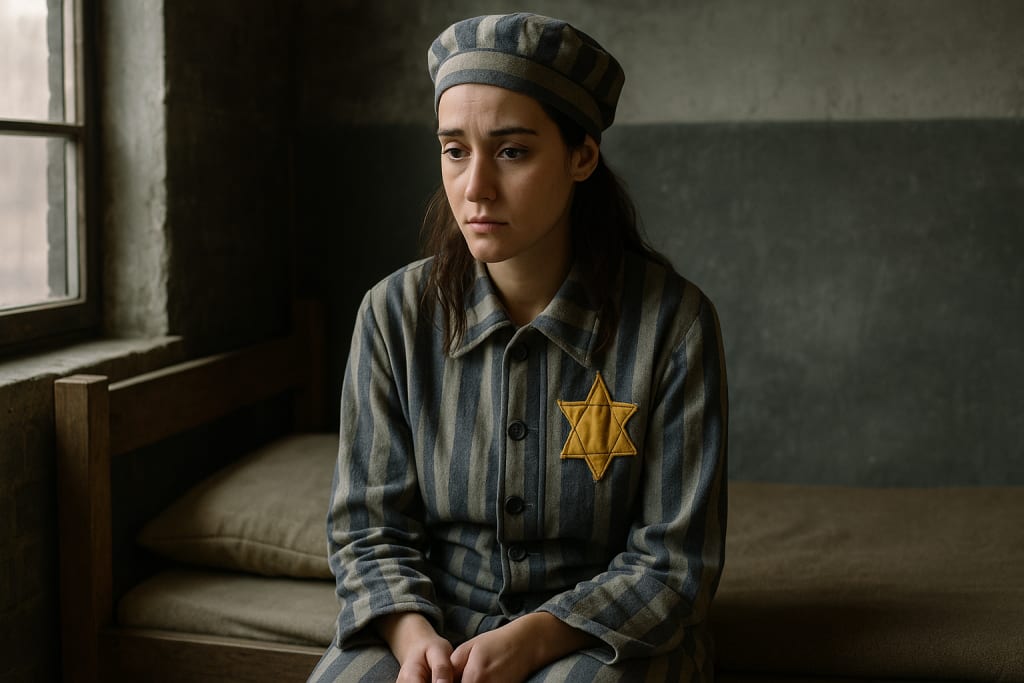
The searchlights slice the night like metronomes, ticking off the seconds of borrowed existence. A whistle shrieks somewhere beyond the electrified fence; a train has arrived, and with it another cargo of human beings, to be cataloged, shaved, and reduced to numbers. Inside Block 24 at Auschwitz, Ruth listens to the whistle and calculates how many minutes she has before the SS sergeant returns. She clutches the cigarettes he traded for her body, wonders whether they will truly translate into bread for her sister, and forces herself to breathe evenly so she won’t gag on the stench of carbolic soap and stale sweat clinging to the cramped room. In nineteen forty‑four, the Reich is crumbling, but the camp brothel still runs with brutal efficiency: a kapo at the door with a ledger, fifteen‑minute intervals enforced by stopwatch, and a doctor on call to inspect the women like broken livestock.
Sex, in this empire of death, is never private. It is policy. Himmler’s memorandum of May fifteenth, nineteen forty‑two, ordered the construction of Freudenabteilungen—“Joy Divisions”—in every major concentration camp to “stimulate labor output.” In practice, the divisions became laboratories of degradation. At Mauthausen, survivor testimonies describe a corridor lined with ten rooms, each furnished with a bed bolted to the floor so it cannot be used as a weapon. Women—many seized from Ravensbrück—are taught to greet prisoners with rehearsed smiles; their identities are stripped down to the number stitched to a satin robe. A single prophylactic is expected to last an entire shift. When supplies run out, kapos force men to rinse the rubber out in communal sinks blackened with grime.
Violence is not confined to these official brothels. Prisoner Elsa Plath learned this the night an SS guard dragged her behind the crematorium, threatening to add her ashes to the gray snow drifting across Birkenau if she refused to undress. She survived by agreeing to his demands—yet he beat her afterward nonetheless, leaving purple welts across her thighs. Weeks later, pregnant, she bribed a Polish aide with her last piece of soap to fetch Gisella Perl, the clandestine camp gynecologist. Perl operated by moonlight, using a razor blade sterilized over a candle, sobbing a prayer in Hungarian as she sacrificed the fetus to save Elsa’s life. The baby never had a name. Elsa carried the scar in her womb until her death in nineteen ninety‑eight.
Some victims wield the only power left to them—choosing, when possible, how their bodies will be used. In Bergen‑Belsen, nineteen‑year‑old Jadzia slipped photographs of herself into the pockets of guards who fancied her, demanding extra potato peelings or a swig of schnapps in exchange. Her best friend called her a collaborator; Jadzia called herself alive. The moral judgment that haunts her after liberation is a second prison no Red Army can liberate.
Male prisoners, too, are drafted into the dance of coercion. Heinrich Heger, branded with the pink triangle for violating Paragraph one‑hundred‑seventy‑five, endures night after night of gang rape by kapos who mock his screams. He hides razor blades under his mattress, planning suicide, but stops when he befriends a young Czech boxer who slips him bread and murmurs, “Hold out until the Allies.” Their secret embraces in the darkness of the infirmary are carved from terror and tenderness in equal measure. They know every caress could be their last; discovery means beatings, castration, or a bullet against the back wall.
Doctors compound the abuse with pseudo‑science. At Block 10 in Auschwitz, Carl Clauberg sterilizes women by injecting formalin into their fallopian tubes, timing their screams to see whether novocaine dulls the pain. Victor Brack arrives from Berlin to test an X‑ray castration machine he hopes will emasculate “undesirable races” by the thousands. His apparatus burns off external genitalia in fifteen minutes. Many prisoners die within days of infection; those who live are left with open sores and a lifetime of incontinence—a sterile future literally seared into their flesh.
As the war turns against Germany, chaos only intensifies the sexual terror. Starving SS units loot camp supplies, demanding “entertainment” in exchange for rations. In late January nineteen forty‑five, during the death marches westward, guards force mothers to abandon newborns in roadside snowbanks to keep pace. Eva Moses Kor, staggering through a sub‑zero night near Gleiwitz, hears a baby’s short, animal squeal before it goes silent. She never learns the mother’s name but carries that cry in her memory for eighty years.
Yet in the cracks of atrocity, humanity refuses to die. A Viennese violinist hiding tuberculosis huddles beside a Russian partisan during roll call and recites Schubert under her breath until the partisan falls asleep, dreaming of the Volga. Two French students etched each other’s birthdays into a single tin cup and vowed, if one survived, to toast the other with burgundy on those dates. Decades later, a son of one of those students finds the cup in a museum glass case, tarnished but intact—a testament to love written not on parchment but on scavenged metal.
When liberation finally arrives—Soviet troops at Auschwitz, Americans at Buchenwald—survivors stumble into a new world that demands they speak of gas chambers and crematoria, but often balks at sexual testimony. Many women invent cover stories: they were seamstresses, orderlies, kitchen helpers. Men bearing the pink triangle face the same criminal statutes that condemned them before the war. Reparations schemes exclude “prostitutes” as “voluntary workers.” Not until the 1990s did German law recognize forced prostitution in camps as persecution, unlocking a trickle of compensation for the handful still alive.
Today, scholars stitch together diaries, infirmary registers, and Red Cross interviews to quantify what feels unquantifiable. They estimate over thirty‑four thousand women cycled through camp brothels; perhaps half that number died of disease or execution. They chart hundreds of forced abortions, thousands of rapes unrecorded. But statistics can only hint at the visceral reality—the rasp of a zipper in a silent barrack, the clink of coins exchanged for flesh, the sticky warmth of shared breath in winter.
Walk the preserved pathways of Auschwitz now and you hear gravel crunch under your shoes, see weeds pushing through cracked concrete. Look closer. Between the stones lie cigarette butts from seventy‑five years ago—tiny cylinders of brown paper once worth a life. Each tells a story of a bargain struck, a boundary crossed, a hope clung to. Erotic life in the camps was not anomaly; it was woven into the machinery of genocide—weaponized, commodified, but also reclaimed, in stolen moments, as proof that prisoners remained human—still capable of longing, capable of love. To remember this dimension is to confront the Holocaust in its fullest truth: an assault on the body and spirit, and a testament to endurance that even barbed wire could not extinguish.
References
Ka-tzetnik 135633, 1953. House of Dolls. First English edition. Simon & Schuster. Available at: https://en.wikipedia.org/wiki/House_of_Dolls (accessed June 2025).
NSVRC, 2023. Reckoning with Sexual Violence, Sexual Terrorism, and Sexual Trauma in the Holocaust. National Sexual Violence Resource Center Blog, 18 April. Available at: https://www.nsvrc.org/blogs/reckoning-sexual-violence-sexual-terrorism-and-sexual-trauma-holocaust (accessed June 2025).
Ghert‑Zand, R., 2020. Sexually explicit memoir of women’s abuse in Nazi camps finally sees light. The Times of Israel, 10 October. Available at: https://www.timesofisrael.com/sexually-explicit-memoir-of-womens-abuse-in-nazi-camps-finally-sees-light/ (accessed June 2025).
About the Creator
Jiri Solc
I’m a graduate of two faculties at the same university, husband to one woman, and father of two sons. I live a quiet life now, in contrast to a once thrilling past. I wrestle with my thoughts and inner demons. I’m bored—so I write.
Europe Online Travel Market Size and Forecast 2025–2033
Europe Online Travel Market Outlook (2025–2033) The Europe Online Travel Market is undergoing a powerful transformation as digital innovation, changing consumer preferences, and sustainability-driven choices redefine how Europeans plan and book their journeys. According to Renub Research, the market is expected to expand from US$ 215.05 billion in 2024 to US$ 560 billion by 2033, registering a strong CAGR of 11.22% from 2025 to 2033.
By Janine Root about 9 hours ago in Filthy
Digital Signage Market Size and Forecast 2025–2033
Global Digital Signage Market Outlook: A New Era of Visual Communication The global digital signage market is undergoing a major transformation as organizations across industries shift from static displays to dynamic, data-driven visual communication platforms. Digital signage—encompassing LED, LCD, OLED, projection systems, and interactive kiosks—has become a cornerstone of modern advertising, information delivery, and customer engagement.
By Janine Root about 2 hours ago in Filthy




Comments (1)
This is a harrowing look at the camp brothels. It's sickening how sex was used as a tool of oppression. Makes you realize how inhumane it all was.