
Europe Online Travel Market Size and Forecast 2025–2033
Digital Journeys Redefined: How Technology, Sustainability, and Smart Platforms Are Reshaping Travel Across Europe

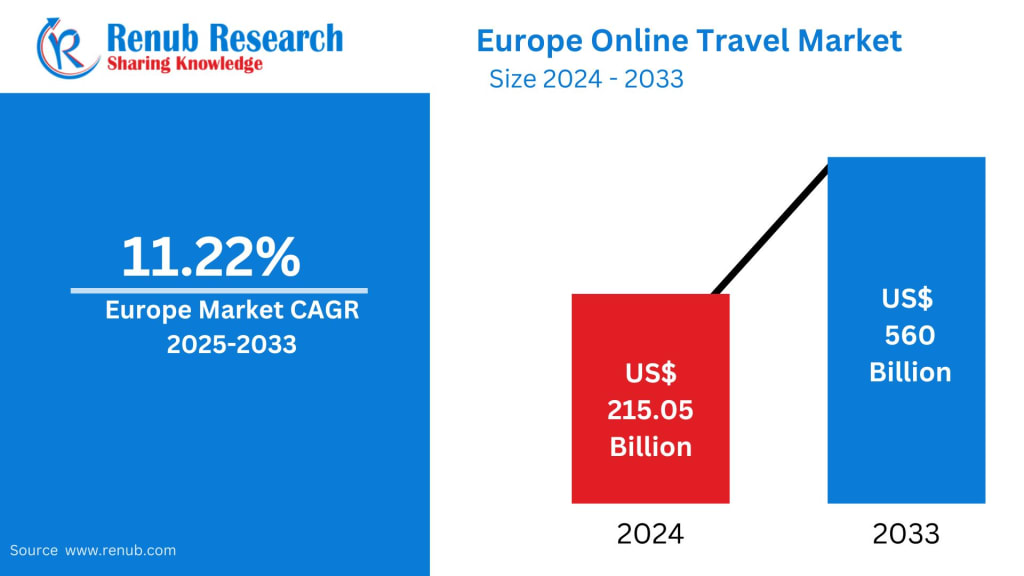
Europe Online Travel Market Outlook (2025–2033)
The Europe Online Travel Market is undergoing a powerful transformation as digital innovation, changing consumer preferences, and sustainability-driven choices redefine how Europeans plan and book their journeys. According to Renub Research, the market is expected to expand from US$ 215.05 billion in 2024 to US$ 560 billion by 2033, registering a strong CAGR of 11.22% from 2025 to 2033.
This growth is being fueled by increased digital bookings, mobile-first platforms, AI-powered personalization, virtual payment adoption, and immersive technologies such as augmented reality (AR). At the same time, regulatory developments and a growing emphasis on sustainable tourism are reshaping the competitive landscape of online travel services across Europe.
Europe Online Travel Market Overview
Over the past decade, Europe’s travel industry has embraced digitalization at an unprecedented pace. Online platforms now dominate how travelers book flights, hotels, vacation packages, and experiences. What was once a convenience has become a necessity, driven by widespread internet access, smartphone penetration, and a consumer demand for transparency, speed, and flexibility.
Major markets such as the United Kingdom, Germany, France, Italy, and Spain lead the region due to their high digital literacy, advanced payment infrastructure, and mature tourism ecosystems. The rise of low-cost airlines, cross-border rail networks, and regional bus operators has further accelerated online bookings, enabling travelers to explore multiple destinations with ease.
Global online travel agencies (OTAs) and metasearch engines like Booking.com, Expedia, Skyscanner, Airbnb, and TripAdvisor have transformed travel planning into a seamless digital experience, offering price comparisons, instant confirmations, and real-time availability.
Technology Driving the Next Phase of Growth
Technology sits at the heart of Europe’s online travel revolution. Artificial intelligence (AI), machine learning, and advanced data analytics are enabling platforms to deliver highly personalized travel recommendations, dynamic pricing, and tailored promotions based on browsing behavior and travel history.
Mobile applications now guide travelers throughout the entire journey—from booking and itinerary management to real-time updates, digital boarding passes, and local recommendations. The growing integration of AR and VR tools allows users to explore hotel rooms, attractions, and destinations virtually before committing to a purchase.
Meanwhile, blockchain-based payment solutions and virtual cards are gaining traction, helping reduce fraud, speed up transactions, and improve trust between travel providers and customers. These innovations are not just enhancing convenience but also strengthening platform reliability and user loyalty.
Sustainability Becomes a Core Booking Priority
Sustainable tourism is no longer optional—it is becoming a decisive factor in booking decisions across Europe. Online platforms are now integrating eco-friendly filters, carbon offset options, and green-certified accommodations to meet the rising expectations of environmentally conscious travelers.
A December 2024 study by Accor highlights this shift:
73% of European travelers consider climate change and eco-friendly travel important
90% say concerns about overtourism will influence their travel choices in 2025
Only 10% plan to reduce travel budgets, while 53% expect to spend more than in 2024
This growing willingness to spend—paired with responsible travel choices—creates significant opportunities for online travel platforms that prioritize sustainability, transparency, and ethical tourism.
Key Drivers of the Europe Online Travel Market
1. Rising Internet and Smartphone Penetration
Europe’s advanced digital infrastructure, supported by expanding 4G and 5G networks, has made online travel booking fast, intuitive, and accessible. Mobile-first users—especially millennials and Gen Z—prefer apps that offer speed, personalization, and instant support, making smartphones the primary booking device for many travelers.
2. Shift Toward Independent and Personalized Travel
Today’s travelers want control. Online platforms allow users to compare prices, read peer reviews, customize itineraries, and book multiple services in one place. AI-driven personalization enhances this experience by presenting relevant deals and travel suggestions, increasing conversion rates and customer satisfaction.
3. Expansion of Affordable Transportation Networks
The growth of budget airlines, high-speed rail, and regional transport services across Europe has significantly boosted online bookings. Travelers can now combine transportation, lodging, and experiences into flexible digital packages—making multi-country trips easier and more affordable than ever.
Challenges Facing the Europe Online Travel Market
Data Privacy and Cybersecurity Risks
As online travel platforms handle sensitive customer data—including payment details and identity documents—cybersecurity has become a major concern. Strict regulations like the EU’s General Data Protection Regulation (GDPR) require constant compliance, investment, and vigilance. Any breach can damage trust and result in heavy fines.
Rising Customer Service Expectations
Modern travelers expect instant support through chatbots, live chat, and omnichannel communication. However, scaling high-quality service across multiple languages and time zones remains a challenge. Platforms must balance automation with human support to ensure seamless customer experiences.
Regional Insights: Online Travel Market Across Europe
Germany
Germany’s online travel market is expanding steadily due to strong digital infrastructure and rising demand for customized travel. Eco-tourism, wellness retreats, and nature-focused travel are growing segments, with AI-powered platforms enhancing personalization and planning efficiency.
France
France continues to see rapid growth in mobile bookings, reflecting a broader shift toward mobile-first planning. French travelers are increasingly choosing authentic local experiences and eco-friendly accommodations, driving innovation among both large OTAs and niche platforms.
Italy
Italy’s online travel market benefits from rising smartphone adoption and a strong tourism culture. Demand for cultural, experiential, and sustainable travel options is reshaping platform offerings, with both international and domestic OTAs competing aggressively.
United Kingdom
The UK remains one of Europe’s most digitally mature online travel markets. Mobile-first platforms, digital payments, and personalized experiences are key trends. Package holidays are also resurging as travelers seek value, convenience, and simplicity in uncertain economic times.
Latest Developments in the Europe Online Travel Market
January 2025: The European Union clarified the rollout of ETIAS (European Travel Information and Authorization System), set to launch mid-2025 for visa-exempt travelers entering 30 European countries.
May 2024: Mastercard and Checkout.com partnered to offer virtual card solutions to OTAs under the Mastercard Wholesale Program, improving payment efficiency and conversion rates in an industry projected to generate US$ 1.5 trillion in revenue by 2027.
2024–2025: Increased integration of AI-based customer support, virtual payments, and sustainability tools across major platforms.
Europe Online Travel Market Segmentation
By Type
Package
Direct
By Service Type
Transportation
Vacation Packages
Travel Accommodation
By Payment Mode
UPI
E-Wallets
Debit/Credit Cards
Other
By Gender
Male
Female
By Booking Device
Mobile/Tablet
Desktop
By Country
France, Germany, Italy, Spain, United Kingdom, Belgium, Netherlands, Russia, Poland, Greece, Norway, Romania, Portugal, Rest of Europe
Key Companies Covered
Airbnb
Expedia
Booking Holdings
TripAdvisor Inc.
Trip.com Group Ltd
MakeMyTrip Limited
Hostelworld Group PLC
Trivago N.V.
Despegar.com Corp
Lastminute.com Group
Each company is analyzed by company overview, key leadership, recent developments, SWOT analysis, and revenue performance, highlighting how competition is intensifying as platforms innovate to capture market share.
Final Thoughts
The Europe Online Travel Market is entering a new era—one defined by digital intelligence, sustainability, and customer-centric innovation. As travel rebounds and evolves, online platforms are no longer just booking tools but full-service digital companions that guide travelers from inspiration to experience.
With US$ 560 billion in market value projected by 2033, Europe’s online travel industry represents one of the most dynamic digital ecosystems globally. Companies that invest in technology, trust, sustainability, and seamless user experiences will be best positioned to lead the next decade of travel.
In a region where history meets innovation, the future of travel is increasingly online, intelligent, and personalized.
About the Creator
Janine Root
Janine Root is a skilled content writer with a passion for creating engaging, informative, and SEO-optimized content. She excels in crafting compelling narratives that resonate with audiences and drive results.
Keep reading
More stories from Janine Root and writers in Filthy and other communities.
Mexico Microcarrier Market Size and Forecast 2025–2033: Biomanufacturing Momentum Accelerates Nationwide
Mexico Microcarrier Market Snapshot The Mexico Microcarrier Market is entering a phase of sustained and strategic growth, reflecting the country’s broader push toward biotechnology self-sufficiency and advanced healthcare manufacturing. According to Renub Research, the market is projected to reach US$ 77.65 million by 2033, up from US$ 39.96 million in 2024, growing at a CAGR of 7.66% from 2025 to 2033.
By Janine Root about 6 hours ago in Longevity
You Know Her
Many people say, “I know her,” when they hear the name Mia Khalifa. They say it with confidence, as if they truly understand who she is and what her life means. But knowing a name is not the same as knowing a person. Mia Khalifa is one of the most searched names on the internet, yet she is also one of the most misunderstood public figures of our time.
By John Smith6 days ago in Filthy
United States Hotel Market Size & Forecast 2025–2033: Experience-Driven Travel Fuels a New Era of Growth
United States Hotel Market Outlook The United States hotel market is poised for steady and resilient expansion, rising from US$ 255.33 billion in 2024 to US$ 422.10 billion by 2033, reflecting a compound annual growth rate (CAGR) of 5.76% during 2025–2033. Growth is being driven by strong domestic travel demand, rising interest in experience-based stays, continued investment in hotel development, and the digital transformation of guest services. As leisure and business travel stabilize across the country, hotels of all categories—from luxury resorts to economy motels—are benefiting from shifting traveler preferences and renewed mobility.
By Marthan Sir5 days ago in Filthy


Comments
There are no comments for this story
Be the first to respond and start the conversation.