
Aroused by the Weird: Why Our Brains Love Kinks
Subtitle: From feet to food play, neuroscience reveals how “WTF” desires are more normal than you think

So… You’re Turned On by Balloons? Cool. Let’s Talk About It.
You’re scrolling through the internet and stumble across someone who gets hot watching latex balloons pop.
Your first reaction might be, What the actual—?
Your second? Wait… why am I kinda intrigued?
Welcome to the strange, fascinating world of kinks—those oddly specific, wildly diverse, sometimes taboo arousals that make sex personal, psychological, and just a little bit spicy.
But here’s the truth: your brain is a playground, and what turns you on is often a mix of biology, psychology, and life experience—not depravity or deviance.
In fact, the question isn’t “Why are some people kinky?” It’s really:
“Why aren’t more people exploring it?”
Let’s unpack why your brain might love the weird, the taboo, and the wonderfully offbeat.
First: What Is a Kink?
A kink is any sexual interest or practice outside what’s considered “mainstream.” Think:
- Foot worship
- Impact play (e.g., spanking)
- Voyeurism or exhibitionism
- Roleplay (from teacher/student to alien/cow)
- Sensory fetishes (latex, silk, food, etc.)
It’s not necessarily about pain or submission. It’s about stimulus + context = arousal.
And if you think that sounds psychological… you’re right.
Your Brain Is Wired for Association
Here’s how it works:
- Arousal creates a powerful neurological “imprint.”
- If that arousal happens during or around a specific object, texture, power dynamic, or fantasy—it gets encoded as sexy.
- Boom. That thing = hot.
This is known as erotic conditioning. And it’s why some people get turned on by the smell of leather, the crack of a whip, or even cartoon characters (yeah, we see you, Lola Bunny fans).
Neuroscience Says Kinks Are Just Emotional Pathways
Kinks often form from:
- Early exposure to something stimulating (not necessarily sexual!)
- Power dynamics that feel emotionally intense
- Safe ways to process trauma or taboo feelings
- A desire for novelty (our brains love dopamine, and kinks deliver)
What feels “weird” is often just your brain’s creative solution to desire.
Fun Fact: The Brain Can’t Always Separate Pleasure from Context
This is why:
- Spanking can feel good (even though it “hurts”)
- Being told what to do can feel arousing (even though we love autonomy)
- Humiliation play can be erotic (even if we hate real shame)
The brain processes pain, arousal, fear, and excitement in overlapping regions.
It’s not that you “like” pain. You like the intensity. You like the control. You like what it symbolizes.
That’s deep. And sexy.
“But My Kink Is Too Weird…”
Let’s normalize a few:
- Feet? Very common. The brain’s sensory map for feet is right next to the one for genitals.
- Choking? Often about power and trust—not actual danger.
- Diaper play? Tied to regression, control, or taboo—not actual children (and no, it doesn’t mean someone’s broken).
- Clown kink? The exaggerated features, colors, surprise = sensory overload = arousal.
It’s not about what’s “normal.” It’s about what works for you in a consensual, safe, and satisfying way.
What Science Says About Kinky People
Fun fact: studies show that people who engage in kink tend to be:
- Less neurotic
- More open-minded
- More sexually satisfied
- Better communicators
- More emotionally attuned to partners
They also tend to negotiate boundaries, use safe words, and talk about consent way more than “vanilla” couples.
So if anything, kinksters might actually be healthier lovers.
Where Shame Comes In
A lot of kink shame is cultural, not logical. It comes from:
- Religious purity narratives
- Sex-negative education
- Pop culture ridicule
- Internet backlash
But guess what? If you’re not hurting anyone (non-consensually), and you’re playing with full consent—you’re doing great.
Shame is the kink killer. Curiosity is the lifeline.
Kinks Are a Roller Coaster for the Brain
Every kink has the potential to offer:
- Heightened intensity: Stronger orgasms, deeper emotional release
- Role flexibility: Escape from rigid identity roles (especially gendered ones)
- Fantasy expansion: Letting your imagination drive your pleasure
- Deep trust: Because good kink play requires communication
This isn’t just about freaky bedroom antics. It’s about intimacy, power, and self-knowledge.
The Kink Is Not What’s Weird—Denial Is
If your arousal lives in unexpected places, good.
You’re awake. You’re alive. You’re exploring.
Your kink might not be someone else’s cup of tea—but who cares? You're not brewing for them.
So if you’re turned on by latex, roleplay, or the idea of being gently degraded by a librarian in Victorian boots?
Lean in, friend. You’re in good (and sexy) company.
About the Creator
Keep reading
More stories from PrimeHorizon and writers in Filthy and other communities.
Early Breakups Often Lead To Stronger And Healthier Future Relationships
The act of breaking up early is devastating and it makes people feel that they are not worthy and that they may never love again. The first heart-break can be very severe as it is the failure of hope, dreams and expectations. The rejection and the realization of the fact that the relationship is not going to develop as planned can add to the pain of many. This emotional conflict, painful as it is, is an inseparable element of the process, as it stimulates self-reflection and emotional development. The exposure and working through of such emotions at a tender age may enable individuals to become resilient, which is important in ensuring that the relationship in future is healthy.
By Mark Hipster2 days ago in Filthy
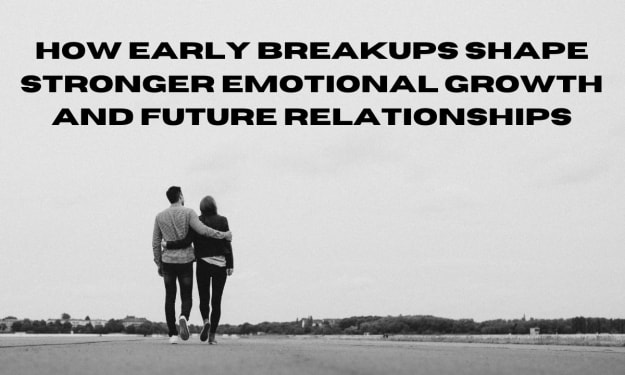
How Early Breakups Shape Stronger Emotional Growth And Future Relationships
Breaking up at an early age may seem like a big burden, which is even more terrifying when it is the first time one is involved in deep emotional connection. The relationships at a young age are full of emotions, dreams, and anticipations of the future by many people. In case those relationships break up, the emotional agony may be acute. Nevertheless, such experiences usually represent a significant moment in shaping a person. Early breakups are not, in most cases, symbols of loss, but of emotional realization.
By Mark Hipster3 days ago in Filthy



Comments
There are no comments for this story
Be the first to respond and start the conversation.