
Winter in a Box
An immortal, a broken machine, and the memory he can finally face

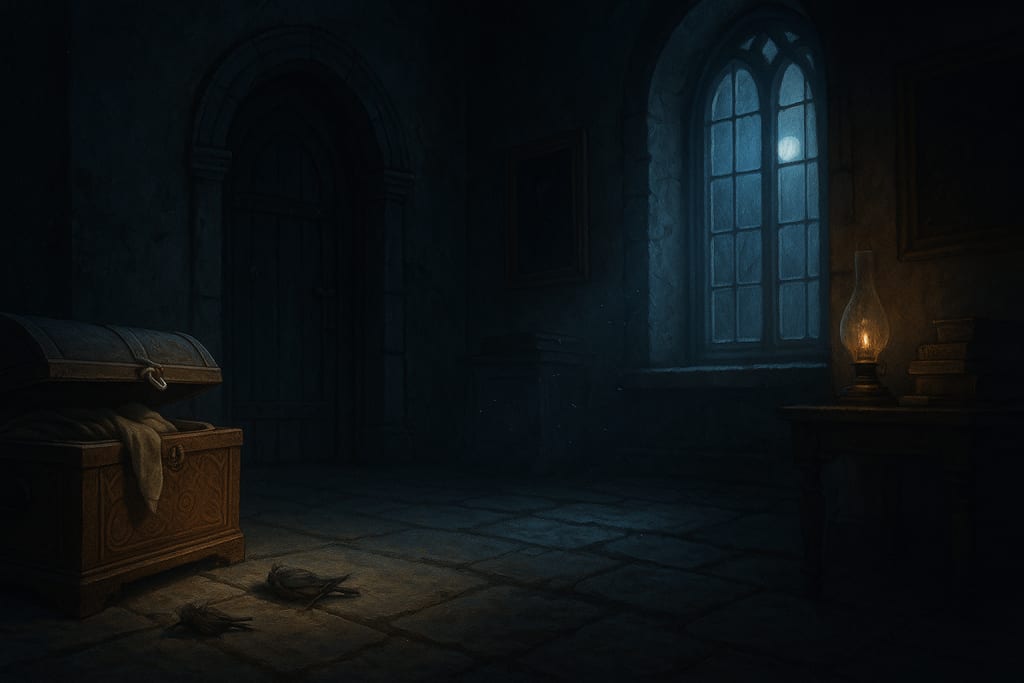
Sebastian is sitting in his favorite chair by the fireplace, reading yet another book. The tall castle windows are covered by thick curtains, and outside, the snow-covered ground softens the sound of the wind and reduces the pressing darkness.
This book is one of the few he hasn’t read endless times, for the simple reason that he just got it. Despite centuries passing since the invention of the printing press, books are still expensive, and the logistics of acquiring them aren’t exactly simplified by his reluctance to leave the castle.
The texture of the pages is still raw, and the smell of the leather binding is a touch too strong to neglect. Its content reads vaguely familiar, yet new, in the way most human stories do. Like the world outside: always shifting, rarely surprising.
A sudden metallic snap forces his attention - the fire? No, it came from the other side of the large room. A sharp sting of burned copper reaches him just as he turns his head and sees a faint trail of smoke curling from a copper coil, extending from the metallic husk of the invention he worked so long to complete.
“Winter in a box”, he calls it, but unlike the glass sphere you shake to create snow inside a miniature world, this one serves a darker yet life-sustaining purpose - keeping the blood fresh.
Although “life-sustaining” might technically not be the right term. It helps him store blood, so he doesn’t have to hunt for fresh blood every other night. It was a life-changing invention once he got it working.
He rises from the chair and walks towards it, brows furrowed as he gets closer and realises the severity. Whatever happened, the silence is telling. The machine is dead. And unlike him, that means it cannot serve its purpose anymore.
He reaches out his hand to gently open the door on the metal box, and a little mist of cold seeps out. The blood sits in glass vials. Still cold, but it won’t last unless he can fix it.
He grabs one of them, closes the door, and takes a sip. Despite its cold temperature, it feels like warmth running down his throat. It tingles.
He licks his lips as the thought comes to him:
“Edmund mentioned something… A fuser, fusage, fuse…? Something like that. In the basement.”
When the lights go out, check the fuse.
He wasn’t using the lights, though. His eyes didn’t particularly need them to navigate the castle. In fact, he found the whirring sound they made annoying. And the few neighbours had stopped making unsolicited visitations since he stopped having them on.
Maybe the darkness made them assume the castle was empty?
Finishing the vial, he walks to the nearest wall and flips the switch, turning his sight down, preparing for the sharp light from the lamp in the ceiling to turn on.
There’s a loud click, but no lights.
Edmund left notes in his study. Sebastian hasn’t been there in… How long has it been? A decade? A century?
No, he’s fairly certain the neighbour who knocked on his door is the same one he saw alive just a few nights ago. Thus, it cannot yet be a century.
Time gets odd when you stop participating in it.
He puts the empty vial on the small table next to his chair. Walking out into the hallway, he heads towards the study but stops abruptly as the door appears at the end of the corridor.
The study is locked.
The heavy wooden door has an old metal lock that fits a heavy metal key. There’s dust on the floor and no footprints, a reminder of how long it’s been since someone last entered.
He hasn’t been there since before Edmund left him alone with the castle. It somehow felt wrong without his permission. Not that he would mind. He is dead after all.
Sebastian could force it open, but that feels even more wrong than entering without permission. A violation of their friendship. Without absolute necessity, it’s not an act he can afford himself.
He hates that he can’t quite remember the instructions Edmund gave him for the door — not because they were complicated, but because he has avoided thinking about them. Avoiding thinking about Edmund overall, he realises, now that the topic faces him.
***
Then, as now, it was winter. Not a harsh one, but wet, dark, and depressing. Moisture would creep inside the castle, dampen materials, and worsen Edmund’s coughing.
They had been working on the early prototype for months. Copper pipes lay everywhere. It had a rotating heat source. Wooden housing.
Unlike Sebastian’s solemn demeanour, Edmund would choose a laugh as a joint of pipe came loose and sprang a hissing sound.
“Careful, it might provoke the Meister!”
‘The Meister’ was the house cat. A grumpy old black and white cat, known for leaving dead mice and birds as a gift for Sebastian.
The Meister watched them from sitting in the doorway, tail wrapped around his paws, judging everything.
Edmund always seemed to think silly frustrations were best met with a joke.
Despite his smile, his sickness was unmistakable and relentless.
It clearly ate at him.
Only barely visible at first. A swallow that took too long. A hand tightening on the stool. A breath he never quite finished.
Then it worsened.
Chunks of hair fell out. The color of his skin turned pale.
“The physician said I’m dying. And soon.”
Uncomfortable with the seriousness of the conversation, the lack of a joke, and no hint of a smile, Sebastian had struggled with a response appropriate for the situation.
He had nodded, and more didn’t need to be said.
Sebastian, unlike Edmund, knew too well what dying looked like.
He didn’t have the heart to share the details.
Instead, their focus on their project had intensified. The way men like them show affection through action rather than words.
One day, though, the unspoken became the spoken, as Edmund couldn’t resist asking.
“Sebastian, are you truly immortal?”
“Unless I forgot to die, it would truly seem so.”
He coughed again, holding his handkerchief to his mouth and taking a seat on a stool.
The raindrops outside hit against the window, slowly navigating their way down the glass, as if racing to be the first to add to decades of built-up rust on the windowsill.
They both returned their eyes to the mess on the table, but Edmund insisted with yet another question.
“Can you somehow… Give it to me?”
The light smile turned painful as Sebastian looked down with a sigh, and then back at him, while searching in his mind for words to explain the depth of agony the question awoke.
As their eyes met, he saw the terror in Edmund’s. The smile was gone.
Looking around him, as if hoping to find an answer lying on the table, Sebastian grabbed a pipe, holding and studying it.
“You don’t know what you are asking for.”
Since they first met, Edmund had gradually learned how Sebastian sustains himself.
That he could only experience the night.
That he had lost everyone he ever loved. Yet the turning itself — that part was too painful to mention.
Edmund’s gaze was unfocused as he turned his face away.
His hands folded, lightly trembling.
“I… I don’t want to die.”
The silence lay heavy between them.
Sebastian put the pipe down.
Uncomfortable, he walked out of the room. Not angry, gentle. As if stepping too hard would break both of their hearts.
And the rain kept tapping the window. The wind whistled outside.
The days passed, and they kept working on the machine. Through coughing fits and the occasional dark joke.
Edmund’s handwriting in the notebook grew shaky.
He gave Sebastian the idea for the final assembly, yet never got to see the machine in its complete form.
As so many others before him, he passed and left Sebastian alone.
The last mortal he had allowed himself to feel love for.
The machine wasn’t meant to last centuries.
The friendship wasn’t meant to end so early.
From the taste of iron, the memory returns to him — he sealed the room himself. Turned the key in the rusted lock and put it away.
He sealed it — not out of reverence, but from grief that grew too inconvenient to face. He had put the key in the chest of Edmund’s belongings in the master bedroom. Another room he never had reason to visit, as sleep was one of those mortal habits he long left behind.
With measured steps, Sebastian started walking towards the bedroom.
***
Through the cold hallway on the upper floor, Sebastian walks toward the room he has avoided for decades. The air is still and dusty; the floorboards creak.
He pushes the door open slowly, and it gives a complaining sound.
The moon shines in through the window. Unlike the ones downstairs, this one is not covered by thick curtains.
As he enters, the room breathes quietly, not in dread, but in anticipation.
A decorated chest sits below the window, and Sebastian opens the lid gently.
Inside lies the coat Edmund wore in the winter. Folded neatly, as if waiting for his return.
The embroidered handkerchief lies next to it. The fabric no longer remembers Edmund. But he does.
And lastly, some letters that once held importance.
Sebastian lifts the stack of letters, and beneath them lies the key. Rusted, but intact.
He grabs it tenderly.
Giving the contents of the chest another look, he then closes the lid as carefully as he lifted it. As if a sudden noise could break the peace of the room.
Standing up again, he looks around the room. Everything sits in its place, undisturbed.
Except, there’s something on the threshold.
Is that — a dead bird?
He hunches down, indeed — a small bird lies in the dust, along with some strands of black hair.
How long it has rested there, he cannot say.
“Don’t provoke the Meister…” Sebastian mumbles to himself as he gently closes the door.
He walks back through the corridor, down the stairs, and returns to the door of the study.
The key fits.
The lock is rusty and first resists, but then gives with a tired groan.
As the door opens, dust swirls in the air, and the distinct but faint smell of old paper, ink, and iron meets him.
Like an old scar he almost forgot he had, everything sits where he expects it.
Exactly as Edmund left it.
The desk with books and papers, neatly stacked but in an order only he knew how to organise. A notebook lies open, with empty pages still left.
A cup of tea, he never finished. Its content dried long ago.
A candelabrum half-burned.
It feels like the room demands he come back and continue his work, but he won’t.
Sebastian’s fingers trace the notebook, and he turns the pages, searching for the notes on the electrical wiring, the fuse, and a hand-drawn chart explaining them.
Turning the pages, he suddenly stops.
A surprised smile appears.
On the page is the distinct and unmistakable pawprint of a cat. It interrupts the notes of familiar shaky handwriting. Lifting the notebook, he squints his eyes and turns the page.
On the next page is the final assembly sketch along with notes in the margins.
As well as a tiny illustration of what is clearly a cat and a dead mouse.
“Fear the Meister, bringer of gifts,” is scribbled underneath.
A small, involuntary laugh slips out.
With the notes recovered, Sebastian next finds his way to the panel, tracing the cables along the wall. Copper cables with woven fabric that follows a complex pattern, mirrored by some of the drawings in the notebook. They seem intact. The fuse is not.
He manages to replace it.
From a distance, he hears the hum of the freezing machine coming back to life, along with the lights of the electric candelabra hanging from the ceiling.
He nods to himself in satisfaction and returns to the library.
Just to make sure, he walks up to the machine and opens the cabinet door.
A sudden hiss escapes from behind, and without hesitation, he says,
“Careful — you might provoke the Meister.”
For the first time in a long time, a smile returns to his lips. He shuts the door, satisfied.
A slight itch forces him to return to the study. He doesn’t reseal it.
He leaves the key in the lock.
He pauses in the doorway.
He can face the memory now.
Maybe he will return tomorrow.
Or next winter.
But the barrier is gone.
In the library, the Winter in a Box hums with renewed virility. The light flickers, but only a little. Sebastian takes his seat once again in his favorite chair and continues to read his new book.
About the Creator
Alessa Fen
Gothic fiction with emotional depth, dry humor, and a taste for the absurd. I explore where memory lingers and immortality complicates everything.
Keep reading
More stories from Alessa Fen and writers in Fiction and other communities.
Must Not Antagonize the Barn Owl
Part I — The Decision Sebastian wandered the castle yard with the solemn determination of a man retracing a thought he had misplaced somewhere between the herb garden and the east parapet. He knew it had been a good thought — promising, even — but then the statue in the center of the yard had leaned at him. Not metaphorically. Physically. Several degrees off true north, as if making an editorial comment.
By Alessa Fen2 months ago in Fiction


Comments
There are no comments for this story
Be the first to respond and start the conversation.