
Must Not Antagonize the Barn Owl
How a Barefoot Nobleman Accidentally Hired a Legacy

Part I — The Decision
Sebastian wandered the castle yard with the solemn determination of a man retracing a thought he had misplaced somewhere between the herb garden and the east parapet. He knew it had been a good thought — promising, even — but then the statue in the center of the yard had leaned at him. Not metaphorically. Physically. Several degrees off true north, as if making an editorial comment.
Naturally, he had gone to fetch the lever to correct it.
This took some time, since the castle was large, the closets were numerous, and past-Sebastian, in his infinite and short-lived brilliance, had labeled one of them “For When I Need This Again,” without specifying what this referred to. Eventually, he found the lever, rust-coated and deeply offended by the concept of usefulness.
It broke halfway through the attempt.
Old iron rusts; medieval iron sulks and collapses. The statue remained crooked, and Sebastian’s original idea — the good one — dissolved somewhere behind his eyes like mist. He stood there for a long moment, hands on the remains of the lever, waiting for the idea to come back out of pity.
It didn’t. Ideas almost never did.
He sighed and turned toward the castle gate. Halfway there, he stopped so abruptly that a bird, startled, abandoned the buttress it had been perched on. This was where he’d been walking when the idea had vanished.
He looked around the yard for clues, scanning the stonework like a detective in a very poorly funded Gothic mystery.
And then he saw it.
A parchment nailed to the inside of the gate, fluttering as if trying to flee the nail’s commitment. His own handwriting — unmistakable, looping, slightly exasperated with itself.
"HELP WANTED"
Ah. That was it. He had been looking for help. He stepped closer, studying the sign as if encountering it for the first time. He had written it, apparently. Interesting, sensible — evidence the idea must have been exceptionally good to survive all the way to parchment.
Someone to help keep the castle livable, or at least persuasive in its stubborn refusal to collapse. Someone who knew where tools went. Someone who might stop him from storing levers in closets whose original purpose no one remembered.
And maybe, a little company at times. The castle had always felt too large for one man — but only since Edmund’s absence had it begun to feel like it noticed.
He nodded to himself, reassured by the fact that even if he did not recall the initial reasoning, the outcome remained reasonable. Although apparently, not many applicants had turned up to apply. Certainly, a more persuasive notice was in order.
For a moment, the yard seemed to hold its breath, as if awaiting his verdict. In the background, an owl gave a hollow hoot. The wind tugged at the edges of the notice, as though encouraging him to get on with it. He straightened, squared his shoulders, and headed for the study.
This required paperwork.
With a long inhale — as if fortifying himself against the blank page — he pushed open the door to the study, feeling the damp chill of cold flagstones underfoot. The cold stone had never bothered him; shoes always had.
The grand oak desk regarded him with the judgment of centuries. The candles flickered with the specific look candles give a man who hasn’t successfully completed documents like these in three decades.
He sat, steadied his hand, and dipped the quill.
“Night Steward Wanted,” he wrote, and the parchment relaxed. Words made the parchment less threatening.
“Must not startle easily.”
“Familiarity with medieval plumbing preferred,” he added, deciding that honesty was kinder than surprise.
“Well organized; able to maintain consistent storage for levers and other tools.”
He sat back, considering whether this was enough to attract competent help. Maybe he should add a line about salary. He suspected that admitting he lived alone with only a barn owl as occasional company might reduce the applicant pool.
He added:
“Must not antagonize the resident barn owl.”
Still… help. That had been the thought. A simple one, but for once it still felt correct. He dipped the quill again.
“Additional duties may include occasional…”
He paused, searching for the word.
“…events.”
He considered elaborating, then decided ambiguity was safer for all involved. That would do. Anyone deterred by ambiguity was probably not cut out for this environment anyway. He hoped the next applicant could read his handwriting. That alone would narrow the field considerably.
PART II — The Neighbor Incident
Sebastian knocked on the door. Politely, but firm. It was midnight, of course, but there was a small chance the neighbor had not yet retired. People sometimes stayed awake later than they admitted. He waited a moment. Nothing stirred.
He knocked again, louder this time. The kind of knock meant to be helpful. A scream erupted from inside, followed by frantic barking. A window above him crashed open, and a voice shouted:
“Go away!”
Sebastian stepped back and looked up, startled by the intensity.
“Apologies,” he said, because it seemed like the right thing to offer when someone was clearly overwhelmed. He cleared his throat, trying again. “I merely require your neighborly advice on hiring matters!”
There was a brief, stunned silence — the kind that suggested the neighbor was rapidly reconsidering the nature of reality. Then, louder:
“Go to the inn! They’ll… take work notices!”
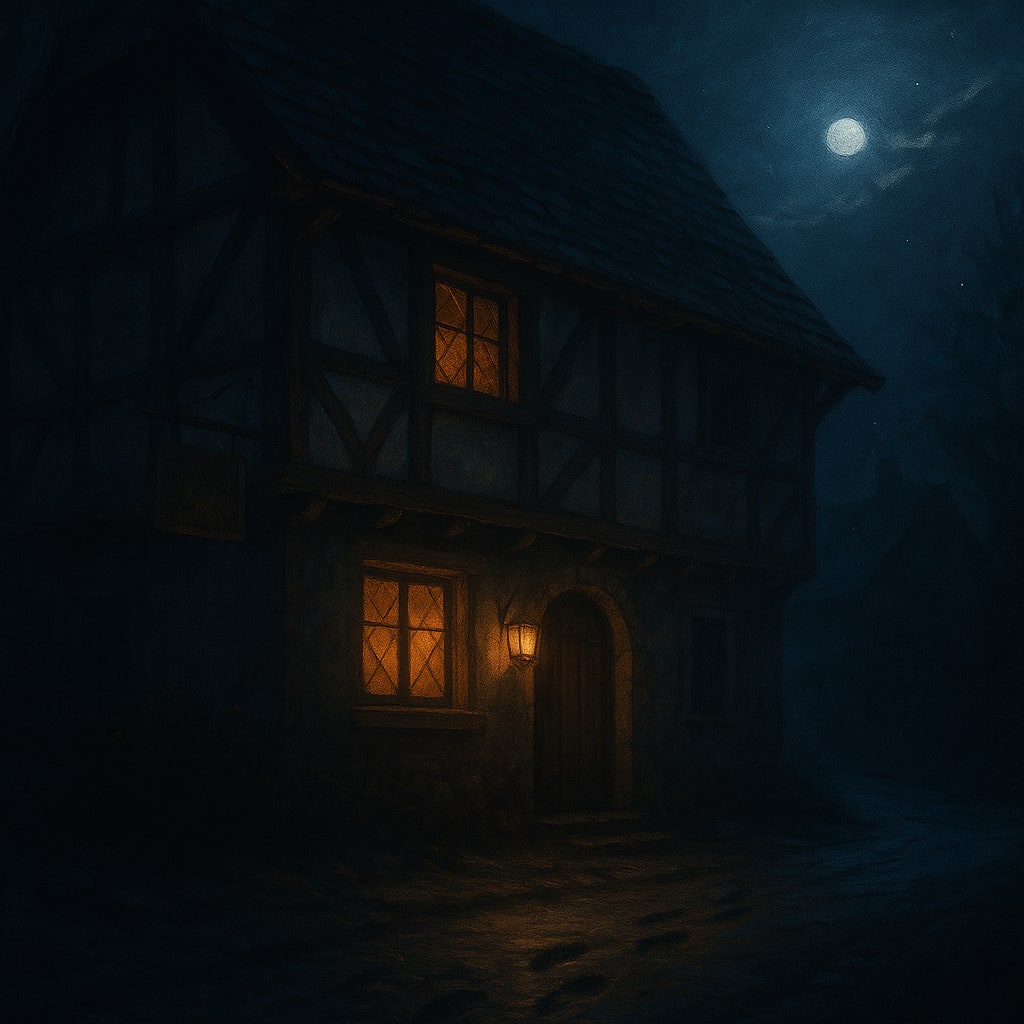
The window slammed shut so decisively that even the dog stopped barking. Sebastian considered the advice. It was, in fact, sensible. He looked around the quiet road, nodded to himself, and turned toward the village. He would go to the inn. They seemed awake. His sharp eyes could see light from the window of the inn in the distance, at the edge of the village. He held the rolled-up parchment under his arm as he walked down the road, humming a tune he couldn’t remember where he had first heard.
Two horses stood tethered by the entrance, and the damped sound of voices met him just slightly after the smell of the people they came from.
PART III — The Inn, and the First Ancestor
The inn was almost empty. At the far end of the room, the fire was dying. A couple of men sat at a table and discussed something, but he could tell from their slurring voices that the conversation was nearing its end. Not because they had run out of arguments as much as energy. A woman in her 20s was wiping off the tables, seemingly preparing to close. She looked up at Sebastian as he entered.
“We’re closing, sir.”
“But yet you’re not,” he replied with a smile as he nodded at his hand holding the door handle. She didn’t seem humored and walked over to the men at the table.
“Time to leave, good sirs. It is past midnight. Surely your wives are eagerly waiting for your returns.”
The irony in her voice stung, but the men seemingly did not care. Rising from their chairs, they followed her instructions and walked, or waddled, towards the door.
Sebastian stepped aside, letting them pass with a friendly smile. One of them looked down at his bare feet and scoffed as he passed. The young woman wiped off the last table with a firm hand and glanced at Sebastian again. She was wearing a green dress, her hair in a bun, and an apron tied around her waist.
“Did you lose your boots, sir?”
Sebastian looked down, losing his smile for a moment, before looking back at her with a new attempt at a friendly face.
“I am hiring help,” he said in a voice of conviction.
“Clearly needed,” she stated with a nod, and put the rag on the counter.
He handed her the notice. She lifted an eyebrow, and after a second of hesitation, she walked up to him and took the notice. As she unrolled it, realizing it was written on old parchment, she gave him another look of suspicion before reading its content in a whisper. The one eyebrow remained lifted, and she looked up at him again with a look of disbelief.
“May I put it on the wall, for the common man to consider?” he asked, in the tone he reserved for statements he hoped sounded convincing.
She lowered the parchment and responded with a question.
“How much work is it?”
He paused and thought of what would be the most fitting response.
“A respectable amount. Definitely enough,” he said, summoning the tone he used for statements that might not survive scrutiny.
She looked at him with her eyes squinting, as if to discern if he was of sound mind or trying to make fun of her. Neither, she concluded, put the parchment on the counter and gazed briefly at the room to assess if it was ready for closing.
“Sir, you need to leave now. I must close, and you are standing in my way.”
Sebastian grabbed the parchment from the counter and backed gently out the door. He turned it in his hands, not entirely certain if the conversation had moved in his favor or not.
“It is well paid,” he said, attempting another gentle smile.
“How well?”
He paused as he realized he had not kept up with the standards of wages for several decades.
“One gulden per week. Not more than two!”
Her eyes widened in disbelief.
“Two?!”
“Well, three then, but that is my final offer!”
The young woman swallowed again, her gaze fixed on him as though he were a puzzle with too many missing pieces.
“Three gulden,” she repeated, almost whispering it, as if speaking too loudly might cause the offer to vanish like mist.
Sebastian nodded, relieved she had understood the number correctly. Numbers, unlike people, were dependable.
“I can pay in advance,” he added helpfully.
Her expression flickered — alarm, suspicion, then something quieter. Curiosity, perhaps. Or pity. She glanced toward the dead hearth, then the empty tables, then at her own hands, red from scrubbing.
“Sir,” she said slowly, “what exactly would I be doing?”
Sebastian opened his mouth confidently, then realized he had no real answer beyond 'everything Edmund used to do'. He hesitated, surprised at the ache that accompanied the name.
“You would… keep things in their places,” he said at last. “And remind me where those places are.”
That startled her into a small laugh. Not unkind — more like something loosening inside her.
“And,” he added, softer, “the castle feels very large lately.”
She studied him for a long moment. A barefoot young nobleman who didn’t seem to notice the cold. A sign written in handwriting that looked dangerously close to despair. His eyes reflected the dim light like a cat’s, but they were friendly.
“Three gulden a week,” she murmured again.
“That’s more than the miller makes in a month.”
Sebastian blinked. “Is it?”
“Yes,” she said. “It is.”
He waited, not sure what the appropriate next step was. He hoped it didn’t involve knocking loudly on anything. Finally, she let out a breath and nodded to herself, making a decision she couldn’t quite explain.
“I’ll take the job,” she said quietly.
His smile broadened, and a look of relief spread across his face, as a small, unfamiliar warmth spread inside him. Like the first glow of a candle after a long night. Something in his posture straightened, as though a thread had been pulled taut again after hanging slack.
“Wonderful,” he said, meaning it with more sincerity than he expected.
She closed the door behind them and turned the key in the lock.
“What is your name, sir?” she asked.
He thought for a brief moment of the most appropriate title to use, but decided to keep it simple.
“Sebastian. Just Sebastian.”
She nodded.
“Liesel,” she said. “Liesel Sauer.”
A name that would one day become Hofmann. A name that would outlive them both.
“Shall I come in the morning?” she asked.
“Yes,” Sebastian said.
And for the first time since Edmund’s death, morning sounded like a thing worth expecting.
PART IV — The Choice
As they departed in their different ways, Liesel walked down the street in the direction of her home, the village smithy. She felt the cold night wrap around her. The wind whipped through the trees, carrying the metallic tang of the forge long before she reached the small house beside it. The fire in the smithy still glowed through the open doorway. Of course, her father was awake.
Jakob Sauer stood at the anvil, sleeves rolled, hammer in hand, shaping a dull-red horseshoe with the patience of a man who had learned to outrun grief by never stopping. He didn’t look up when she entered. He never looked up first.
“You’re late,” he said.
“I had cause,” she replied.
He quenched the iron with a hiss. “Bad cause?”
She hesitated. “Strange cause.”
He finally lifted his gaze, one brow raised in the way that meant ‘speak plainly’.
“There’s a man up at the castle,” she said. “A… young nobleman. Barefoot. Polite. Possibly touched in the head.”
Jakob grunted. That narrowed nothing.
“He offered me work,” she continued. “Real work. Steward’s work. Cleaning, managing, and repairing. Keeping things in their places.”
Jakob snorted. “That place needs ten men just to keep the mice honest.”
“I know,” she said. “But he offered… three gulden a week.”
Jakob froze. Not with anger — with calculation.
“No one pays that,” he said quietly.
“I know.”
He set the hammer down. “What kind of man does?”
She swallowed. “The kind who lives alone in a house too big, with too many rooms, and doesn’t know how to fill them.”
Jakob looked at her for a long moment — long enough for the fire to drop from orange to embers.
“You want the job,” he said. It wasn’t a question.
Liesel didn’t answer. Not with words.
He wiped his hands on his apron, then reached for a small shelf by the window. From it, he took a cloth-bound ledger with a worn spine — her mother’s ledger. The only thing she had left behind besides Liesel herself. Jakob placed it in Liesel’s hands.
“You’ll need this more than I will,” he said.
That was everything: his permission, his fear, his pride, his grief — distilled into a single gesture. Liesel held the ledger against her chest.
“I’ll go in the morning,” she said softly.
“I’ll walk you there,” he replied.
She didn’t argue. He would do it anyway.
PART V — The next morning
Sebastian was already at the castle gate when they approached — not because he expected her, but because he had been awake all night, pacing and pretending he wasn’t waiting.
Liesel stopped a few paces away. Jakob stood beside her, wearing his smith's apron, arms folded, assessing the structure, the stones, the roofline — everything except the man.
Sebastian straightened; Jakob didn’t.
“You are early,” Sebastian said.
Liesel nodded. “Are you prepared for me to begin?”
Sebastian opened his mouth — then closed it. He wasn’t prepared. Not for her competence. Not for her steadiness. Not for the way the morning felt different with another human within the walls. But he said, earnestly:
“Yes.”
Jakob stepped forward. Not threatening — just… present.
“You treat her fairly,” he said.
Sebastian blinked. “Of course.”
“And if you don’t,” Jakob added, “I’ll know.”
Sebastian nodded sincerely, because there was nothing else to do.
Jakob placed a hand on Liesel’s shoulder. A rare gesture. A father letting go while pretending not to.
Sebastian interrupted their moment with a question.
“Maybe, you could shoe my horses?”
Jakob looked around.
“You have horses, sir?”
Sebastian looked down.
“Not yet.”
A confused look spread on Jakob’s face.
Sebastian realized he hadn’t quite thought this through, but continued on the path as it seemed like changing his mind at this point would be a mistake.
“Can you help me acquire a few? I shall pay you accordingly, of course.”
Taking a step back, Jakob looked down the road to the village, then up at the castle, and then back at Sebastian.
“You, sir, are an odd man.”
Liesel looked slightly worried at them both.
Jakob reached out his hand to Sebastian, who - still standing in the shadow of the gate - reached out quickly. Jakob's face now looked more friendly, and they both shook hands before Sebastian eagerly retracted it back into the shadows.
“I shall acquire you two horses, shoe them, and bring them here,” Jakob stated with confidence.
Sebastian seemed relieved, and so did Liesel. She turned toward the castle.
The gate groaned softly as Sebastian pushed it open for her to enter. Cold air drifted out — old stone, old silence, old sorrow. But something else, too. A hollow that might one day be a home.
Liesel stepped inside.
Sebastian exhaled — a sound almost like relief.
The castle no longer felt quite so empty.
About the Creator
Alessa Fen
Gothic fiction with emotional depth, dry humor, and a taste for the absurd. I explore where memory lingers and immortality complicates everything.
Keep reading
More stories from Alessa Fen and writers in Fiction and other communities.


Comments
There are no comments for this story
Be the first to respond and start the conversation.