
Will this Asteroid DESTROY Earth in 2038?
The Chicxulub impactor

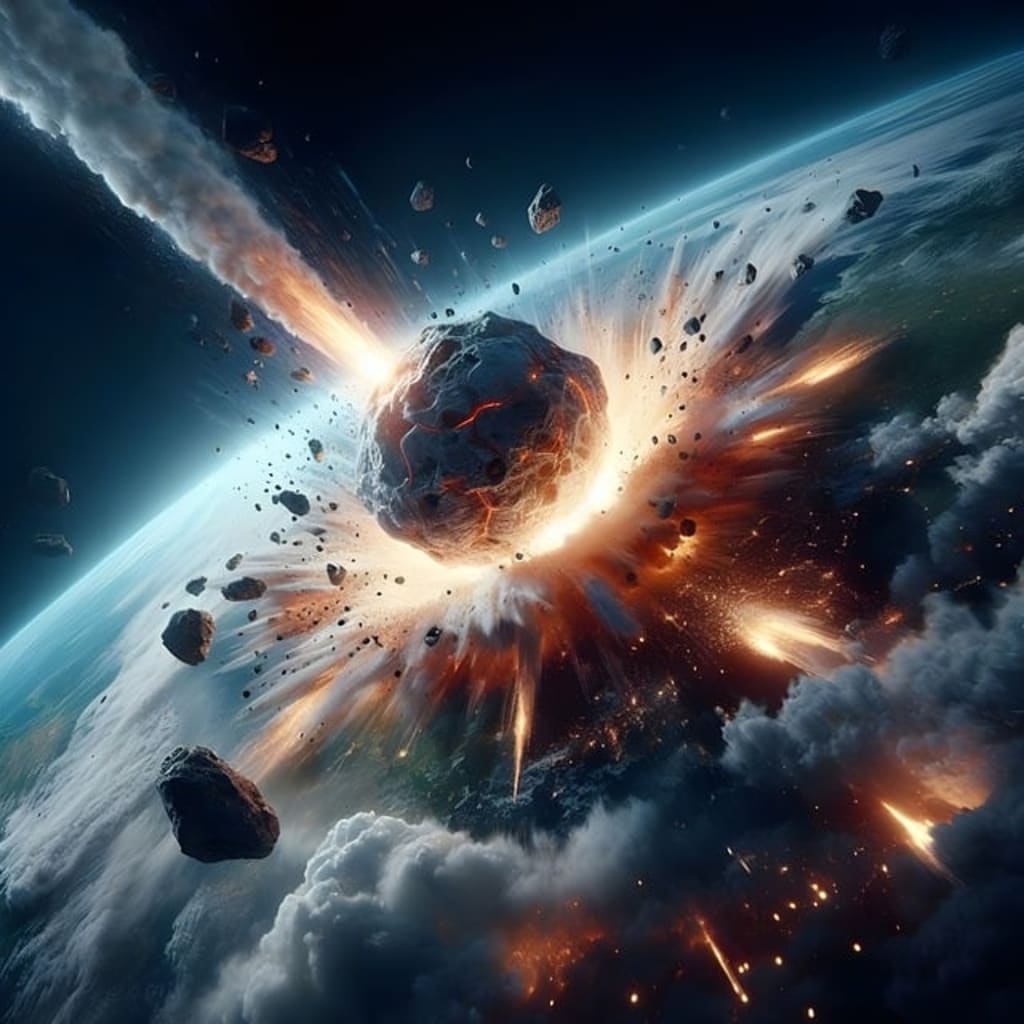
Hey there, friends! Buckle up because we’ve got some cosmic drama unfolding on April 13, 2029. That’s the date when a colossal asteroid named Apophis—over 1,000 feet in diameter—is set to make a close pass by Earth. If this space rock were to hit us, we’d be looking at a calamity of epic proportions: think one million times the energy of the Hiroshima bomb, towering tsunami waves, and entire cities potentially wiped off the map. And as if that wasn’t enough to keep you up at night, there’s a potential for another asteroid to slam into Earth on July 12, 2038. And get this—there’s a 72% chance of it happening. NASA is already on high alert and running planetary defense drills.
In a recent twist, the Chief of ISRO has even warned that we might face extinction! Yep, that’s right—an Earth-destroying asteroid could be speeding our way. But how real are these cosmic threats? What’s the scoop on NASA’s plans? And which asteroids are truly the most dangerous?
Let’s dive into the asteroid universe. Asteroids, often called planetoids, are like mini planets—gigantic chunks of rock orbiting in space. They range from a mere 20 meters to a whopping 200 kilometers in diameter. The smallest one we’ve found is just 2 meters wide, while the biggest, Ceres, spans 940 kilometers. Most of these space rocks hang out in the Asteroid Belt between Mars and Jupiter, a region so crowded with asteroids that they’re spread out more than a million kilometers apart.
But occasionally, these rocky wanderers venture closer to Earth, and we label them Near-Earth Objects (NEOs). NEOs include asteroids, comets, meteors, and meteoroids. Here’s the breakdown: asteroids are rock and metal chunks, comets are icy, dusty balls often with a spectacular tail, meteoroids are smaller fragments of asteroids or comets, and when these meteoroids enter Earth’s atmosphere, they become meteors—better known as shooting stars. If a meteor survives its fiery descent and lands on Earth, it’s called a meteorite. And when meteors fall in swarms, we call it a meteor shower.
Now, when it comes to danger, comets are scarier than asteroids. They travel twice as fast and give us less warning. Picture a comet swooping in unexpectedly—just like in the movie *Don’t Look Up*—where a comet was spotted with only six months’ notice.
NASA and other space agencies are on the lookout for these celestial threats. Their detection systems include LINEAR, CSS, PAN-STARRS, and ATLAS. These projects work tirelessly to spot and track asteroids. For instance, LINEAR, a collaboration between NASA, MIT, and the U.S. Air Force, discovers over 10,000 objects annually. CSS from the University of Arizona, with its high-precision telescopes, once predicted an asteroid’s exact landing spot with pinpoint accuracy. PAN-STARRS uses the world’s largest digital camera to scan the skies, while ATLAS provides last-minute alerts for any missed threats.
But what if a big asteroid does come our way? NASA has tested the Kinetic Method by crashing a spacecraft into an asteroid to change its orbit—successfully, I might add. They also consider the Slow Push and Pull method, using solar energy to gradually shift an asteroid’s path, and the Nuclear Method, which involves nuking an asteroid. This last method is more theoretical and fraught with complications, but it’s considered for extremely large threats.
The good news? There’s no imminent danger. As of now, no significant asteroid has more than a 0.01% chance of hitting Earth in the next 100 years. NASA’s upcoming space telescope, the Near-Earth Object Surveyor, will further enhance our detection capabilities.
So, stay calm and don’t fall for sensational news.
and remember—keep your eyes on the stars, but your feet on the ground!
About the Creator
15.Goutami Debnath
I love breaking down complex issues in simple words
Keep reading
More stories from 15.Goutami Debnath and writers in Fiction and other communities.
Sometimes It's Like That and That'sThe Way It Is
It was the late 1960s, and ten-year-old Gloria Coleman was standing with her grandmother on the side of the highway waiting for the bus. As the Greyhound pulled up, it seemed monstrous and intimidating. Grandma Elizabeth grabbed Gloria's hand, holding it tightly as they boarded.
By Cheryl E Preston2 days ago in Fiction

Comments (2)
So so amazing .i love your content and subscribed. Kindly reciprocate by subscribing to me also . thank you and keep it up
Thanks for sharing