
The Devourer of Villages
Cherry Trees, Honesty and Other Falsehoods
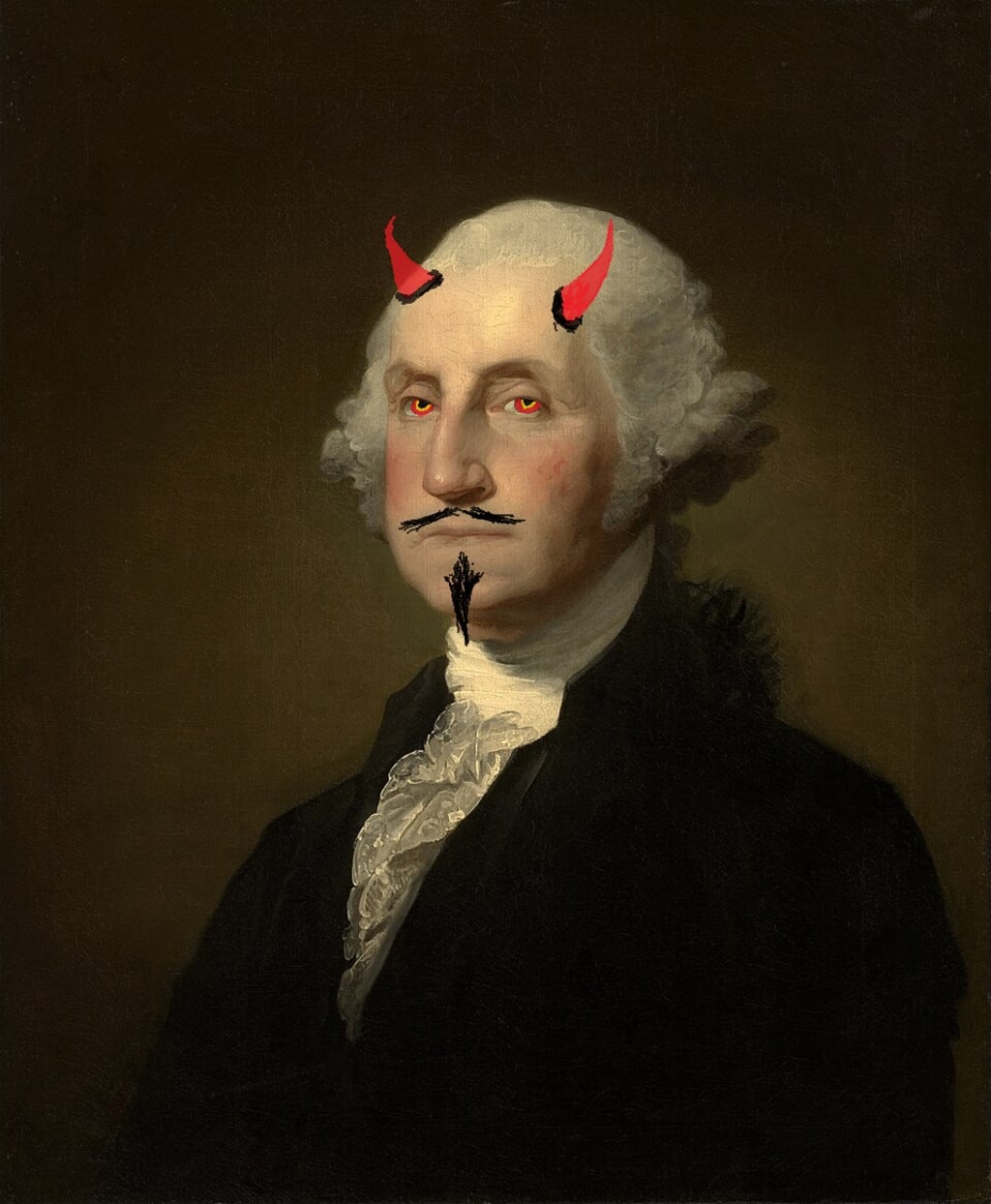
There are several "Founding Fathers" celebrated in American history, but none more famous and mythologized than our very first terrorist-in-chief: George Washington.
This is the story of his shining, compulsively honest spirit.
***
Once upon a simpler time, back in the 1738, there was an American boy named George.
George was sweet and innocent and just as boyish as any other rascal. He had plump, rosey cheeks that were always quick to smile.
One day, at the bright and beaming age of 6, young George came into glad possession of a shining hatchet!
It wasn't a gift-- of course not. Because even though these were simpler times, adults still had enough sense not to gift little children deadly toys.
No, this beautiful hatchet was a beautiful stolen hatchet. Yes! That loveable imp, little Georgey Washington swiped it from a workstation or a storage shed on his father's farm.
Almost certainly, swiping this tool would draw the ire of whatever overseer inventoried the tools. Perhaps one of the enslaved men working on George's daddy's farm would be blamed. Perhaps one of the enslaved men would be whipped for the missing hatchet.
But ah, we don't need to worry about such unpleasant possibilities. Georgie boy certainly wasn't worried about that. Please don't blame him for such seeming callousness. Remember, the poor lad was only 6, so he couldn't be expected to care about other people bearing the consequence for his actions. And don't forget, George's beaming face was white-- and these were simpler times. Back then things were different. It really wasn't such a big deal for little white boys to defer consequence on the people their parent's forced into labor and bondage. Polite society was more laid back about stuff like that. So, please let's not be too hard on young master Washington.
Anyway.
Like all little boys, George was thrilled to wield such a glorious tool-- he swung the lovely hatchet in playful arcs, testing the sharp blade on anything he could reach.
Sticks and pieces of bark and rotting stumps crumbled away before his brutal strikes-- he even dulled the blade on some stones, just to watch the pretty sparks fly. But again, let's not hold anything against him. Remember, he was six. And compared to a grown adult in possession of their full faculties, tiny little six year old George was basically an idiot.
But even then, the boy had enough creativity to imagine himself in future glory!
He knew one day he'd be a soldier-- no, a commander of soldiers... preferably one as genius as merciless and as lethal as his heroic great-grandpa John Washington.
Little George loved hearing stories about how his great-gramps commanded the Virginian colonial militia, as a brilliant colonel, to make the beautiful land of Virginia safe for innocent English people back in the 1670's.
Back in his great grandfather's day this blessed land had all been frontier, which meant it had just been sitting there, ripe for the taking and waiting to be put to use! So enterprising white imperialists claimed and harvested and farmed whatever land they wanted, at their pleasure.
Infuriatingly, there were indigenous aggressors-- psychopaths and violent maniacs who hassled those intrepid and innocent white colonizers.
George couldn't pronounce any of their names but they clung to silly and absurd tribal affiliations. There was the Doeg Tribe, the Susquehannock Tribe, and the Piscataway Tribe.
Little Georgie had heard stories about how uncivilized those people were. They were basically subhuman. More like rabid animals. They'd squat in bushes waiting to ambush Christian women and children.
It was said that they ate human flesh, from those poor souls they managed to lay hold of and take as prisoner back to their filthy hovels in the woods.
But brave and noble white men like Great Grandpa John, they heard the cries of the innocent, and they rose to the defense of the colonists' God-given right to take whatever land and resource they wanted.
He loved hearing stories about his great-grandfather's battles and glory, and he especially loved hearing stories about how his great-grandfather slaughtered the Susquehannock chiefs who had been behind the savage raids on English imperialist settlements.
It wasn't any of his glorious battles that most impressed George, it was the way Great-Grandpa John got the bad-guys in the end. He invited them to a parlay and executed them, even as they cried peace.
Genius!
Supposedly when word spread to the remaining, leaderless savages of Great Grandpa John's tactical brilliance and combat prowess they bestowed on him an Algonquin name of great honor, that translated to English: The Devourer of Villages.
That story stood as an early lesson to George: it wasn't always necessary to best one's enemy with physical might or military force. To be a truly master tactician, one had to be clever like Great-Grandpa John.
To truly master his evilest of enemies, George would only have to outsmart them by inviting them to a peace talk and then ambushing them.
Then, God willing, he could bear a name that would strike terror into the hearts of their children, just like Great-Grandfather-Town-Devourer.
But as compelling as that fantasy was, the boy still had a hatchet in his hand so he could not resist the pleasant imaginings of a lovely, close-quarters melee battle!
That was where the real action and thrill would be found.
So Georgie imagined each and every twig and bark on his father's farm to be the leering faces of his fierce enemies. He pictured them, as the rage-fueled grandsons of the men Great-Grandpa John had outsmarted and destroyed.
In George's mind these enemy warriors wore war paint and buck skin and feathers in their wild hair.
They were formidable.
They were tall.
They were strong and they were proud.
But he, George Washington, was the greater warrior.
Now this wasn't an especially realistic fantasy, of course, because little George was a six year old idiot. But the imagination of a blood-thirsty, white supremacist child knows no bounds.
George dodged all the savages' arrows with ease. He danced between them like an avenging angel, or like a hero of antiquity. He'd raise his hatchet, again and again, slashing their flailing red bodies to ribbons!
What joy.
They assailed him there, in his father's garden, an endless host. Oh, how they whooped and hollered and fell upon him.
There were times where little, heroic Georgie might have been bested-- indeed the savage hordes were so great in number that a lesser man than George might have trembled and surrendered and begged mercy from ther merciless.
But not George!
He fought all through the afternoon, brave, with his head held high and his grip on the hatchet strong and steady.
After an exhausting foray, he stood as the victor, among scattered branches and wood chips.
And lo!
But his thirst for blood wasn't quenched. George looked at his father's prized English Cherry...
And lo!
The young cherry stood tall and proud, a full head taller than George himself. It's green leaves fluttered in the wind, as the feathered war bonnet of a Susquehannock Chief!
George pretended to lay down his arms.
And George pretended some flattery. His little voice rang out, boistrous and cocky across his father's garden. Employed laborers and forced laborers alike pretended not to notice the little piece of shit: "Oh noble Susquehannock Chief-- we have met in battle and you can see we are matched. Shall we fight to the bitter and bloody end? Or may we yet reach an accord? Come, let us discuss the terms of parlay."
But despite their revulsion and their attempts to look away, employed laborers and forced laborers alike took painful notice... They saw the wicked gleam in young Georgie's eye, and they saw his cruel, baby-toothed grin as he raised his hatchet and sank it into the tender bark of the master's prized cherry.
And they heard George's weird, staccato laughter as he gloated over his sadistic fantasy: "Oh noble savage, oh Mr Lo, you could have stayed Chief had you chosen to live in peace-- but you chose to test your will against a deadlier warrior! Don't you know who I am? I am George Washington, great grandson of the legendary John Washington-- the Devourer of villages!"
Around that time George's father, Augustine Washington, happened on the scene. He immediately inferred the truth when this sight met his eyes: his strangely war-obsessed son standing, sweaty with a pilfered hatchet clutched tight in his tiny palm. The boy stood panting beside Augustine's favorite sapling, a beautiful English Cherry, now mangled beyond hope.
Augustine, thinking to catch his son in a lie asked, "Why George, have you any idea what terrible fate has befallen my favorite tree? Can you tell me what thoughtless savage has menaced this beautiful Cherry?"
George thought on the lessons he'd been taught-- he knew he had to be clever.
He briefly considered trying to blame one of the slaves, but he knew the lie wouldn't hold water.
If only he had ditched the guilty hatchet!
Ah, but there he stood. Caught nearly in the act-- close enough for the truth to be obvious.
George knew what he had to do.
He had to confess, in the hopes of securing a softer beating.
"Oh Pa, I can't tell a lie. You know I'm not capable of uttering a lie. It was I who did it, I am the culprit. Yes Pa, I struck your prized cherry with the hatchet."
And all the rage bled out of Augustine. It wasn't that George didn't deserve a severe whooping, it was that the old man was tired. He'd been ordering his slaves around most of the day, and that was quite exhausting.
At the very least he could use this moment to impress upon George the importance of telling the truth, in the hopes he'd be an honest man someday instead of a devious piece of shit.
He pulled the boy into a reluctant embrace, because he was still kinda pissed.
"Alright George. Thank you for telling me the truth. If you had been fool enough to lie to me, I would have had you whipped with rawhide. But you were honest, so I can't stay mad at you. Little George, remember this: your honesty is worth more than a thousand cherry trees, even if their branches were all laden with the sweetest, plumpest fruits-- or draped with jewels and gold. You said you cannot lie and I hope that remains true throughout all your long life."
George couldn't believe his good fortune. He grinned that same creepy grin as before. "Of course it will remain true Pa. I'll never lie."
***
But the legend of George Washington's total and complete honesty doesn't end there! That little boy went on to achieve his great dream of leading men in bloodshed and violence-- commanding the 13 colonies to victory against the British during the American Revolutionary War.
And as proof of his endless nobility and shining virtue the boy/ general-of-the-continental-army who could not lie directed one of his subordinates, a man named John Sullivan to lead several regiments in a shock and awe campaign against peaceful, indigenous villagers!
Washington ordered Sullivan to wage this campaign of violence as a sort of preemptive strike against the target tribes, in the hopes that they'd fall into in to such confusion and terror that they wouldn't dare aid the British or act out against the revolutionary soldiers who were making strategic use of their lands.
He specifically ordered Sullivan to take as many hostages as possible, of every age and sex, so as to totally demoralize any who escaped. Furthermore he gleefully ordered that as these villages were overrun, all crops and structures should be utterly destroyed!
A brilliant, moral, and noble tactician. Just like his Great Grandfather.
In fact, a Seneca leader named Tanacharison noted the familiar barbarity and bestowed the same nickname on great-grandson Georgie:
The Devourer of Villages.
***
***
***
Author's Note:
This is for the "What the Myth Got Wrong" challenge.
The original myth about the cherry tree and George's supposed honesty was ironically a total fabrication. It was written 1800 by a man named Mason Locke Weems, in the pursuit of profit, as one part of his exaggerated, sensationalized, and downright inventive book: The Life of George Washington. You can read the original in PDF form here: https://ia601304.us.archive.org/31/items/lifeofgeorgewashweem/lifeofgeorgewashweem.pdf
It's kind of hilariously ironic that this entirely falsified account has helped solidify George Washington's reputation as an unflinching truth teller in the US American cultural consciousness.
And it's sadly ironic to consider how many of his outright lies were accepted as truth, for decades, in part because of his status as an honest American hero.
Chief among his outright lies was his assertion that he hated slavery and would gladly see it abolished. He said stuff to that effect... a bunch.
BUT NEVER PUBLICLY, as the most powerful man in America, he remained shamefully silent on a thing he professed to care about.
And he's lauded as the only slave-owning president to grant manumission to his forced laborers via his will after his death.
But he quite literally chased escapees-- and told outright lies to keep them in his service. Read about Ona Judge, one of several who managed to escape. If you want to be utterly appalled. (Washington tried gaslighting her, over and over and over into returning to bondage, under him.)
https://wams.nyhistory.org/life-story/oney-judge/
Anyway, the myth got George's honesty wrong, the man turned out to be a prolific liar.
But the stuff I added to Weems' myth was all the stuff about George fantasizing about murdering Indigenous people. It is true that his Great Grandfather was a war criminal who murdered a group of Susquehannock Chiefs during a peace negotation, and it's true the Algonquin gave him that nickname. But I like to think it was intended as a badge of shame, rather than honor.
It's also true that George Washington, as general, ordered an unprovoked campaign of terrorism against Native Americans who he feared might be sympathetic to the British.
Yeah, he was a slaver and a war criminal. And a liar.
About the Creator
Sam Spinelli
Trying to make real art the best I can, never Ai!
Help me write better! Critical feedback is welcome :)
reddit.com/u/tasteofhemlock
instagram.com/samspinelli29/
Keep reading
More stories from Sam Spinelli and writers in Fiction and other communities.



Comments (2)
Very relevant story based on all the information that's become widespread recently. The American Revolution was led by power-hungry rich men, who either (a) didn't want to pay taxes, or )b) wanted to continue slavery. The first legal ruling in the UK against slavery was made in 1772, and by 1800 slavery was eliminated in Canada. At least for one group of people, it would have been much better if the US remained part of the UK and independence happened 100 years later like it did with canada.
Biting. Like a hatchet in a cherry tree. Good luck in the challenge.