
Whispers of the Forgotten Clock
A Tale of Time Unraveled in a Town Where Seconds Stand Still

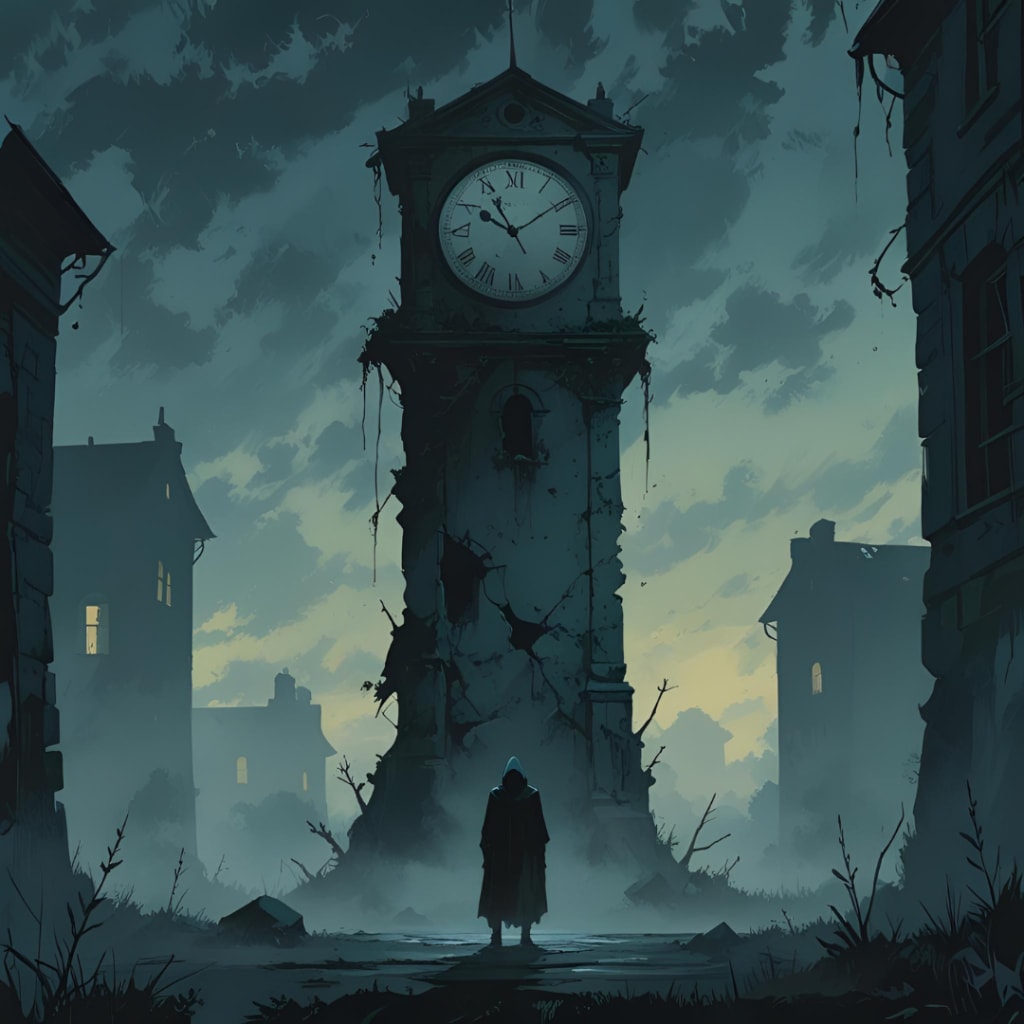
In the sleepy town of Elderglow, nestled between rolling hills and a river that sang secrets to the stars, time had a peculiar habit of standing still. Not metaphorically, but literally. The townsfolk swore the old clock tower, perched on the edge of the square, hadn’t ticked in a century. Its hands, frozen at 3:17, cast long shadows that never shifted, as if the sun itself respected the clock’s stubborn refusal to move. The townspeople called it the Forgotten Clock, and they whispered that it held the soul of Elderglow, trapped in a moment no one could remember.
Lila Wren, a young woman with a penchant for unraveling mysteries, arrived in Elderglow on a rainy afternoon, her boots splashing through puddles that reflected the gray sky. She’d heard of the clock from an old book she’d found in her grandmother’s attic, its pages yellowed and brittle, detailing a town where time refused to flow. The book hinted at a curse, a pact, and a key—none of which made sense, but all of which ignited Lila’s curiosity like a match to dry tinder. She’d come to Elderglow to write a story for Vocal Media, hoping to uncover something extraordinary.
The townsfolk were kind but cagey. At the local diner, where the air smelled of coffee and burnt toast, Lila asked about the clock. Old Mr. Harrow, who claimed to be ninety but looked no older than sixty, squinted at her over his glasses. “Some things are better left alone, girl,” he said, his voice like gravel. “That clock don’t like being questioned.” Others echoed his sentiment, their eyes darting to the tower as if it could hear them. But Lila wasn’t one to heed warnings. She thanked them, paid for her coffee, and headed to the clock tower.
The tower loomed over the square, its stones weathered but unyielding, ivy crawling up its sides like veins. The door at its base was locked, but Lila, ever resourceful, found a loose windowpane and slipped inside. The air was thick with dust, and the faint scent of rust clung to everything. A spiral staircase wound upward, its steps groaning under her weight. At the top, she found the clock’s heart—a massive mechanism of gears and springs, frozen mid-motion. In the center, dangling from a chain, was a small, ornate key, glinting faintly in the dim light.
Lila reached for it, her fingers brushing the cold metal, when a voice echoed through the chamber. “You seek what you cannot understand.” She spun around, heart pounding, but no one was there. The voice was soft, almost sorrowful, like a sigh carried on the wind. “Who’s there?” she called, her voice trembling. No answer came, but the air grew heavier, pressing against her skin. She grabbed the key and stuffed it into her pocket, determined to uncover its purpose.
Back at the inn where she was staying, Lila examined the key under the flickering light of a lamp. It was intricately carved with symbols she couldn’t decipher, but it felt alive, warm to the touch. That night, she dreamed of the clock tower, its hands spinning backward, the town unraveling around it. Faces she didn’t recognize pleaded with her to return the key, while others begged her to use it. She woke in a cold sweat, the key still clutched in her hand.
The next day, Lila returned to the tower, determined to find answers. She explored the town first, piecing together fragments of its history. The librarian, a woman with eyes like storm clouds, told her of a watchmaker who’d built the clock in 1873. He’d loved a woman named Elara, but she vanished on the night the clock was completed. The town believed the watchmaker had bound his grief to the clock, stopping time to preserve her memory. “Some say the key unlocks the clock,” the librarian whispered, “but others say it unlocks something far worse.”
Lila’s heart raced as she climbed the tower again. The voice returned, louder this time. “You hold my prison,” it said, and now Lila was certain it was Elara’s voice, trapped within the key. She hesitated, her fingers trembling as she approached the clock’s mechanism. The key fit perfectly into a small slot she hadn’t noticed before. She turned it, and the gears groaned to life, a deep, resonant hum filling the tower.
The world outside shifted. The sky darkened, the air shimmered, and the townsfolk froze in place, their faces contorted in fear. Lila ran to the square, where the clock’s hands were spinning wildly, forward and backward, as if time itself was unraveling. Shadows moved in the corners of her vision—figures that weren’t quite human, their eyes glowing like embers. “You’ve freed me,” Elara’s voice whispered, now clear and sharp. “But you’ve also freed them.”
Lila realized too late what the librarian meant by “something far worse.” The clock hadn’t just preserved Elara’s memory—it had trapped the watchmaker’s despair, his rage, and something darker, something that fed on time itself. The shadows grew, coalescing into forms that reached for her. She sprinted back to the tower, the key burning in her pocket. With no other choice, she yanked it from the slot, and the clock fell silent once more.
The shadows vanished, and the town returned to its eerie stillness. Lila stood panting, the key heavy in her hand. She could leave now, write her story, and let Elderglow keep its secrets. But the voice lingered in her mind, pleading. “I’m still here,” Elara whispered. Lila looked at the key, then at the clock. She could try again, find a way to free Elara without unleashing the darkness. Or she could walk away, leaving the town to its frozen fate.
She chose to stay. The story wasn’t over yet.
About the Creator
Keep reading
More stories from Nauman Hassan Khan and writers in Fiction and other communities.
The Mirror’s Truth
In the faded blue light of dawn, Eli lay awake, listening to the shrill alarm clock echoing through the paper-thin walls of their cramped apartment. The ceiling above him was cracked, the paint peeling in lazy curls, and the only warmth in the room came from the golden sliver of sunlight fighting its way through threadbare curtains. The air was thick with the scent of burnt toast and cheap coffee—his mother’s signature breakfast, a smell that clung to everything they owned.
By Nauman Hassan Khan8 months ago in Fiction
The Easter Hat
“Is your mother going to come with your Easter hat?” his kindergarten teacher asked him, almost accusingly. Joshua shrugged his shoulders. He put his right forefinger up to his mouth and uttered a single cough. He scratched his head and slumped his shoulders, walking to a folding table with premade hats.
By Paul Aaron Domenick5 days ago in Fiction
Top tipple tricks
Been thinking a lot about drinking, lately. Not least because of a recent episode of over-indulgence and the inevitable after effects. Some readers may recall the earlier articles I wrote about beating the booze. Here I set out an experiment in techniques for cutting down on my alcohol intake. The experiment was successful, the techniques worked, and I have armed myself with an arsenal of weapons in the war against the demon drink. I have yet to fire the first round however. It's all a question of timing (perhaps procrastination).
By Raymond G. Taylor7 days ago in Psyche



Comments (1)
Your words touched me more deeply than I expected—sometimes we write through pain, and sometimes we heal through someone else’s. Thank you for reminding me that stories like ours matter. I’m also someone who writes from a place of struggle and silent strength. Following you now—and I’d be honored if you ever visit my corner of Vocal too. We rise when we lift each other.