
The Mirror’s Truth
A Journey from Doubt to Self-Belief

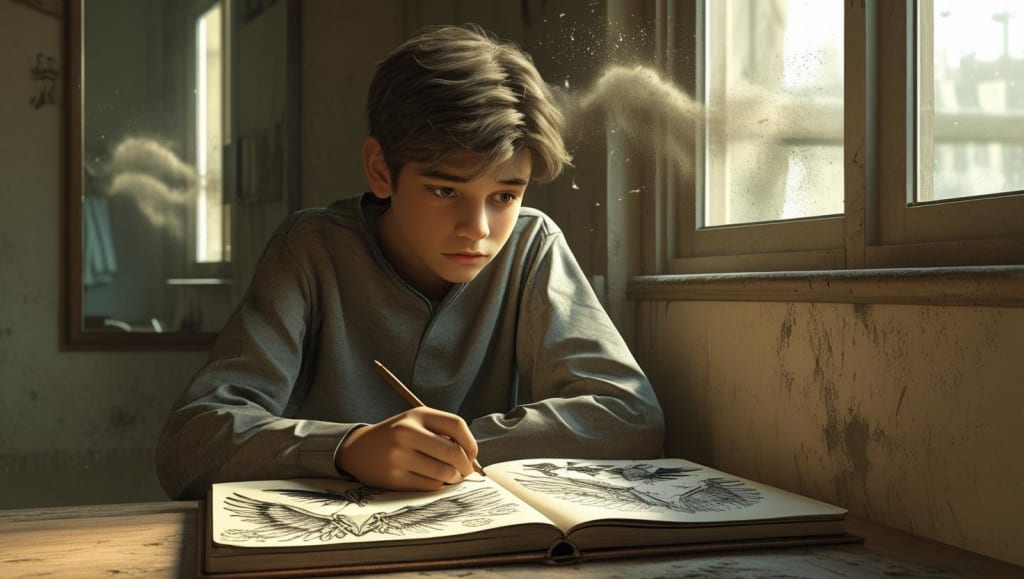
In the faded blue light of dawn, Eli lay awake, listening to the shrill alarm clock echoing through the paper-thin walls of their cramped apartment. The ceiling above him was cracked, the paint peeling in lazy curls, and the only warmth in the room came from the golden sliver of sunlight fighting its way through threadbare curtains. The air was thick with the scent of burnt toast and cheap coffee—his mother’s signature breakfast, a smell that clung to everything they owned.
Clara, his mother, was already bustling in the kitchen, humming a lullaby she’d carried from her own childhood. The words were long forgotten, but the tune was stitched into Eli’s bones, a comfort that never faded, even when the world outside felt cold and indifferent.
Eli’s world was small and worn at the edges. His father’s absence was a silent ache, a gap in the family photos and in the stories Clara never told. She worked herself raw at the Maple Street Diner, her hands red and cracked, her laughter edged with exhaustion. Yet every morning, she found a way to slip an extra pancake onto Eli’s plate, to make a joke about the stingy customers, to look at him with eyes that said, You matter. She was his safe harbor, the only person who saw past his silence and his awkwardness.
At school, Eli faded into the background. He wasn’t the kid who scored goals or aced tests. He was the one hunched over his desk, sketching wild, impossible worlds in the margins of his notebooks. Drawing was his escape—a place where he could be brave, where monsters could be tamed and heroes could fly. But in the real world, his art made him a target. Ryan, the loudest kid in the cafeteria, made sure of that. One rainy afternoon, Ryan snatched Eli’s sketchbook, flipping through the pages with a sneer before tossing it into a muddy puddle. Laughter followed Eli as he knelt in the dirt, cradling the ruined book. He didn’t fight back. He never did. But the sting of Ryan’s words—You’re nothing special—followed him home.
Clara noticed the heaviness in his eyes that night. She served up burnt toast and eggs, her voice gentle but unyielding. “Eli, you keep searching for something out there to fix you. But you’ve got everything you need right here.” She pressed her hand to her chest, then to his. “You’re enough. You just have to believe it.” Eli tried to smile, but the words felt like a story meant for someone else.
Later, in the bathroom, Eli stared at his reflection. His hair was a mess, his eyes rimmed with tiredness, a faint scar above his eyebrow from a childhood fall. He saw nothing remarkable—just a boy weighed down by doubts. Clara’s words echoed in his mind: If you’re searching for the person who’ll change your life, look in the mirror. He almost laughed, but the sound died in his throat. The mirror showed only Eli—ordinary, invisible.
The next morning, Clara was gone before sunrise, her uniform already stained with coffee. She left a note on the fridge: You got this, kid. Love, Mom. Eli tucked it into his pocket, a small shield against the day. At school, Ryan’s taunts were sharper than ever. “Still drawing your fairy tales, loser?” Eli kept his head down, clutching his sketchbook like a lifeline.
But in art class, something shifted. Ms. Harper, with her wild hair and paint-splattered clothes, stopped him after class. She held up one of his drawings—a winged figure soaring above a city. “Eli, this is beautiful. You have a gift. I want you to enter the district art contest.” Eli shook his head, embarrassed. “It’s just something I do.” Ms. Harper smiled, her eyes kind. “It’s not just something. It’s you. Don’t hide it.”
That night, Eli sat at the kitchen table, sketching by the flickering light. Clara’s words—You’re enough—echoed in his mind, mixing with Ms. Harper’s encouragement. For the first time, he wondered if his drawings could be more than an escape. Maybe they were a way to show the world who he really was.
In the weeks that followed, Eli poured himself into his art. He stayed late at school, working on a mural for the contest—a boy on a rooftop, his shadow stretching behind him as wings against a sky full of stars. It was raw and honest, and sharing it felt terrifying.
On contest day, Eli stood in the crowded auditorium, his mural displayed among dozens of others. Clara was there, wearing her best dress, her eyes shining with pride. She squeezed his hand. “I’m proud of you, Eli. No matter what.” He didn’t win. He didn’t even place. But as he stood by his mural, he heard a girl whisper, “This one makes you feel something.” For the first time, Eli felt seen—not as the quiet kid or the one with the ruined sketchbook, but as someone who mattered.
That night, Eli faced the mirror again. He saw the scar, the messy hair, the tired eyes. But he also saw the hands that created worlds, the heart that kept going, the boy his mother believed in. And for the first time, he believed in himself, too.
About the Creator
Keep reading
More stories from Nauman Hassan Khan and writers in Fiction and other communities.
Mother's Promise
In the parched expanse of the Kolara Hills, where the earth bled gold like molten tears and the air tasted of dust and despair, the year was 1982. Life here was a relentless grind, a cruel tapestry woven from glittering mines and squalid shanties. The hills echoed with the clatter of pickaxes and the whispered prayers of the broken. Above all, Kolara was ruled by Dheeraj—a warlord whose wealth was built on the broken backs of his workers, a man whose shadow stretched like a plague over the land.
By Nauman Hassan Khan6 months ago in Fiction
Miss Persephone's Manual to a Seemingly Ordinary Life
Miss Persephone was found at the dining table, her blue eyes swollen, her tears arriving and retreating like the tides of the ocean. Earlier that day, her family had visited her in the retirement home where she had lived for eight years. It was her eightieth birthday.
By Imola Tóthabout 24 hours ago in Fiction



Comments
There are no comments for this story
Be the first to respond and start the conversation.