
Where the Road Forgets
A Journey Through Lost Places and the Self
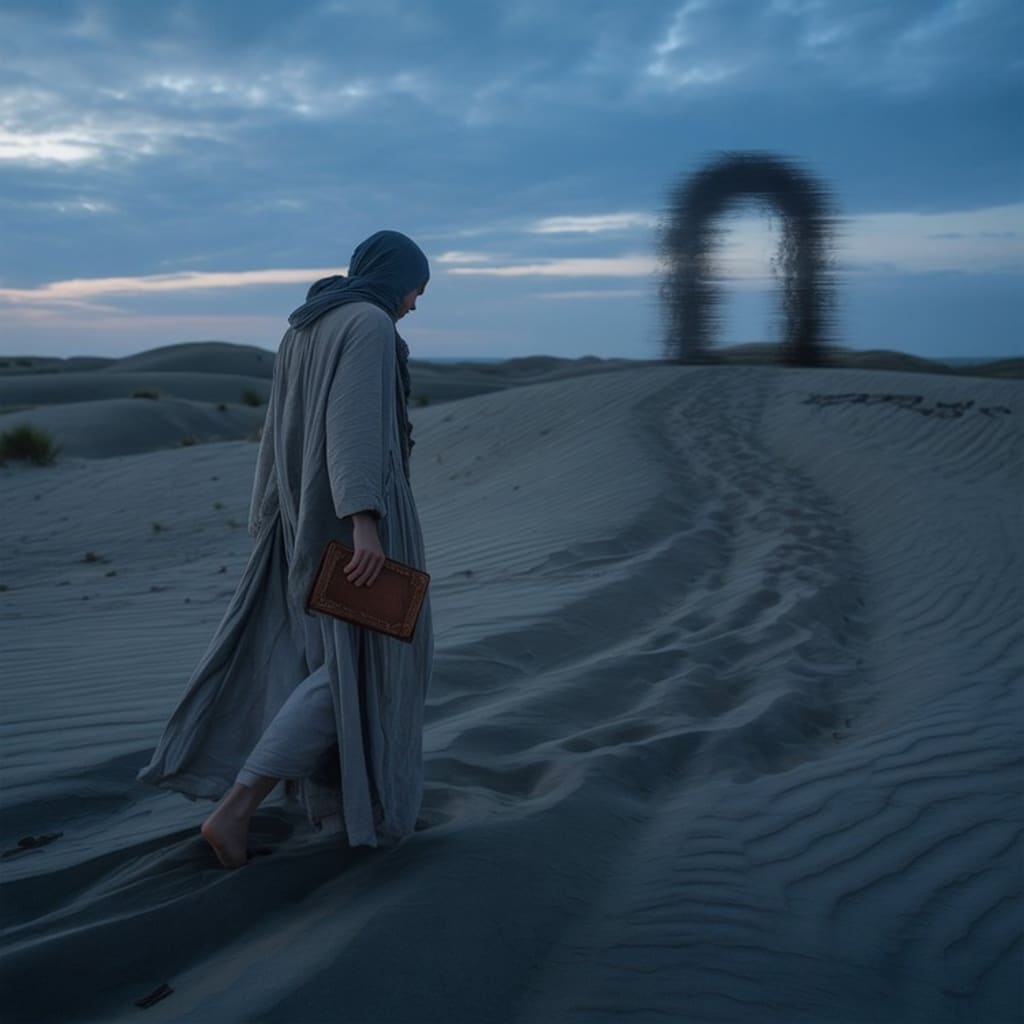
The road stretched endlessly ahead, crumbling at the edges like the pages of a forgotten book. Dust spiraled up with every step he took, though the wind had long gone still. The sky above held no sun, only a pale light that seemed to come from nowhere and everywhere at once. He didn’t know how long he had been walking—only that he must keep walking.
He had no name. At least, none that came to him now. Faces flickered at the edge of memory—laughter, a child’s voice, the warmth of firelight on skin—but they dissolved when he tried to hold them. His boots were worn, soles thin as paper. A coat hung from his frame, tattered but heavy, stitched with patches he did not remember sewing.
Sometimes, he passed signs. Not road signs—those were long rusted or swallowed by ivy—but signs of something: a rocking chair swaying on a porch with no house, a swing hanging from a tree with no leaves, a broken locket gleaming beside a stone. Each object stirred something in him, a breath of a story he had once lived. But like the morning mist, the feeling never stayed.
He called these places the Forgetting Grounds.
He wasn't alone in them. From time to time, he’d meet others—travelers like him. Some were friendly, their eyes tired but kind, offering pieces of bread or firewood. Others were hostile, their minds cracked under the silence of the road. And then there were those who didn't speak at all, only stared with hollow expressions, as if the road had taken too much from them to leave even words behind.
One night, he came upon a woman sitting by a stream that murmured like a lullaby. She looked up as he approached, her face lined not by age, but by waiting.
“You’ve been here a long time,” she said.
He didn’t answer. Instead, he sat beside her, watching the water carry leaves from a tree that had no roots nearby.
“You don’t remember, do you?” she asked.
He turned to her, startled. “Remember what?”
“Why you began walking.” Her voice was soft, almost sad. “The road only forgets what we ask it to.”
He opened his mouth, then closed it. The wind picked up just slightly, brushing past them like the whisper of an old friend.
That night, he dreamed of a child with dark curls laughing beneath a wide blue sky. A woman stood nearby, her arms folded, smiling gently at him. He felt the weight of a name on his tongue, but it vanished as he woke. The stream was gone. So was the woman.
Only the road remained.
Days blurred into each other. He stopped tracking time. Sometimes the terrain changed—forests that whispered in languages he didn’t know, cities swallowed by sand, staircases that led nowhere. And yet, the road was always there beneath his feet, guiding, urging, deceiving.
Then one day, he reached a place unlike any other.
A doorway stood in the middle of a clearing—just a door, freestanding, no walls. Its wood was carved with symbols he recognized but couldn't place. Something tugged at his chest. His hands shook as he reached for the handle.
The world shimmered.
He stepped through.
Suddenly, he stood in a house he didn’t remember, but knew was his. Toys scattered across the floor. A woman stood in the kitchen, her back turned, humming a song that made his throat tighten. The air smelled of bread and honey.
He tried to speak, but his voice caught.
The woman turned. Her eyes locked on his. A single tear slipped down her cheek.
“You left,” she said, not in anger—but in sorrow.
“I didn’t mean to,” he whispered. “I forgot... I forgot everything.”
“You were grieving,” she said. “And grief is a long road. But you stopped walking home.”
He looked around. Every inch of the house pulsed with memory. A picture frame on the shelf showed the three of them—him, the woman, and the child—smiling under the sun.
“I thought the road would lead me somewhere,” he said.
“It did,” she said. “Back.”
The dream—or vision, or memory—began to fade. He reached out, trying to cling to it, but the house slipped from his grasp like smoke. He was back on the road, standing where the door had been. Only this time, something inside him had changed.
The road was still long. Still strange.
But he remembered a name now. His son’s name.
The next day, he began carving signs as he walked—marks on trees, arrows in the dirt, messages in bottles. Not for himself, but for others who might lose their way. A path of memory through a world that tried to erase it.
And when he met other wanderers, he greeted them with a smile and a question:
“What is it you’re trying not to forget?”
Because now he knew.
The road forgets only what we allow it to.
And to remember... is to begin returning home.
About the Creator
Keep reading
More stories from Muhammad Abbas and writers in Fiction and other communities.
Lessons Beyond the Classroom
It was the first day of autumn, and the golden leaves outside the school window danced with the wind as if nature itself was turning the pages of a new chapter. Inside classroom 3B, Ms. Harper sat at her desk, reviewing lesson plans with the usual calm she had cultivated over the years. She had been teaching English for nearly two decades, and though the syllabus rarely changed, the students always did. Each year brought a new set of eyes — hopeful, confused, tired, or curious. But this year, one pair stood out immediately.
By Muhammad Abbas 8 months ago in Education
So You Decided To Become a Nurse Practitioner:
So you decided to become an "Advanced Practice" nurse. Congratulations!... is what I would say if this was a good idea. Grad school? In this economy? What were you thinking? Likely it was something along the lines of either 1) “I've seen these other chucklefucks do it— Why can't I?” or even 2) “I've got a nice career, I should shake it up. I miss feeling like I have no clue what I'm doing.”
By Sandor Szabo5 days ago in Fiction
Tall Timmy & the Top Hat
Timmy wasn’t just short—he was the shortest seventh grader in his class. In his school. In his town, even. He had to stand on his tippy toes to reach the faucet in the restroom. He had to suck in his breath and reach for his lunch tray until his back cracked. He had to find small windows of space in the horde of classmates during dismissal, just to spot his mom’s car. She frequently circled the pick-up line, as if she were a fixture on the worst carousel ever.
By SUEDE the poet5 days ago in Fiction


Comments
There are no comments for this story
Be the first to respond and start the conversation.