
Where the Blue Eye Meets the Heart
A Love Story Served with Sweet Tea and Secrets"

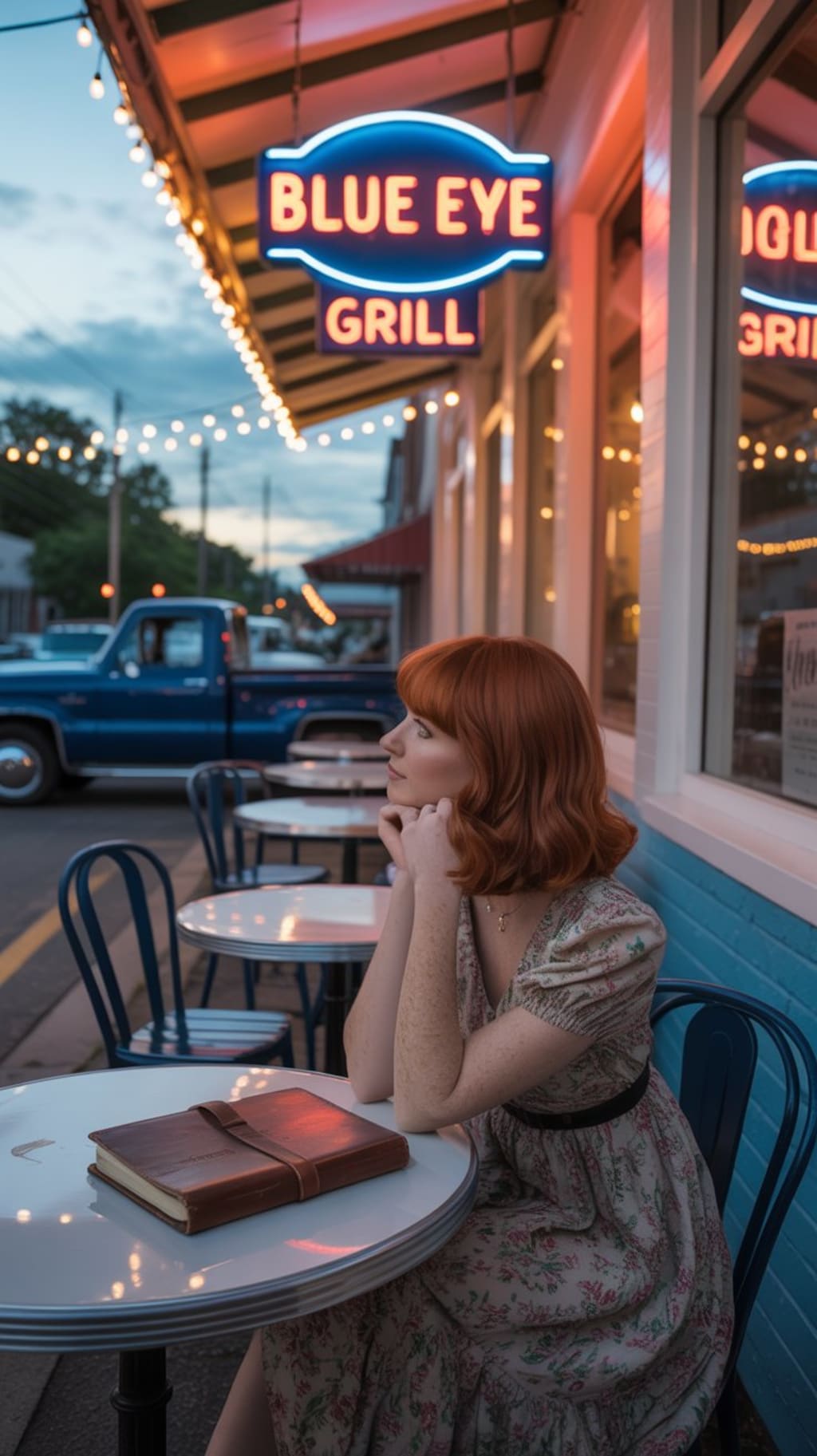
The old grill sat at the edge of Highway 9, nestled between the gentle hills of South Carolina’s forgotten countryside. Its neon sign flickered, the words Blue Eye Grill glowing faintly against the darkening sky. Locals called it “The Blue Eye,” and not just because of the sign. Legend had it the place saw everything—births, breakups, and secrets carried on summer winds. It was a quiet witness to a thousand little stories.
Tonight, the air was thick with humidity and honeysuckle. The cicadas sang their song, and the windows of the diner glowed like fireflies in the night. Inside, the clink of forks, low laughter, and Patsy Cline’s voice floating from the jukebox created a lullaby of small-town life.
Ella Rose Carter pushed open the front door, the bell above jingling softly. She hadn’t stepped inside in ten years—not since she’d left Blue Ridge for Charleston. Life had taken her through heartbreak, career success, and the loneliness that comes with both. Her hair was shorter now, her heels taller, but the ache in her chest was the same. She was searching for something she couldn’t name.
“Ella Rose?” came a familiar voice, thick with surprise and coffee-stained comfort.
Ella turned, heart stuttering.
There he was.
Jack Hollis.
He stood behind the counter, towel slung over one shoulder, flour dusting his shirt. His blue eyes—yes, the real reason behind the diner’s name—looked straight into her. Years folded in on themselves like an old map.
“Jack.” Her voice barely made it over the lump in her throat. “Didn’t think you’d still be here.”
He smiled, small and real. “Didn’t think you’d ever come back.”
They sat in a booth near the window. Outside, the stars blinked awake. Jack poured her coffee just the way she used to like it—two sugars, no cream. Muscle memory, she thought.
“So, what brings the city girl home?” he asked.
Ella stared into her cup. “Mom’s house sold last week. I came to say goodbye.”
“Guess she figured it was time to let go?”
“She figured right.” Ella hesitated. “Thought maybe I could let go too.”
Jack nodded. “Funny, isn’t it? The past doesn’t really stay in the past. Especially not here.”
She smiled weakly. “Still waxing poetic, Jack?”
“You bring it out of me.”
The silence between them was deep, but not uncomfortable. Outside, the wind picked up, rustling the faded awning above the porch. Inside, Ella watched Jack’s hands—how they moved with care, how they hadn’t changed. She remembered those hands cradling her face the night they said goodbye. She’d cried on his shirt and told him not to wait.
But she’d hoped he would.
Jack led her into the kitchen after hours. It smelled of grease, spices, and memories. He cooked her the old Blue Plate Special—fried chicken, mashed potatoes, and collard greens. The kind of meal that hugged you from the inside.
“You remember everything,” she said softly.
Jack set the plate in front of her. “Hard to forget the best part of my life.”
Ella blinked, tears pricking at the corners of her eyes. “Don’t say that.”
“Why not?”
“Because we were kids, Jack. Dreamers. That wasn’t real life.”
He leaned against the counter. “Then why does it still feel real?”
Ella looked up at him. “I don’t know.”
After dinner, they sat on the front steps of the grill, listening to the night. Fireflies danced like sparks between memories. Ella rested her chin on her knees.
“Do you regret staying?” she asked.
Jack shook his head. “No. This place needs someone. People come here for more than food. They come to feel seen.”
She laughed gently. “You sound like a preacher.”
“I sound like a man who never stopped waiting.”
That silenced her.
“Ella,” he said after a long moment, “I didn’t ask you to stay because I knew you needed to go. But part of me always hoped the road would lead you back.”
“And what if it doesn’t?” she whispered.
He looked at her, the way he always had—like she was sunlight and poetry and gravity all at once. “Then I’ll still be glad I got this night.”
Ella reached for his hand. “Maybe this night is a beginning.”
He looked down at their fingers intertwined. “Or a continuation.”
The next morning, Ella walked through town, past the church where she’d been baptized, past the high school with its broken bleachers, and finally, the cemetery where her father rested. She laid down a rose and closed her eyes.
She’d built a life of independence. She’d earned her degrees, her promotions, and the respect of colleagues. But in the quiet corners of her success lived a loneliness too proud to speak.
Back at the diner, Jack was prepping lunch. Locals filtered in—Miss Betty with her white curls, Curtis and his overalls, teenage girls gossiping about boys and breakups.
Ella sat at the counter, notebook open, pen in hand.
“I forgot you used to write,” Jack said, sliding her a slice of peach pie.
“Guess I forgot too,” she said, scribbling the words Blue Eye at the top of the page.
For the next few days, Ella stayed. The house sold, the movers came, and the keys changed hands—but she didn’t leave. She spent mornings walking by the creek and evenings peeling potatoes beside Jack. They talked about the old days and the roads between then and now.
And one evening, when the storm rolled in and lightning cracked the sky like a whip, they kissed under the Blue Eye sign, lips trembling like teenagers. The rain poured, and they laughed, soaked and weightless.
On her last night, Ella packed her suitcase. She had a life to return to in Charleston. An apartment. A job. Responsibilities. Yet her heart stayed stubbornly behind.
At the diner, Jack waited by the window.
“I should go,” she said, voice low.
He nodded. “I know.”
“I don’t know what this is.”
“It’s real,” he said. “That’s all I know.”
Ella walked to him, touched his cheek. “What if I came back?”
His breath caught. “Then the Blue Eye would finally see something new.”
Three months later, the locals buzzed with gossip.
Ella Rose Carter had moved back into town. She opened a small bookstore next to the grill. On weekends, she hosted poetry readings and story nights, where kids listened wide-eyed and old folks wept softly into their napkins.
Every evening, she had dinner at the Blue Eye Grill—seat by the window, heart on her sleeve, and Jack by her side.
The sign still flickered, but no one minded.
Because now, the Blue Eye had not only seen love.
It had helped it find its way home.
THE END
About the Creator
So You Decided To Become a Nurse Practitioner:
So you decided to become an "Advanced Practice" nurse. Congratulations!... is what I would say if this was a good idea. Grad school? In this economy? What were you thinking? Likely it was something along the lines of either 1) “I've seen these other chucklefucks do it— Why can't I?” or even 2) “I've got a nice career, I should shake it up. I miss feeling like I have no clue what I'm doing.”
By Sandor Szabo4 days ago in Fiction




Comments
There are no comments for this story
Be the first to respond and start the conversation.