
When Man’s Companion Becomes the Government’s Spy
Eyes in the Sky

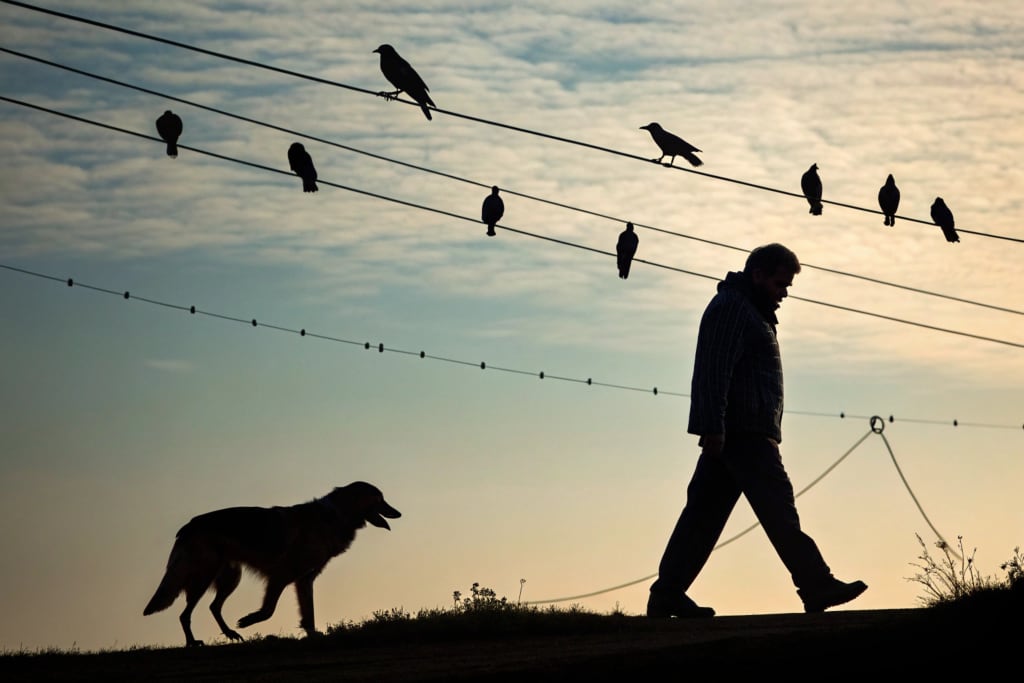
They watch from rooftops, utility poles, and abandoned towers—silent, patient, and unblinking. Crows congregate in tight formations, shifting positions without ever breaking focus. One departs, another immediately takes its place. To the casual observer, they are merely birds—but for those who know, they are far more than that. They report. They observe. They are the World Collective’s unseen eyes.
After humanity’s collapse, society was rebuilt under the strict guidance of the World Collective. Their mission: ensure the catastrophic ideologies that had once torn civilization apart never resurfaced. The Department of Watchers was established to oversee compliance. Unlike typical law enforcement, the Watchers were not to interfere—they were invisible custodians of observation, cataloging every suspicious activity, every gathering that hinted at rebellion or regression. Religious ceremonies, political factions, racial exclusion, or tribal rituals—all were flagged and forwarded for review.
Initially, surveillance relied on cameras, social media monitoring, and human agents. But as the population increased and society became more mobile, these methods proved insufficient. Technology offered a solution: animal spies. By embedding microchips into food, the Watchers could observe through a creature’s eyes and ears. Birds, rodents, even certain insects became invaluable assets. Dogs, loyal and obedient, were the most effective, while cats, snakes, and most reptiles proved unreliable. Suddenly, the world’s most trusted companions were now agents of the government.
John trudged home through his former industrial town, now quiet and sterile, a ghost of its coal-dominated past. Once an ambitious politician, he now assembled wind turbines on a monotonous factory line. He despised the city, his work, and the monotony that enveloped every street. As he walked, four crows perched on a utility pole caught his attention. One took flight, immediately replaced by another. John’s eyes flicked to the sky, not in fear, but calculation.
That evening, John was headed to a clandestine meeting. Attendees included ex-priests, retired executives, and former politicians—ordinary people with extraordinary memories of a past they longed to revive. Each brought a dog to mask the gathering as a casual neighborhood stroll. The disguise was clever: loyal companions, wagging tails, and obedient eyes made the assembly appear innocent to any passerby—or surveillance agent.
Inside an abandoned bank, stripped of its financial purpose, the conspirators met. They spoke in hushed tones, devising plans to restore the traditions and freedoms they felt had been lost. Maps were studied, signals arranged, and roles assigned. Each man carried not only his intentions but the weight of a shared nostalgia. Outside, the crows shifted and croaked softly, transmitting each movement, each whisper to the unseen authorities.
John’s dog padded silently at his side, unaware of its role in the web of observation. The Watchers’ technology allowed the government to see through its eyes, hear through its ears. Every sigh, every subtle gesture, every whispered conversation was cataloged and relayed to the central command. Trust, once a given, had become a dangerous luxury.
The raid came suddenly. Doors burst open, lights blinding, commands shouted. Men were restrained, dogs separated, and the conspirators’ world collapsed in an instant. The local news later reported the event: participants sent to re-education centers, their animals reassigned to approved homes.
In the aftermath, John stared at the empty streets, the weight of surveillance pressing down. The crows still perched silently above, ever watchful. Even a man’s best friend could no longer be trusted; in this rebuilt society, loyalty had shifted, observation had become omnipresent, and privacy had become a relic of a forgotten age.
In a world where every move was seen and recorded, and even animals were agents of the state, the question remained: who truly held freedom, and who merely imagined it?
About the Creator
Atiqbuddy
"Storyteller at heart, exploring life through words. From real moments to fictional worlds — every piece has a voice. Let’s journey together, one story at a time."
https://shopping-feedback.today/authors/atiqbuddy%3C/p%3E%3Cp class="css-1923z11-Text">
The Devil's Cut
“Comrade, finally you’re awake.” The voice was smooth, sensual. A flickering incandescent bar was all that lit the white, sterile room. All Vladimir remembered was everything going black. He tried to move his arms and found them strapped to the gurney.
By Matthew J. Fromm5 days ago in Fiction


Comments
There are no comments for this story
Be the first to respond and start the conversation.