
When a forgotten city awakens, its secrets refuse to stay buried
Whispers Beneath the Canopy

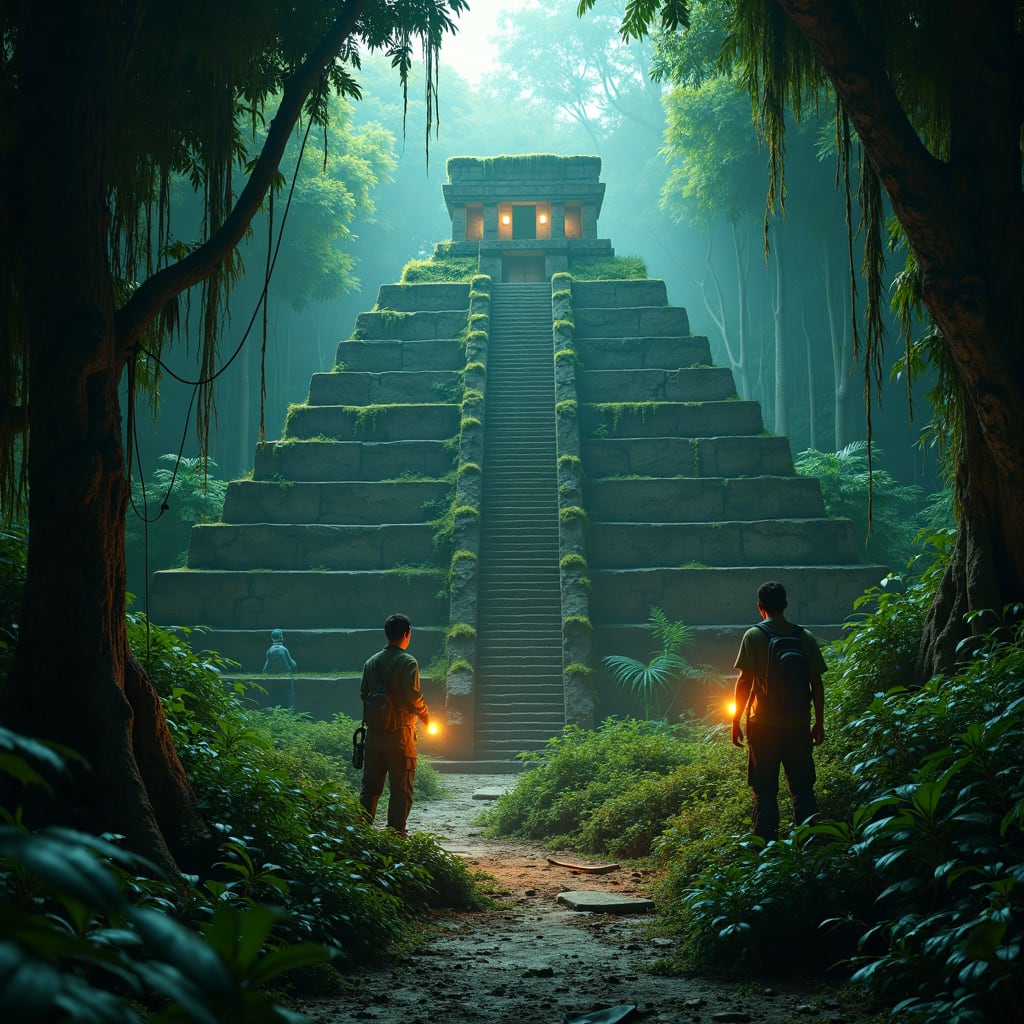
The year was 1926 when Professor Elias Greaves led his small team of explorers deep into the emerald heart of the Amazon. Funded by the Royal Geographic Society and driven by rumors found in the letters of a vanished Spanish conquistador, Greaves sought what many believed a myth—Ciudad de los Silencios, the City of Silence.
The jungle swallowed sound. Even the birds seemed to respect the weight of the unknown as Greaves, along with cartographer Lillian March, botanist Dr. Tomas Rivas, and guide Mateo Silva, pressed through terrain few dared to map. Their boots sank into soil damp with centuries of decay. Vines coiled like serpents around trees that towered into mist. Every step forward felt like a trespass.
On the twelfth day, they found it.
A clearing opened like a breath. There, half-consumed by vines and roots, stood a sprawling complex of stone buildings—pyramids carved with spiraling glyphs, monoliths etched with unfamiliar faces, and a grand plaza where jaguar statues stared with hollow eyes. The city was intact, as if its people had left in haste and time itself had politely waited for their return.
“We’re not the first to stand here,” Lillian whispered, her voice reverent. “But we may be the last.”
They set up camp near the entrance to a temple with doors so large they had to be pried open with levers and ropes. Inside, murals danced with scenes of celestial alignments, blood rites, and figures robed in feathers and bone. Dr. Rivas declared it a civilization distinct from Incan or Mayan—perhaps older. They documented feverishly, sketches and photographs by lantern light, eager to be the ones who redefined history.
But the jungle did not welcome intruders.
First came the voices. Whispers at night, words none of them understood. Then the footprints—bare, small, and always in circles, just outside their tents. Tomas swore he saw eyes in the trees, but by morning, only silence and branches remained. Mateo, the most grounded of them all, found one of the jaguar statues shattered. Not eroded—destroyed, violently and recently.
They should have left. But Elias refused.
“This city chose to show itself to us,” he said one night, his voice cracking with awe. “We cannot walk away from that.”
That was the night Lillian disappeared.
Her journal remained behind, open to a page she hadn’t written: a single glyph etched in ink not her own, matching none they had catalogued. Beneath it, smeared in charcoal: They are watching.
The remaining three searched until dawn, but found no trace of her. Not even broken branches. By evening, Tomas was gone too. No struggle. No noise. Just absence. Mateo wanted to flee, but Elias, feverish and frantic, insisted they were on the brink of understanding. “We’re guests here,” he muttered, “and we’ve broken something sacred.”
That night, Elias entered the temple alone. Mateo waited hours. When the sun rose, he went after him.
The walls were freshly marked in blood. Symbols danced across stone in a language not spoken aloud for a thousand years. And in the center of the altar, under a shaft of gold light, lay Elias’s satchel—unzipped, empty, and humming faintly.
Mateo never returned to London. His account, scrawled on pages torn from Lillian’s journal, was found months later by a second expedition that vanished days after arrival.
To this day, no modern explorer has located Ciudad de los Silencios again. Some say the jungle took it back. Others whisper that it never truly left.
Only that it waits—listening.
Thank you for reading. In every hidden corner of the world, there are stories that refuse to sleep.
About the Creator
Lucian
I focus on creating stories for readers around the world
The CEO’s Bitter Game
Avery Sinclair had spent the last three years rebuilding what her family had lost. Her father’s company, once a thriving enterprise, had been ruined in a single deal orchestrated by Damien Blackwood — the ruthless CEO whose name still made her blood boil. But Avery had a plan. She would rise, stronger and smarter, and one day, she would make him pay.
By Millicent Chisomabout 23 hours ago in Fiction



Comments
There are no comments for this story
Be the first to respond and start the conversation.