

I told Fionn we were headed somewhere safe. He just nodded, eyes full of sleep. It never ceases to amaze me how much my son trusts my every word. Not only that I would take him somewhere safe - of course I would. But he trusted without so much as his usual ‘why?’.
Outside, headlights whisper past. Taillights appear, grow smaller and then disappear, leaving me to wonder what they’ve seen.
Was it like this in other cities, the countryside, the continent? Was this it? Or...I try not to think of Ardara. God, I never thought I’d miss the news so much.
“Where are we going, Dad?”
“I told you, we’re going camping.”
“But you didn’t say where.” No challenge, only curiosity.
“We’re going west.”
“Why? What’s west?”
“Beautiful hills, and the sea, too.”
“The sea’s in every direction, Dad. Ireland’s an island.” He grins.
“Is it now?” I say and ruffle his hair. The more time I spend with him, the more I see the world through his eyes. It’s playful, unattached to outcomes. It softens the edge. Behind me, the city fades in the rearview mirror, until its lights flicker into obscurity.
Safety, when I did think of it, belonged to that category of invisible things. Things like love, or happiness, you only learn the shape of by the impression left after they’re gone. I never described our life in Dublin in terms of safety. Instead, I described it in terms of time and tiredness, the weather, the seasons. The opposite of safety was on the other side of time and oceans.
A tickle in Fionn’s throat becomes a cough that makes his brown eyes water. With one hand on the wheel, I fish in the backseat for the inhaler.
I never thought twice about the air before Fionn was born. It was empty and benign. But his lungs were not what they should have been. I thought about the air often, then, about how it’s full of little things I couldn’t see. Debris. Having Fionn was like being handed a golden egg, beautiful and terrifying. It taught me that danger could be all around, invisible, intangible.
But we lived in Dublin. There was a pharmacy down the street. Our world had solved problems like his.
“I don’t need it yet,” he says through wheezes.
Brave boy. “Use it,” I tell him.
He gasps in. His shoulders hike up. “How many are left?” I ask.
“24.”
“Don’t use it unless you need to. Do your exercises. Five in, five out. I’ll do it with you.”
That’s how we drive as the dark surrounds us. Breathing. Five seconds in, five seconds out. Soon my mind grows fluid, like the countryside. Slowly, Fionn’s wheezing fades and I watch his small shoulders relax.
I never thought of Dublin as safe until it wasn’t.
When the petrol station on our street burned, I decided to leave. The smoke left a black film on everything and Fionn coughed all night. The next night two more shops went up. Our neighbours’ car was smashed and burned. I watched through the blinds as they doused and lit it. The glow from the lighter showed their faces, grinning. It turned out we needed the noise, the voices on the telly, the invisible ones and zeroes floating through the air. When it all stopped, people went mad.
“Pack for camping,” I told Fionn. “But bring the stuff you really care about, too. Stuff you wouldn’t want to lose.”
He looked at me like he didn’t understand. Why would he? But he did it anyway, trying to figure out what he was packing for. I suppose that’s what I was doing, too, but I allowed myself the delusion of knowing what we’d need. I watched him pack his spiderman pyjamas, his raincoat, books he’d already read. From the kitchen, he took a bag of rice. Nothing else. He laid it in his bag ceremoniously, as if he’d know its meaning later.
Outside, the sky is clearing. Stars poke through. I roll down the windows and Fionn leans his head out. The wind stands his hair on end.
“There’s a car, Dad.”
“I see it.” I pull over. “Stay in the car, Fionn.”
It’s a white Toyota wagon, in the ditch, pointed down. There are fresh tracks pressed through the soft grass. The front end looks sideswiped. I don’t see another car. The driver’s seat is empty. The heat of the wreck hits me. I smell fuel.
“Dad.”
“Fionn, be careful! You need to listen when I tell you to stay, ok?”
He’s bent over something. “Dad there’s a woman.”
“Jesus, Fionn get away from her.”
“Is she alive?”
I push him back and bend down, my hand trembling. “Not anymore.”
“She looks like Mom.” His tone is calm, meaning he can tell that this woman only looks like his mom.
She does look like her. Not a lot, but too much. It’s the hair. Blonde and wisping at the edges. Her shoulders, too, have a familiar curve.
“Don’t say that, Fionn.”
I get him into the car and we leave. There’s fog ahead. The road is wet and shimmers in my headlights. The air smells like wet earth. I check the dash. The fuel gauge is a little over halfway. I guess 350 kilometres until the car dies, presuming there will be no opportunity to refuel. Enough to get us back to Dublin if we need, but not much else. I notice that I’m still planning on returning, that my imagination has not been able to travel further than a week or so into the future.
I try to keep our speed steady to save fuel. When I can see a few lights up ahead, I pull over. I’m not going to risk entering town at night. We’ll camp in the hills and drive in tomorrow. Then I do something I’ve always wanted to do. I drive straight through the fields. The car bucks like we’re on a ride at the fair. Fionn wakes up, alarmed at first, then laughs with delight. I laugh, too. For a few minutes we’re just having fun, bouncing and laughing. No burning petrol stations. No grinning madmen in the dark. No car in the ditch. No woman. Fionn looks at me as if we have a new secret.
“Was that a house?” he asks, when we step out of the car.
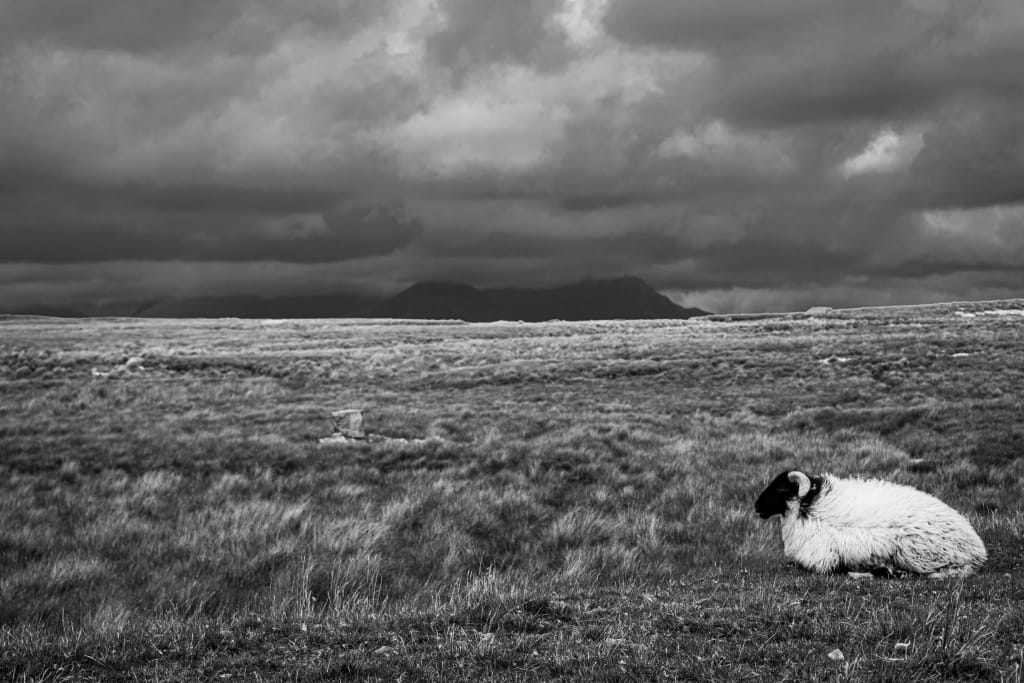
“It’s a dolmen,” I tell him. “A tomb. Made by people who lived here a long time ago.”
“Can we sit under it?”
I pause. I look out at the black expanse that stretches around us. We’re far enough from the road that the headlights look like shooting stars. “We can, as long as we’re respectful.”
“It’s not going to fall, is it?”
“I think if it was going to fall, it would have by now.”
He nods and walks deliberately under the shelter of the stone. He reminds me of her, the way he accepts the strangeness of his surroundings so immediately. The ancientness of this space unnerves me. It’s so quiet. All I can hear is the wind in the grass.
“Don’t touch the rocks, Fionn.”
“Why?”
“It’s bad for the stone,” I lie. He looks at his fingertips questioningly and I feel a pang of guilt for making him think his touch is toxic, but I don’t know any other way to explain it. The mind of a child is like a prism; it can’t hold something as cloudy as superstition.
“Why did we leave that dead woman?” he asks.
“What else would we have done?”
“I don’t know. Something.” He looks down.
“You know that things aren’t normal right now, Fionn, don’t you?”
He nods. “We can’t call Mom, can we?”
“No,” I tell him. “Soon, though. Maybe tomorrow.” I should stop lying to him. We can’t talk to her tomorrow. We can’t talk to her until she’s standing face to face with us. That was the only way now. The air had gone quiet.
Using our flashlights we set up the tent and though it is sturdy and waterproof, Fionn asks if we can pitch it inside the dolmen. It feels wrong, but I say yes. He seems relieved, which makes it worth it.
I notice his hand has been in a fist for a while. “What’s in your hand?” I ask.
He shies away, but then his shoulders sag and he shows me his palm. Nestled in it is a silver locket, in the shape of a heart, as white as the moon.
“Where did you get this, Fionn?”
He’s silent.
“Where, Fionn?”
“It’s no different,” he says, “than the museum. They told us when we went that that’s where the jewellery comes from. From graves. It’s not bad.”
I’m shocked. I know it means something else to him than it does to me, but the thought of him plucking this off a dead woman’s neck makes me feel weak.
“It is different, Fionn,” I say rigidly.
“No it isn’t,” he insists, his voice upset. He does not want to believe he has done a bad thing. I don’t, either. “It’s what they do in the museum,” he sulks.
“Why did you take it?” I ask him. “Was it because she looked like Mom?”
He thinks hard, trying to give me an honest answer. I see the image of a child’s arm extending towards a beautiful thing, giving it new life. Is that really bad? If we pass a ransacked store tomorrow, I will take what we need and not think twice.
“Maybe,” he says at last. “She’s not coming back, is she?”
I thought he was old enough to understand death. “The woman or Mom?”
“Mom.”
I can’t keep lying to him. He’s the only one I have right now, and we’re already on an island. “I don’t know. A long time ago, Mom and I decided there was a place we would go if something happened. Something like this.”
“What’s it called?”
“I don’t know the name, but it’s close to Ardara.”
“What’s Ardara?”
“A village by the sea. Where Mom’s family is from.”
He grows quiet for a while and I see both of us in him. I see her strength, the way she moves on to the next thing, to what can be done. And I see the canyons of myself, where loss only deepens and widens over time. When he speaks, his voice is slower, older.
“If things don’t work like they used to, how will Mom get back?”
“She’ll find a way,” I say. “You know she will.”
He’s silent.
“I heard someone back home say that it was the end of the world.”
I arch my back and look at the sky. “You know, in the old stories they say the world has already ended three times.”
“How do they know?”
I shrug. The wind picks up. He pulls the blanket, his hand still clutching the locket, closer to his chin. I look back at him through the doorway of the standing stones.
“What happened to them?” he asks at last.
“Their world ended. It changed. And they changed with it. And you know what? They became us.”
He looks cozy with his blanket and flashlight, tucked against the rock. I realise then why we both felt drawn to this place. It was old and safe and looked as though it would stand forever. I wish she could see him like this.
I think of the freezing sea between her and me. I’ve heard jellyfish float as thick as clouds through it.
I think of the numbers. 24 inhalations. 350 kilometres. How many more days? And nights?
The wind stirs the grass gently. The air is quiet, empty.
Above me the stars seem brighter than I remember. I look down and see that Fionn is looking up at me.
He looks to the stones. “You can touch them,” I tell him. “It’s ok.”
About the Creator
Keep reading
More stories from Fionn Mallon and writers in Fiction and other communities.
Cute Town
Rebecca found Sal’s Diner in much the same state she remembered leaving it. Cracked vinyl booths, dirty windows with handprints, and a chimney that sported a thick bib of creosote. A few patrons spun idly on vintage bar stools, while a stooped and aged fry cook stood next to a sizzling grill, his attention elsewhere. Rebecca strolled in and seated herself in a corner booth next to the dirtiest window she could find.
By Fionn Mallon5 years ago in Fiction
The Devil's Cut
“Comrade, finally you’re awake.” The voice was smooth, sensual. A flickering incandescent bar was all that lit the white, sterile room. All Vladimir remembered was everything going black. He tried to move his arms and found them strapped to the gurney.
By Matthew J. Fromm7 days ago in Fiction


Comments
There are no comments for this story
Be the first to respond and start the conversation.