
which one is she talking about dad
You know which one she is talking about. The struggle is as usual with the translation. As the double-decker boat makes a wide turn and begins to float back southeast down the river, what you really wanted to ask your father is: how does the tour guide incorporate the construction of new skyscrapers into her careful narrative? She speaks so confidently, and yet the content of her performance is nothing less than an entire city. Really just singular skyscrapers, sure. And so really just the static arrangement of the downtown area of this particular place, with its unique confluence of architectural trends, economic forces, geological features. But then really the associations with the networks of neighborhoods outside of it, not to mention the relations to and departures from the patterns of other cities, close by and far away. What is any singular consideration of the way anything has been built without proper attention to its intended and actual functions? How do people inside spend their time? What is any place about, narratively, except the way it was constructed, and so the way it comes to contain and exclude the entirety of certain experiences? And so on.
She has moved on but you are still wondering whether she walks down here in the mornings, before the tour, to watch the crane above the river lift up skeletal racks of steel only so that she might answer rude inquiries from the men on the boat regarding exact construction timelines, men who care more about demonstrating their own fragmented knowledge than retaining the things she says (to deploy piecemeal at some future tour). You would be scared of forgetting so many moving parts. Incidentally: you did not ask about the skyscraper under construction because you fear losing a sense of place in her narrative—this would be odd, given how carefully she directs your gaze to each of the towers. Rather, your question is located in what is still missing from this specific edifice, which has now cast a sense of permanence and uncertainty over the rest. Here is a thing that could still be anything even as it seems to lift itself. How to describe the place of something that does not yet fully exist—unlike her, out here you find that you do not possess the proper language.
when was it built
This seems like the type of question that would be important to your father, and so you ask it. Unlike him, you do not yet have the internal, idiosyncratic chaos of moments and associations—the bureaucracy of spent time, whose inconstancy somehow still distinguishes us well enough among each other’s skylines—you lack what would otherwise provide relative meaning to such a fact, to the year this building he stared at especially long was built. You ask this because you have begun only now to understand that this trip is somewhat monumental in the landscape of his midlife, and you want him to remember you, too, as a curious and important presence, the way you think, subconsciously, of him: as someone to draw attention and color and importance to things otherwise passed by. You begin to think that this inquiry about the year of construction is not the way to cement yourself into his homecoming.
did you live here when you lived here
Your father does not ask the tour guide any questions and for this small difference you respect him greatly. It is not that he knows all the answers, and it is not that he is not curious. He merely respects the rituals and self-erasure of education, chooses rather to place faith in the expertise of someone who has spent years perfecting a ninety minute delivery of the most relevant, entertaining architectural facts in sync with a crowd’s journey through the urban flux of visual aids. You care less about the location—where he lived, so long ago, before you, but near to you here now together—than the idea that he became the way he is in part by living in this place specifically, that he feels smarter than these other tourists—above them—due to some historic wayward trajectory through the city that you can only intuit from the models of literal, professional movement on either sidewalked edge of the river. He is defined here by many negations, as he does not look like they do, and you cannot picture the shape of their lives (nor his) on either end of this mass movement to and from work, and you cannot separate the ways in which he is different because he used to exist here from the ways in which he is different because he used to exist everywhere else from the ways in which he became built, environment notwithstanding. You watch the people walking so intentionally on the edges of the river and find them as fascinating as the buildings. Most of them are like he used to be: not bobbing in that willful tourist trance of receptivity but en route between routines. He probably used to sit in one of the office buildings, and you picture everyone completely silent. You wonder what he had been working out, back then, but you can only ask where he had lived.
Many of the facts are not entertaining. Some of the other people on the tour seem bored. Anecdotes from the lives of architects in medias res are lost on you. But as you watch your father’s reaction to their dry delivery you pine for that same sense of excitement he clearly feels in connecting together, if only briefly, all of these disparate zigzagging histories. Taking an interest in the points of their intersection. You decide in this moment that things will only ever be as compelling as you let them.
could I live here
The midwestern wind cuts right through your questions because you can’t help but whisper. This city introduces to you, for the first time, a scale to life that is dizzying. At home you often dump pounds of toy bricks onto a blanket all at once. The plastic waterfall emptying onto the ground echoes through the rest of the house on the weekend mornings. You pull the edges of the blanket, applying the gravity of urban life, and build from the middle out. Several things are odd about this ritual, refracted through the tour: the way that the clumsy results are informed so totally by the pieces’ initial placement on the blanket, as if a new city rises in your mind for each infinite Saturday; the way that you have to settle for making ersatz structures out of red, since you don’t own enough grey to erect these monochromatic, symmetrical towers; the way the things you build become different places as soon as your father enters the room in the evening and describes them to you. On this boat when you ask if you could live here, he will translate your own uncertainty into his distaste for urban life, as if the prospect of a bustling place scares you in the way it used to weigh upon him. When you ask if you could live here, what you really mean is: could I even consider myself the same person, if I had been here, and not somewhere else?
when is the museum
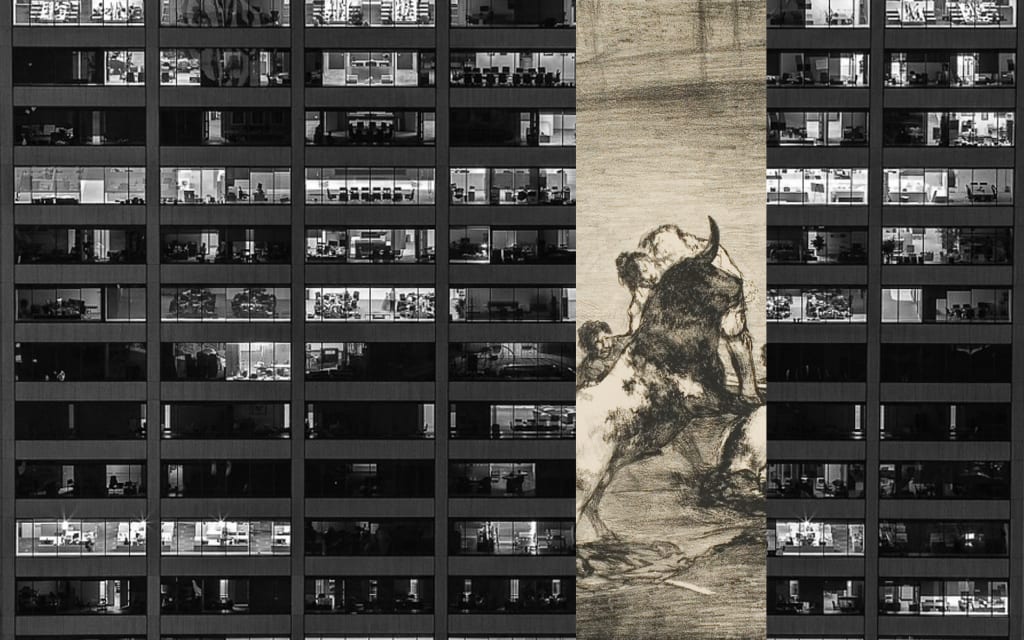
A painting hangs in your house. You cannot verbalize the difference between what is painted, and what is merely reprinted digitally and framed following the fame of an original lithograph, drawn in 1825 on thick paper using nothing but a black crayon and crude metal scraper, so you just call it a painting. And when you think of the painting it is just called ‘the bull’ because you cannot recall the intricacies of its given title—without any meaning attached to words like ‘Bordeaux’ and ‘Picador,’ they become harder to remember. Vowels and consonants cluster together arbitrarily, like the other characters here on the boat, or up in the buildings. When you think back to this mess of moments with your father, the tour and the museum, what you will remember less than your conviction that etymology, architecture, visual art all seem to be studies of accidents—like toys spilled onto a blanket—is your own inability to have expressed these ideas to him. To have demonstrated a love for the confusion their intersecting lines create. A love much like his.
The painting belongs to your father, and depicts several men wrestling a bull while a crowd spills into the arena. He had tried to explain how the artist did not use any preparatory sketches—the event did not happen as he depicted it because there was no event to depict: in the twilight years of his life, exiled from the places he loved, the artist had placed a piece of featureless paper on stone, covered its surface in black grease, and then carved or retouched its waxy surface until the moment arose out of the sepia fog between the back of his eyelids. He had explained all of this and more while you had wondered how the old man had known to color the top half of the bull’s coat just so—a darker shade than its rear legs. Thinking now of the looming transition between the architecture tour and the art museum, the elegant urban vomit of exteriority and the high water marks of black interiority plucked from across the globe, you feel homesick for whatever is left between them.
can we go home
At your age—you hate these three words—you’ve reached that rude intersection in which the confidence and content of your speech has not kept pace with the richness of your thoughts. The tour guide at the front of the boat seems to always already know how to speak to the progress of everything in real time, but you can only watch. If your questions are rough proxies for the thoughts in your head, then what is it like inside hers? The difference between the two of you is staggering—she seems taller than the skyscrapers. Almost as tall as your dad, who you’d really like to ask:
Will you explain to me the way you felt when you saw these buildings without the context of curated performance, the way you stumbled underneath them like an insect until you reached a gift shop where you found a laminated reproduction of something that allowed you to to fix yourself in the landscape, that invented impression of men wrestling nature into a corner and losing that you recognized as somehow a missing piece of yourself, and which you took home under the crook of your arm so that we could gaze through it together and look forward to the way our time was spent retracing your steps among the skyscrapers?
He says he will buy you an ice cream as soon as you get off the boat together, but pauses to say a few words of thanks to the tour guide.
About the Creator
S. J. R.
Based in Chicago, submitting sporadically.
Happy VD
Something was definitely wrong. I’d always laughed about burning piss, but holy fuck, this was no joke. My dick felt like it was on fire, and not in the good way. I’d been on the prowl a lot since Debbie dumped me, tagging a groupie at every gig. Best way to get over one woman is to get over another few.
By Harper Lewis3 days ago in Fiction




Comments
There are no comments for this story
Be the first to respond and start the conversation.