
Tipu Sultan – The Tiger of Mysore
The warrior-king who defied empires and died on his feet fighting for the sovereignty of his land.

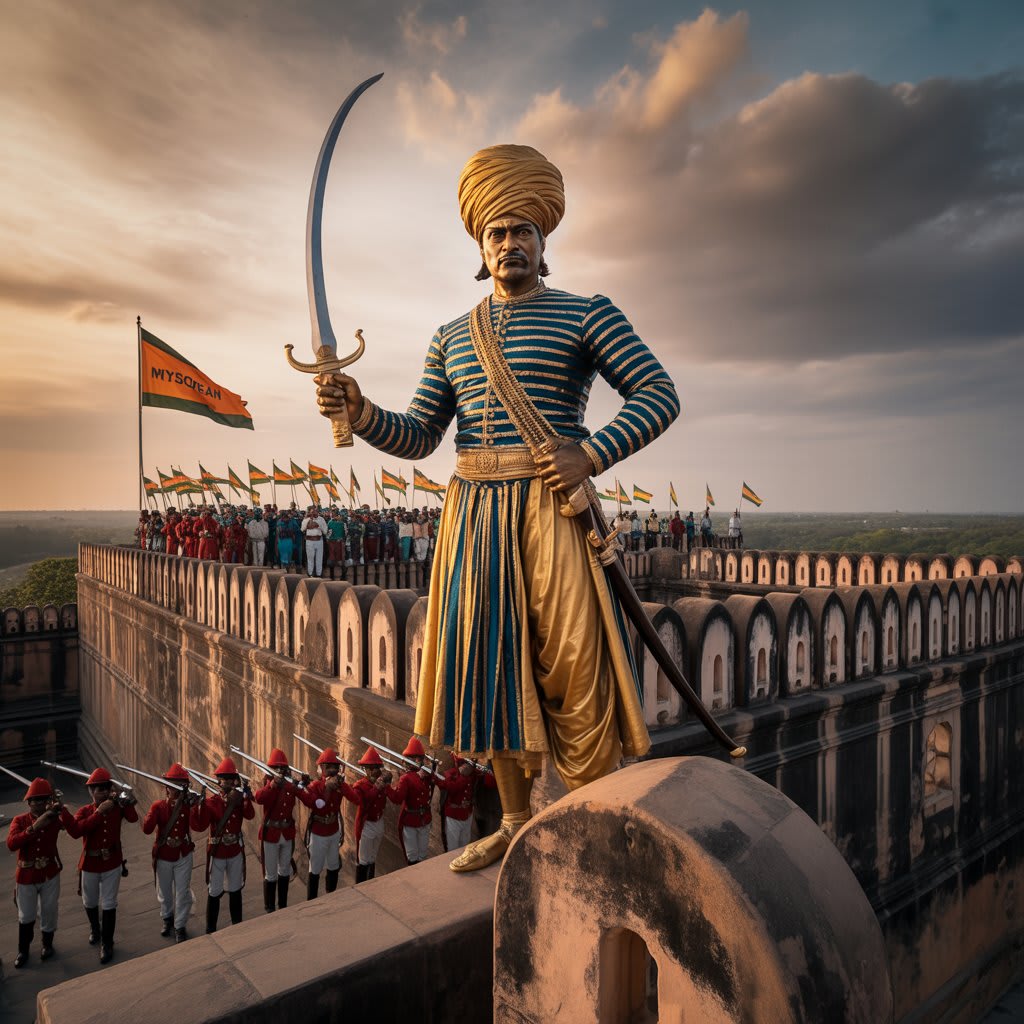
In the sultry heartlands of 18th-century southern India, when the sun beat down on the palm-lined rivers and British ambition stretched like a shadow across the subcontinent, there rose a king whose name would echo in both fear and reverence — Tipu Sultan, the Tiger of Mysore.
Born in 1751 in Devanahalli, near modern-day Bengaluru, Tipu was destined for greatness. His father, Hyder Ali, was a brilliant military commander who rose through the ranks to become the Sultan of Mysore, forging a formidable kingdom that rivaled the might of European colonizers. Tipu was trained from a young age in warfare, politics, languages, and science. He spoke Persian, Arabic, Kannada, and French, and studied military tactics from both Islamic and Western texts. He was not only a warrior but a visionary — a ruler who understood that the age of muskets and strategy had dawned.
When Hyder Ali passed away in 1782 during the Second Anglo-Mysore War, Tipu, just 31, ascended the throne. What followed was a reign defined by fierce resistance to British encroachment, sweeping modernization reforms, and an unyielding commitment to sovereignty.
Tipu Sultan inherited not just a throne but a war. The British East India Company had begun carving out its empire with a mixture of diplomacy and deception. Unlike many Indian rulers who chose compromise, Tipu saw clearly the threat the British posed to Indian independence. He reorganized his army along European lines, introduced new artillery, and even employed French military advisors. He sent envoys to the Ottoman Empire and France, seeking alliances, hoping to build a global front against the British Raj.
His symbol — the tiger — was not just a motif but a message. It adorned his throne, his cannons, even mechanical toys like the famed automaton “Tipu’s Tiger,” which depicted a tiger mauling a British soldier, a chilling symbol of resistance. He famously declared:
“Better to live one day as a tiger than a thousand years as a sheep.”
Under Tipu’s leadership, Mysore transformed. He implemented agrarian reforms, improved irrigation, encouraged silk production, and introduced a new coinage system. He was a devout Muslim, but his administration was largely secular, employing Hindus in key positions and patronizing temples alongside mosques. His rule was firm, often strict, but never stagnant.
The Third Anglo-Mysore War (1790–1792) saw Tipu stand nearly alone against the combined forces of the British, the Marathas, and the Nizam of Hyderabad — a coalition stitched together by colonial diplomacy and bribes. Despite heavy losses, Tipu negotiated peace without surrendering his crown, though he had to part with half his territory and two of his sons as hostages. But his spirit was far from broken.
He spent the following years rebuilding, reforming, and preparing for one last stand.
The Fourth Anglo-Mysore War came in 1799. By now, the British, led by Lord Wellesley, had resolved to eliminate Tipu once and for all. They feared not just his military might, but his ideology — a native Indian ruler who refused to bow to imperialism. They surrounded Srirangapatna, his capital, with overwhelming force.
On May 4, 1799, as British troops stormed the walls, Tipu Sultan stood inside the breach — sword drawn, bloodied but unyielding. Refusing to flee or surrender, he fought till his last breath. His body was later found under a pile of dead soldiers, still clutching his sword.
With his death, the last major resistance in southern India crumbled. The British installed a puppet regime and began their unchallenged expansion across the subcontinent. But in Tipu’s death was born a legend — of the king who never bowed, who never betrayed his people for survival, and who chose martyrdom over submission.
Even his enemies admired him. Napoleon Bonaparte, whose correspondence with Tipu had never materialized into direct support, once called him “a hero who preferred honor to compromise.” The British, though victorious, feared his memory — censoring plays and poems that romanticized his defiance.
Today, Tipu Sultan remains a contested figure. To some, he was an enlightened ruler and freedom fighter; to others, a stern and sometimes ruthless monarch. But none deny his courage. None forget that when others signed treaties, he sharpened his sword.
In the chronicles of Indian resistance, Tipu Sultan stands not just as a king — but as the embodiment of rebellion. His tiger stripes still mark the soil of Mysore, and his final roar echoes in every tale of courage whispered by the wind through the ruins of Srirangapatna.
About the Creator
Muhammad Sohail
Stories have the power to change lives. I aim to transport you to new worlds, ignite your imagination, and leave you thinking long after the final chapter. If you're ready for unforgettable journeys and characters who feel real.
Keep reading
More stories from Muhammad Sohail and writers in Fiction and other communities.
Major Mohammad Zaki: Valor Beyond Borders
The winter of 1941 blanketed the hills of Rawalpindi in silence. The barracks were quiet, but within them stood a man whose mind was far from calm — Major Mohammad Zaki, a proud officer of the British Indian Army, a decorated soldier, and a man at war with his own conscience.
By Muhammad Sohail9 months ago in Fiction
So You Decided To Become a Nurse Practitioner:
So you decided to become an "Advanced Practice" nurse. Congratulations!... is what I would say if this was a good idea. Grad school? In this economy? What were you thinking? Likely it was something along the lines of either 1) “I've seen these other chucklefucks do it— Why can't I?” or even 2) “I've got a nice career, I should shake it up. I miss feeling like I have no clue what I'm doing.”
By Sandor Szabo2 days ago in Fiction



Comments
There are no comments for this story
Be the first to respond and start the conversation.