
Three Elephants On The Beach
Unbelievable heaviness of being
THREE ELEPHANTS ON THE BEACH
By Ania Bilous
"The cabin in the woods stood abandoned for years, but one night there was a candle burning in the window” – I still remember how my Grandpa read me his favorite scary story in his sharp whistling voice.
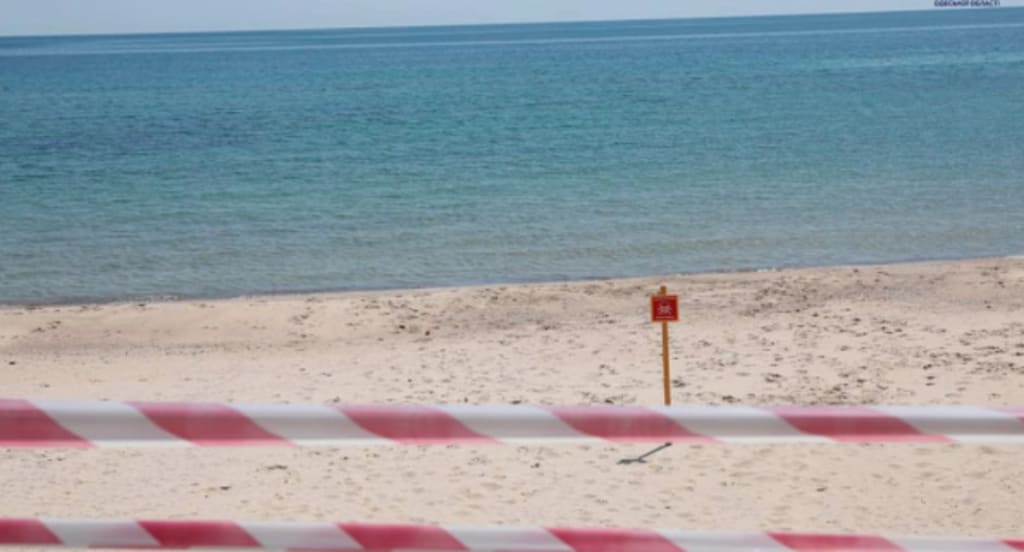
Today the wind is blowing from the sea and the stench is fading away as if it had never even permeated this quiet sandy beach.
My hands are sandy and black with dirt after adding old wooden planks to the fire.
Our fire pit is primitive, made of old bricks and stones that Dima collected from the nearby street. Some bricks have a shiny modern look and don’t really fit into the general picture of the chaotic life around us. They seem to belong to another dimension of time, when local fashionistas trotted down brick-paved streets surrounded by rows of sleek designer shops, overflowed with prams and filled with waffle ice cream and the positive news of the day.
I never knew that I would pay attention to the bricks…but the past few months have shown that in our current lives we are all dismantled, uprooted and thrown into the line of terror – just like bricks.
“In the line of fire, ordinary people and road bricks become the same.”
“What are you talking about?” Dima says and looks at me as he fixes the fire with his big hands.
I realize that I’ve probably spoken out loudly and my words do not make any sense.
“You don’t make any sense!” says a summerly dressed woman, sitting across from me on the other side of the fire pit.
I don't think I know her. She is skinny and blond and looks very scared, almost small, like a child-like girl, her face covered in heavy makeup and dust.
“I must be dusty myself,” I think.
“They were continuously attacking the metallurgic plant all night,” says Dima in a gloomy voice.
“He must have been somebody important in the past, like a manager,” I think.
I remember how we met. I came to the city orphanage to deliver humanitarian aid, a heavy load of laptops for schools that I had brought with me from Canada. Dima was also there, in city school No. 23, where orphans studied. That day, he brought a truckload of lemonade to the orphanage.
I remember having a brief conversation with him and then quickly forgetting about the whole episode, not really paying attention to the people around me but just focusing on my mission. I guess I wanted to be important!
But then, a week later, the piercing sirens started wailing day and night, and everything in this peaceful city around me fell apart right around me.
This war, the humanitarian catastrophe and the constant shelling in the city caught me off guard.
Involuntarily, I missed a couple of easy exits and overcrowded buses that Grandpa had carefully planned for me as a backup exit escape.
My fate pushed me to stay and suffer sleepless nights and empty days, helping my Grandpa with his everyday chores and trying to plan our future escape from this surreal tragedy of life that turned into a bloody war shaking everything around to fell like dominoes on a table of a bleeding map of Ukraine.
I might have double vision. It takes time to understand what is going on around me.
Four men and one woman sit around a fire pit on a sandy beach in front of a bonfire made of whatever remains of our lives, surrounded by a cemetery of beach umbrellas and deck chairs that once served their normal purpose.
The long, comfy chairs around us have broken legs, their striped bodies torn. Beach umbrellas have lost their heads and tops. Their metal legs are scattered here and there on the dirty sand.
I’m cold, the spring wind is not very inviting, and I try to get closer to the fire.
Black smoke drifts above the fire pit, and every now and then, my hair catches ash and smoke. The smoke travels back and forth. During some of these puffs of black reality, I hold my breath and try not to inhale.
It is hard to believe, but just a couple of weeks ago I was also serving a real purpose and being useful in this life.
Thinking about life doesn't seem to do much good when you have a headache, but I still ask myself: Why did I even travel six thousand miles to a city I had only seen once as a child?
My head hurts and pounds.
“Lena, are you OK?” somebody says very quietly.
I see the face of a bearded man staring at me. He seems to be shouting, but I can hardly hear his voice.
The man looks young, but his tanned face is strangely surrounded by a large stack of a gray hair. I don’t know him and I don’t know what to say.
The woman in front of me starts eating from a small plate.
I realize that there is also a small plate in front of me, and I see that the rest of the people around the fire pit have already started eating.
“There were three elephants at the Zoo,” says another man. He scratches his bushy beard as he talks.
The long-sleeved sailor's T-shirt he wears is tattered and torn, dirty and dusty, with small and large holes around his chest.
My head still hurts. I suddenly remember packing my bags in Canada. There were gifts for my Grandpa and laptops for the orphanage, which I promised to deliver personally. Three big shiny suitcases that I was so proud to take with me! These were my gifts, my gifts and donations: the symbolic ransom I wanted to pay for the years of absence and neglect of this important part of my family outside of Canada.
Back then, before leaving, my own life was unimportant to me. It was packed as a small stash of personal belongings and only took up a small corner in the suitcase I brought for a short trip.
I was supposed to stay for two weeks, yet now it feels like I’m stuck in this city for an eternity.
The flashy pink roses on the woman’s dress sitting across from the fire pit made me nervous. Her dress and the bright lipstick she wears do not belong in this gray distorted picture of the day.
“I counted a hundred bodies yesterday …. and this morning we took out more than fifty corpses,” says Sergey and slaps his knees, as if trying to get rid of the last memories.
In fact, he is just blowing red campfire sparks and ash off his pants. They look old and muddy. It looks like he’s been wearing them since February or March.
“Where did you take these bodies, Sergey?” the blond woman asks, and I finally hear her voice, which sounds deep and sexy, but it doesn’t fit.
“We moved and put them all in the mall, right on the cement floor.… the mall is now a morgue…there are hundreds of bodies there, no freezer or any ice, so you can imagine the stench,” he says, continuing to eat.
I see the woman’s eyes rolling and almost popping out of their sockets. I think I know both of these people, but I have such a headache that I could easily be wrong.
Sergey treats himself to a piece of meat sizzling on a large metal bicycle wheel placed over the fire. Meat juices and fat flow through the spokes and sizzle on the silver coal heads on the ground.
“They made a nice dinner,” I think to myself.
“How are you feeling, Lena?” Sergey asks me.
“I am fine, why do you ask?” I mumble.
“Well, I am glad you’re all right, because we pulled you out of the rubble just yesterday … Do you remember anything?”
“I remember everything!” I answer right away, but feel that it is not so.
“What is the last thing you remember? Does your head still hurt?” says the woman, and the sounds she makes do not match the movement of her mouth.
I can see her screaming, or maybe I can’t hear well.
I decided not to answer and ignore the conversation.
Around me are guys in camouflage uniforms and tattered old clothes, and the woman’s flashy summer dress looks very awkward by the fire pit.
A man in a sailor’s T-shirt chews his meat and continues…
“Today, three elephants in the Zoo had to be put to sleep. There was no food to feed them, and their little enclosure had too many shell holes. Two elephants broke their legs and were in pain. I had to shoot them myself.”
It sounds like a small report of the day, but the people around the fire pit do not even raise their heads. They continue to eat pretending they don’t hear anything, or it could just be because their ears get used to hearing about so much human suffering that news of poor elephants won’t even register.
Looking from afar, I see that Dima’s jacket is burnt around the edges; his left knee is wrapped in some kind of medical gauze. He looks tired and eats his food in a hurry.
There are bottles of lemonade for everybody.
“Our last picnic on the beach!” the woman says theatrically, looking at the lemonade as if it were the only reminder of non-existent normal life.
“Why are you telling us about these animals?” she adds, shaking nervously. “Eight Russian soldiers raped me two days ago and none of you even care,” she says as if in disbelief, forgetting about her food and starting to sob.
“Why should I care about stupid elephants and their Zoo?
I tried to kill one of the last guys who raped me, you know…I tried to do it when all the other guys left,” she says, almost smiling through the pain.
“What happened next, Zoya?” asked the man with the silver beard, forgetting about his food. You are a poor soul!”
“What happened, what happened?” she chuckles…”He strangled me instead!” she burst into laughter and her skinny body began to shake side to side.
The bearded man doesn’t know what to say and starts laughing too.
I feel that I am not hungry anymore. This couple terrifies me more than the beach itself and even more than the meat we eat.
“My Grandpa worked as a Zoo consultant,” I still say quietly, trying not to spoil the memory I treasure.
“The last time I visited him, ten years ago, we fed three young elephants together. Then he took some pictures and made notes about their daily routines. It was part of his job; back then I envied his life,” I say, addressing Dima and the other men who are not laughing.
Dima stayed silent. He is probably one of those guys, who always hesitates how to act and respond.
I feel like he wants to control the situation and our gruesome beach barbeque, but he does not say anything.
“For the second time in my life, I visited my grandpa in February of this year. I finally got a break from school and decided to come and do it, not knowing what to expect. I just didn’t know him and wanted to learn more about my family roots. You know, my Grandpa was patiently waiting for me.”
The crowd is silent, and I continue.
“I prepared your room. Can’t wait for you to come!” he said to me on the phone when I called to say Happy New Year,”
I almost cried.
I felt more and more sadness return to my chest. It began to push at my heart and lungs, devouring everything inside.
None of the people around the fire reacted to anything I said. They just kept to themselves and finished their meal in silence.
Tears came to my eyes. I could feel their bitterness and salt on my cheeks. In a few seconds, the wind blowing from the see smears tears all over my face.
Suddenly, a man with a silver beard began to shout after hearing me speak.
“Wishing you a Happy, Happy New Year, 2022!”
I didn’t expect it, but he acted as if I weren’t there.
“I am sure… This is going to be the best year of your life, kids! Get ready to be happy! Drink more champaign!” he began to scream and jump on the sand, raising his dirty hand and pointing it to the sky.
I turn away and cannot let go the memories of my Grandpa.
“Do you remember your little horizontal bar and hanging upside down like a monkey when you came last time?” his soft voice asked me over the ocean, miles and miles of clouds between us, when I called him…
I do remember his town house with a small orchard and large windows. My Grandpa smelled of grass and old photos.
“The film goes through a developer, bleach, fixer and stabilizer, and then a dryer”, he used to say when teaching me how to properly develop pictures.
A year ago, our family in Canada learned that out that Grandpa Tolia was dying from cancer. He refused to move, so my mom came every three months to look after him, and then with the approaching of February, it was my turn to visit.
Four men and two women were still sitting around the self-made fire pit.
I do not eat and look at the people around. My vision is still blurry from last night’s explosion.
The blonde lady is no longer laughing. She is talking to a guy in a long sleeved T-shirt. Instead of answering, he gives her an apple from his pocket. They are like a team.
Dima is standing not far from me. He is the only one standing.
Smoke from the fire rises to the sky. I’m surprised I don’t see any birds around the beach.
“Our citizens have eaten all the seagulls in the last month, you know,” he says in a hoarse voice, still looking at me in disbelief. Then he adds, as if trying to redeem the citizens of his beloved city and the whole world… “People are starving, Lena!”
“What kind of meat do you think we’re eating now?”
“I can’t believe this is happening in the twenty-first century!” I can only shout back at them and try not to look at the improvised grill on the bicycle wheel.
The gray smoke from our fire rises higher, and I suddenly see twelve-story buildings burned to the ground, the cranes of a modern port broken in half, and a seashore town that once flourished on the shores of the Sea of Azov. Instead of wide modern streets, bomb pits opened their mouths in an abyss that stretches to the very horizon. This manmade catastrophe has neither beginning nor end.
Houses crumble and their balconies fall as the last signs of hope. The ones that haven’t fallen yet are swaying left and right, the stones are falling without any sound, or maybe I can't hear well yet.
“You hit your head when you fell there, in the house. Or, so to speak, the wall fell on you after Russian planes attacked our street”, I learn from the silver-beard man.
“I do not remember that!” I say. “Who are you?”
“I am Maxim, a fighter pilot of the Russian Federation, but I’m Ukrainian and my mom lives in this city, he says half smiling….”
“You probably heard on the news that two days ago I bombed my mom and the city where I was born…You know, I couldn’t disobey the orders I had…You probably would have done the same,” he adds, gulping his lemonade.
“Later I hanged myself,” he adds without hesitation.
The narrow neck of the bottle in his hands shines in the early morning light, like the wing of a fighter jet, reflecting the waters of the sea…
I do not want to say anything. I feel horror and a big lump in my throat.
If this is a dream, I want to wake up from this nightmare and these dead souls gathered around the fire pit.
The blond woman in the pink dress is again laughing and crying alternately. I look at her closely and notice the red scratches and then blue and green strangulation marks on her chest and neck.
The faces of the men sitting on the sand around the fire pit are cloudy as a Canadian Milky bar chocolate that I will probably never see again in my life.
My head spins and hurts. I find myself stretched out on the sand.
Dima turns to the rising sun, and I notice that his head is chopped in half. From Dima’s left temple, grayish mushy brains and sticky blood pour in a waterfall. He looks at the horizon and walks forward. I can smell his blood.
The wind stops blowing from the sea, and the distinct stench of dead bodies that filled this once-thriving touristic city envelopes everything around me, crawls into my nostrils and makes me gasp and vomit.
Nausea does not go away.
I look at the fire pit. It is still burning, but there are no people around.
I am left alone on the sand, like a deserter or an imposter who has come to save freedom and was left with nothing.
“Forgive me!” I hear.
I turn my head at the sound and see my grandpa standing in the empty doorway that was never there, the morning sky shining behind him.
“The walls in my house weren’t strong enough to protect you from bombs!” he says and begins to cry.
He sobs and covers his eyes with wrinkled grayish hands. I try to get up and hug him like a child. My Grandpa still wears an old checkered half-sleeve shirt that I sent him years ago from Canada. He smiles and waves at me as if I am going on a fieldtrip and will be back soon.
“The only thing you need to remember is the address of a Canadian Embassy abroad!” my sister Nina told me back in Vancouver.
Her words and voice still ring in my head. I am sitting on the cold morning sand by the Sea of Azov, filled with bombs and corpses.
I think I’m ready to go.
The fire glows and the smoke rises to the morning sky. There is no one around me.
I am a small dot surrounded by burnt buildings, overturned cars and headless corpses inside them. I am washed by the stormy groundwater, splashed with debris and covered with the stench of a dead city. I am still here and I exist.
My grandpa is slowly walking away from the beach. His body begins to glisten in the rising sun, and after a couple of minutes, I can only see his silhouette disappearing over the sand.
Three gray elephants follow him. They walk slowly behind, as if pulled by the rope of fate.
My head hurts and my body is shaking from yesterday’s explosion.
It is time to leave Mariupol for now.
July 3rd, 2022
About the Creator
Mamamera
I create moss art, I have met more friends than enemies, lived in Ukraine, Georgia, England and Canada.
I love traveling, volunteering, attending jazz concerts and opera, snowboarding and writing short stories. My goal is to share.


Comments
There are no comments for this story
Be the first to respond and start the conversation.