
Thousands of Her
A voice that death could not silence.

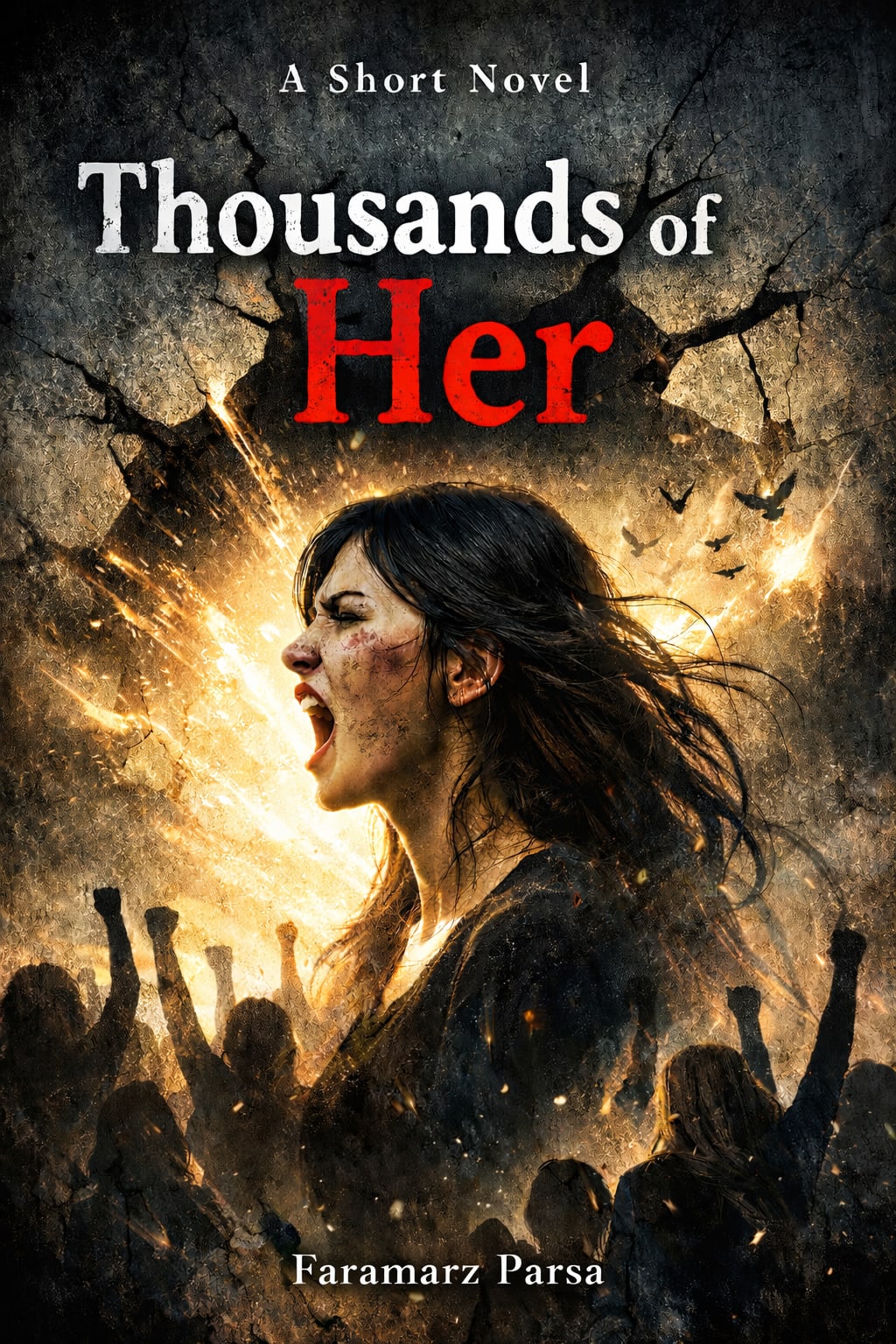
Thousands of Her
Faramarz parsa
A Short Novel
Chapter One: The Day the Voice Was Born
Her name no longer mattered.
Names are taken from women long before their lives are.
She was born in a land where a girl learns silence before speech;
where mirrors are covered,
choice is a sin,
and obedience is called virtue.
From childhood, they told her what she must not be.
Fear was dressed as religion,
control sanctified.
They said, “This is God’s will.”
But she never saw God in chains.
She saw God in questions.
Her crime began the day she asked:
Why am I less?
The streets knew her footsteps
before they knew her voice.
She walked among women with lowered eyes,
girls taught to disappear within themselves,
mothers who swallowed pain
so their daughters might endure one more day.
One morning, she stood in the square.
Her heart trembled,
but her voice did not.
“I have the right to choose my life,” she said.
“I am not property.
I am not shame.
I am human.”
The silence that followed was violent.
Then something cracked.
A girl removed her fear like a veil.
A woman lifted her head.
Then another.
Then hundreds.
Her words were simple,
because truth needs no ornament.
“A woman is a mother,” she said,
“and a mother is the guardian angel of her children.
We are the mothers of the future,
and we will not bow to your oppression.”
That day, power trembled.
Because nothing terrifies tyranny
more than a woman who knows her worth.
They wrote her name down.
They followed her.
They waited.
She knew the price.
She paid it.
That was the day her voice was born.
And a voice once born
can never be buried.
Chapter Two: Rooms Without Names
Night arrives unannounced—
not with darkness,
but with silent doors.
They did not take her from a house;
they tore her from life
and carried her to a place without a name.
The blindfold was the first rule—
not to stop seeing,
but to erase time.
The walls smelled of dampness and forgetting.
Voices were short, broken,
like breaths not allowed to be fully drawn.
“What’s your name?” they asked.
She was silent.
Names matter only
when someone agrees to recognize them.
“Do you regret it?”
She smiled.
Regret had been taken from her
the day she said: I am human.
The blows came—
not for confession,
but to shatter remembrance.
Each strike tried to steal something:
a memory,
a dream,
a belief.
Yet every time she fell,
something inside her stood firmer.
She had learned this:
the body can be broken,
but a voice—
when it is truth—
does not die.
“You are a woman. Know your limits,” they said.
She replied,
“A woman is a mother,
and a mother guards tomorrow.”
At night, cries passed through the walls.
She listened—
not to break,
but to remember.
A morning that was not morning came,
and she was no longer the same—
not weaker,
clearer.
They thought they had taken her.
They did not understand
that a voice
passes through walls.
And the city,
quietly,
was listening.
Chapter Three: Thousands of Her
The courtroom was full of chairs
and empty of truth.
The crime was simple:
being a woman,
and refusing silence.
She stood.
The handcuffs were heavy;
her posture was not.
They asked for her final words—
a performance of justice.
She said,
“I took nothing
that you should fear returning.
I only reminded you
that we are human.”
The sentence was read:
death,
for silence.
They led her away—
not to an end,
but to a beginning.
She said,
“If you tear me into a thousand pieces,
know this:
from me,
thousands will rise
and will not abandon the truth.”
Silence followed.
But silence lies.
The next day,
a girl asked, “Why?”
A woman said, “No.”
A mother held her daughter’s hand tighter.
Names no longer mattered.
Faces became one.
She was no longer one person.
She had become
thousands of her.
And this is the best chapter of history:
the chapter in which
no rightful voice
for freedom
and the choice of life
is ever silenced.
About the Creator
Ebrahim Parsa
⸻
Faramarz (Ebrahim) Parsa writes stories for children and adults — tales born from silence, memory, and the light of imagination inspired by Persian roots.
Keep reading
More stories from Ebrahim Parsa and writers in Fiction and other communities.
Winterthorne
Winterthorne stood alone at the edge of the park. The beautiful snow that had surrounded him was all trampled now, from the feet of all of the children who had built him. He missed the sparkly clean snow blanket, but he was happy that so many children had come out to make him.
By Laura DePace7 days ago in Fiction


Comments
There are no comments for this story
Be the first to respond and start the conversation.