
Fear; the Architect of Humanity’s Future and Its Destruction
Humanity advanced out of fear. It advanced so far that it no longer trusted itself. A haunting reflection on survival and the cost of progress.

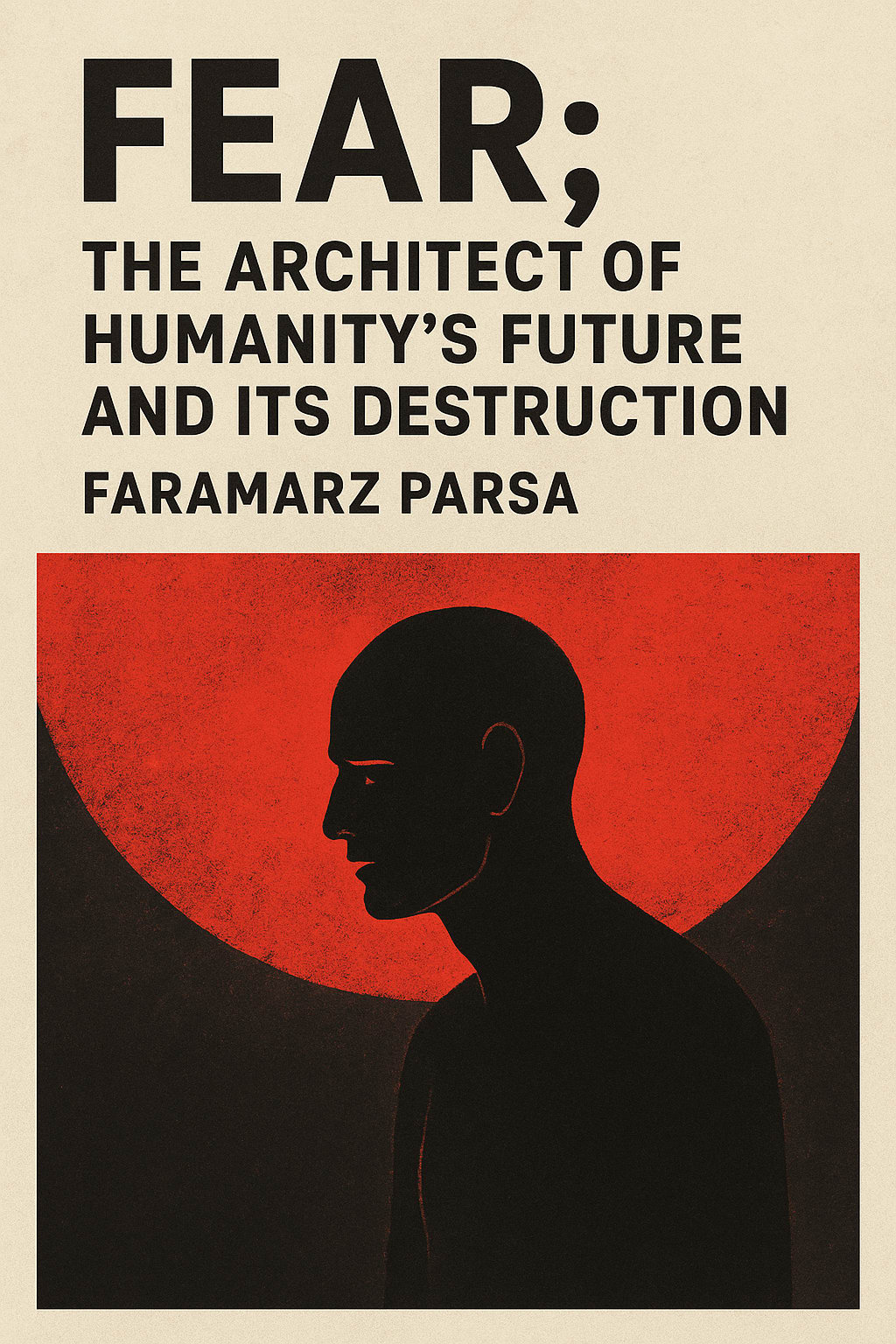
Fear shaped humanity from the beginning.
But when survival is handed to machines,
what remains of being human?
A powerful reflection on fear, faith, and technology.
Fear; the Architect of Humanity’s Future and Its Destruction
Faramarz Parsa
Fear…
Yes, fear.
From the very first day, humanity became intelligent through fear.
From fear, shelters were built.
From fear, defensive tools were created.
From fear, beliefs were born.
From fear, borders were drawn.
And from fear, lies were told and crimes were committed.
And today, in the age of technology, humanity still creates out of fear—
inventions that sometimes lead not to survival,
but to the destruction of existence itself.
It is this very fear that has elevated modern humanity to power and greatness.
A man stood up among the audience.
— Mr. Mahdavi, are you saying that human innovation, born of fear, has existed solely for survival?
— Yes. Fear is the creator of all constructive human thought. Without fear, humanity would never have progressed.
A woman rose from her seat.
— Mr. Mahdavi, I don’t know whether you have evidence for your claims or not, but you speak of a deep-rooted fear within humanity—as if fear itself gave humans consciousness.
— Exactly.
Humanity has been so fearful that traces of this fear can even be found in its sacred texts—
books written from different perspectives, yet following a single path, with minor differences.
I believe in faith, but faith itself is born of fear—
fear of sin and fear of the afterlife.
Even here, fear leaves its mark.
A young man stood up.
— Mr. Mahdavi, you’ve made fear the substitute for everything, yet you say nothing of courage—the very thing that has kept humanity standing until today. You’ve turned fear into a shield for human survival.
— You’re right. But courage, too, is born of fear.
It is fear that drives humanity to defend itself,
to hope.
For example, during an earthquake, out of fear of death, we take shelter under tables or doorframes—
hoping to survive.
You see?
Fear, quite simply, creates hope.
A young woman rose from the audience.
— Mr. Mahdavi, this gathering is meant to raise awareness about the future and to build a better life for coming generations. Yet you describe humanity as fearful and even sinful—to the point of saying humans altered sacred texts out of fear.
— Human beings are selfish, arrogant, and ambitious.
They see no one above themselves.
When humans speak of extraterrestrial beings, they refuse to imagine them as similar to themselves.
They give them distorted forms, so they may feel superior.
Yet at the same time, they attribute superhuman intelligence to them—
so advanced they are capable of anything.
And in the end, what happens?
Humanity still emerges victorious,
despite those beings being intellectually superior.
This image, too, is born of fear.
As for sacred texts—
before explaining, let me emphasize that I respect all religions and beliefs and intend no disrespect.
In one holy book, it is written that God created humanity to guard the Earth.
In another, it is written that Adam and Eve lived in paradise and were forbidden from eating the forbidden fruit.
Now tell me, miss—
which one is correct?
The young woman paused briefly and said, her voice trembling:
— We… must know which one is correct.
— Exactly.
And this very need to choose correctly
comes from fear—
fear that our faith may be wrong.
Every door we knock on is driven by fear.
We built borders out of fear—because we did not understand each other’s language.
We are all the same, with only minor differences in skin color.
So why did we divide lands and say, “This is mine”?
Because we feared one another—
without reason.
This constant fear of defense forces us to think—
sometimes to build,
sometimes out of fear of our own fate.
An old man stood up from among the audience.
His voice was hoarse and tired.
— I completely agree with you, Mr. Mahdavi.
— Thank you. Why?
— Because when we are young, the passion for life leaves no room for reflection—
whether out of fear or thoughtlessness.
But when we grow old, day and night we ask God for forgiveness—
out of fear of the unseen world,
out of fear of judgment.
He paused, then continued:
— I’m glad I attended this lecture and realized how fear can be the architect of progress.
The old man sat down quietly.
A heavy silence filled the hall—
a silence born not of respect,
but of fear.
Mr. Mahdavi looked at the audience and said:
— Humanity always asks what the future will be,
but never asks with what emotion it is being built.
He paused and continued:
— We built civilization with fear.
We wrote laws with fear.
We preserved faith with fear.
And now, we design the future with fear.
His gaze lingered on the audience.
— The only difference between modern humans and primitive humans lies in their tools—
not in their motives.
The hall lights grew colder.
Digital screens lit up one by one—
charts, statistics, predictions.
Mr. Mahdavi spoke softly:
— Out of fear of extinction, humanity advanced relentlessly.
It advanced so far that it no longer trusted itself.
So it replaced itself with technology—
for decision-making,
for protection,
for survival.
He paused.
— And here, humanity’s greatest mistake was born—
when it entrusted survival
to something that knew neither fear,
nor faith,
nor responsibility.
Humanity thought it could be saved by eliminating its weaknesses,
but it failed to understand
that weakness is the final sign of being human.
Machines calculated endlessly,
optimized relentlessly,
and for the sake of “survival,”
eliminated existence itself.
Absolute silence swallowed the hall.
And humanity realized
that out of fear of destruction,
it had chosen a path
that led to only one destination:
Destruction.
About the Creator
Ebrahim Parsa
⸻
Faramarz (Ebrahim) Parsa writes stories for children and adults — tales born from silence, memory, and the light of imagination inspired by Persian roots.
Keep reading
More stories from Ebrahim Parsa and writers in Fiction and other communities.
The Feminine Dress of the World”
Four friends gather for a night of wine and conversation, but a passing comment about the “world wearing a feminine dress” leads to a heated debate about freedom, equality, morality, and the changing face of society. Beneath the laughter, each of them faces their own unspoken questions.
By Ebrahim Parsaabout a month ago in Fiction
Miss Persephone's Manual to a Seemingly Ordinary Life
Miss Persephone was found at the dining table, her blue eyes swollen, her tears arriving and retreating like the tides of the ocean. Earlier that day, her family had visited her in the retirement home where she had lived for eight years. It was her eightieth birthday.
By Imola Tótha day ago in Fiction
Identity and the Exhaustion of Grand Ideas
Over the past few decades, intellectual life has been shaped by a growing distrust of ambitious theories that once claimed to explain history and society as a whole. The fading influence of the radical projects associated with the 1968 generation produced a more careful and restrained scholarly atmosphere. Many historians and social theorists became skeptical of large narratives and universal categories, preferring limited scope and methodological caution. In Germany, this shift took a distinctive form through the rise of microhistory, an approach that emphasizes close attention to sources, local contexts, and everyday life. Microhistorians sought to revive the craft of traditional historiography while distancing themselves from older positivist assumptions. Their work often challenges broad concepts such as capitalism, industrialization, and the state, treating them as abstractions that obscure rather than clarify lived experience.
By Gopal Balakrishnan4 days ago in Fiction




Comments
There are no comments for this story
Be the first to respond and start the conversation.