
She sat in roped handcuffs that scratched the circumference of her delicate wrists – ‘cuffs wrapped so tightly the skin on both arms had developed a blue veil. Her wrists were still fit for purpose, and so it would not matter if they turned blue, orange, red, or green. Pain must take a back seat to productivity, and Sophie accepted those wrists were no longer her own.
She had been in her dank, wooden work cell for what was, perhaps, two years. There were no windows to feel the seasons, but the rats who kept to their corner had birthed pups twice, and Sophie had reasoned that such an occasion likely only happened in the Spring time. Her black hair had frazzled and fallen in areas, and her dull clothes remained unchanged since her inauguration into the cell. She wore no shoes, and one of her small pleasures had become the rush of endorphins engendered from the rubbing of her right foot against the splintered ground to scratch between her toes. The nails of which had curled round the edge of each digit in all directions, just as the contorted form of haunted trees might twist and cripple and bend.
Five years ago Sophie had trained as an art teacher. She had planned to use this career as guaranteed entry from Scotland to America – having grown up with the notion that vast land masses were where life happened with gusto. She loved Scotland, but it was small, unambitious, and ultimately trampled upon. Sophie wanted to live somewhere that felt humungous and ripe with opportunity. Before such a move was realised, life had changed rapidly for everyone, and Sophie was surprised how much it was the act of painting she grieved most, as opposed to the possibility of travel or life happening with gusto.
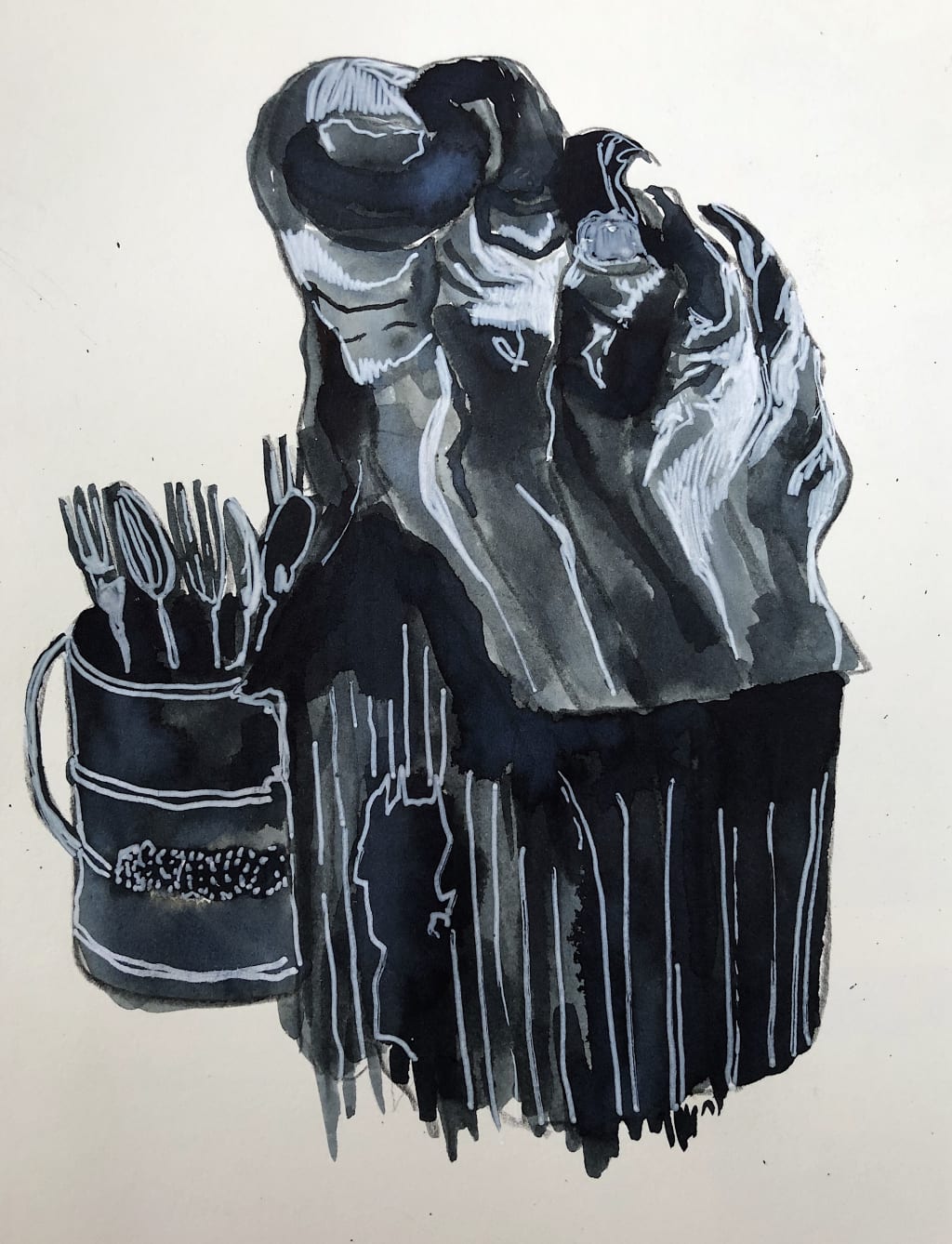
Longing to paint, sometimes she would stare at the decaying cell walls and imagine swirls of colour, shape, and pattern meeting to create visuals of her choosing as opposed to what she had been tasked to manufacture. She would remember the fluidity of a paintbrush in her hand and the feeling of sense and logic that arrived from brushstrokes layering and lines meeting to create accuracies or abstractions. In a world where art no longer mattered, Sophie’s role was now very different, and she was pragmatic enough to keep her imaginings at a distance in order to focus on what she needed to do to survive. Art was obsolete, no one left in Sophie’s world was interested in what she could create, and those who remained only cared to see what she would instead mass produce using flint in the absence of a knife: wooden cutlery.
Sophie was now Worker Number 48270, and had been chosen alongside thousands of others who shared in a modicum of artistic or practical ability. Painters, joiners, sculptors, dress makers – all taken from their homes and assigned different work cells in which to carry out their new roles and responsibilities. With the absence of metal tools caused by the theft of all reflective materials by the invaders – regardless of what we might have deemed valuable metals or cheap steel – high society rebelled against any new normal that might involve eating with fingers, gardening by way of knuckle, or cutting hair by twisting strands of dead keratin around palms and pulling until a painful snap revealed manageable lengths. Cutlery manufacture was but one tangent deemed necessary for the continuation of civilised society. It came at the cost of Sophie’s freedom and her identity, but high society did not care, provided it meant they could continue to eat with dignity and pomposity.
Sophie had limited experience in whittling – sculpture, essentially – but her painting ability and penchant for visualising three dimensional form seemed to lend itself well to the role. She had been thankful of this, as shortly after first entering her work cell she had heard the anguished cries of a man who had failed to carry out his assigned task. Whether through frustration, refusal, or sheer inability, the cries she heard had been followed by a piercing shot, and silence next door had travelled like an empty mist ever since. Sophie often wondered if she would be left to work until she died of another fate – of old age – and how ‘old’ she could possibly become given the dowdy circumstances of her new existence.
In the course of at least two years, Sophie had not been gifted the mobility to move from her seat to use the toilet, though it taunted her in the left corner of her cell. It became quite normal for her to feel the sting of urine disgust her legs, or the stench of excrement encrust her gaunt and woolly thighs. Sophie would visualise the day she might perish, and despair at her worthlessness in the immediacy in which she knew she would be replaced. Replaced by someone who shared in being that strange mix of useless yet useful towards the rebuilding of society. She supposed there might be some pride in this – being a single brick towards the reconstruction of civilisation – yet reasoned quickly this manner of thinking was surely a cousin of Stockholm syndrome.
The only soul she encountered in her work cell was a silent woman who entered daily, albeit briefly, to place a bottle of water and a plate of bread at her desk while removing Sophie’s cutlery output. Sophie assumed this repetitive, mute task was simply the daily visitor’s assigned role in a new society. She felt no animosity towards her for this reason, though for the first year she wondered what the woman’s background had been to make her so very appropriate for such an unkind task. The woman quickly became transient furniture – no more eventful or communicative than a daily alarm. She never looked at Sophie or suggested she was offended by her pungent smell, and Sophie never thanked her for the basic sustenance.
Sophie was not allowed to keep any of the cutlery she had whittled for her own meals, and this told her everything she needed to know about the world that now spawned outside her walls. She realised she would instead have to make her world inside as fair, as just, and as reassuring as it could be – before the rest of her life would be lost. Lost to old age; to urine; to excrement; to non-communicative daily visitors; to the silence of empty mist; or to the prospect of death and rapid replacement. Between carving uniform knives and forks, Sophie took her flint tool and began to chip away at an altogether more secret and spherical design: a heart shaped locket.
Sophie had not been overly interested in jewellery in her previous life, and she did not meet anyone significant prior to her imprisonment to justify any romantic intentions of capturing missed, cherished individuals inside a locket. However, as a child she wore lockets that housed images of childhood dogs, and so her mind returned to such a vessel for precious thoughts. Slicing, chiselling, and carving with a speed and sensitivity that outweighed any effort placed into the perfection of her cutlery, Sophie chipped away at the golden textures of wood until she had rounded two halves of a heart shaped locket. The locket was no bigger than two inches from left to right, and was compact enough for Sophie to stow it away inside her top at the end of every working day - preserving its integrity.
It took a further two years to gleam the locket to perfection. The most exposed layer of wood was so finely shaved that its beige, smooth undertone appeared like solid gold inside the otherwise darkened cell. Inside the locket, Sophie had carved the ridges of what still mattered to her – a life of boundless opportunities, and the possibility of a vast land mass outside her work cell walls, where life happened with gusto. No single person or animal featured – just land, the bumps of wood protruding to mirror the terrain of hills intermixed with the skyline of distant stars and industrious skyscrapers.
Decades passed. With years spent rubbing her locket at the beginning and end of her shifts – and with every finger following the contour of an imagined life elsewhere – Sophie fantasised of a life that was simply yet to begin.
The illicit locket was never exposed. On her dying day, aged approximately 64, Sophie had already stashed her unseen comfort where it lived at night, wedged beneath her right oxter. The locket had been her sole company for so long that as her own heart gave way and body shut down, Sophie had a brief moment to consider the clinical and perfunctory nature of life. Even in her final moments no one arrived to comfort her into the nothingness that surely awaited, and even her locket was not to hand. Life was no longer cruel nor comforting, it was just a series of events that had happened to her.
Sophie’s life had been used for a purpose, and she was replaced within an hour.
About the Creator
Keep reading
More stories from writers in Fiction and other communities.
The Duelist
The rays of a dying red sun flashed against the onrushing blade. The grey beards say the key to dueling lies in size, speed, reach, righteous fury, whatever the person in front of them pays them to say. Matteo knew better than any it was none of these and had an undefeated record on these sands to prove it.
By Matthew J. Fromm5 days ago in Fiction


Comments
There are no comments for this story
Be the first to respond and start the conversation.