
The Weight of the Empty Chair
The Silence We Pass Down

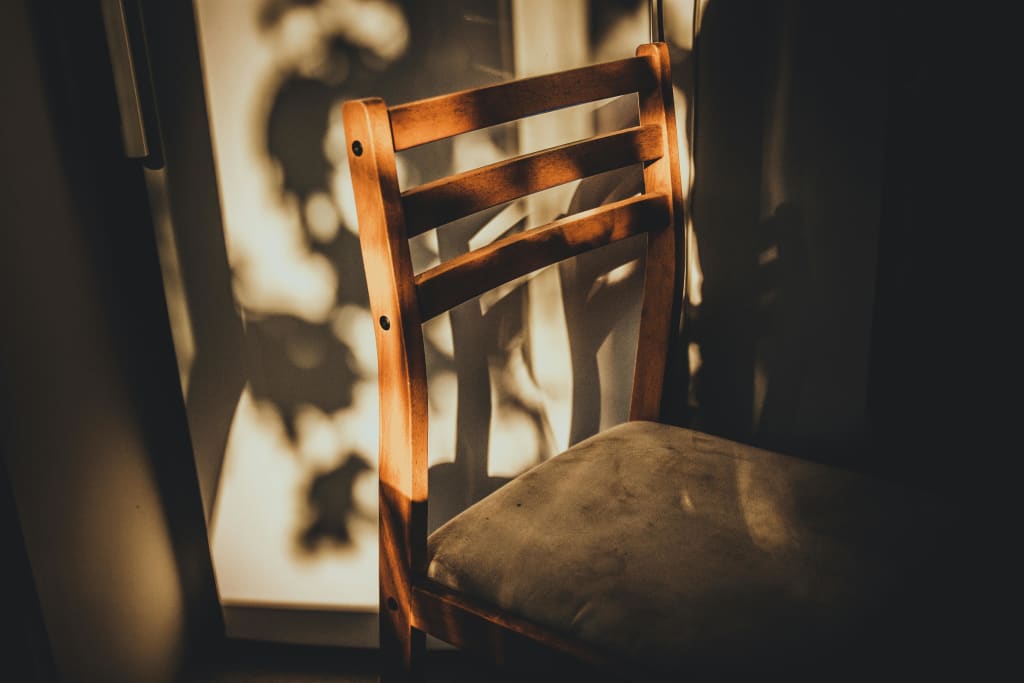
The smell of rosemary and pie filled the house, warm and too familiar. Rachel hovered in the doorway between the kitchen and the dining room, a damp dish towel still clutched in her hand. Her mother stood at the head of the table, folding a napkin with slow precision.
Not just any napkin—the good ones. Linen, cream-colored, ironed flat and stiff. Rachel’s chest tightened.
Nora laid the napkin across the empty plate like she was tucking something in, or someone.
Always the same plate. Same fork. Same damn chair.
Rachel opened her mouth to say something—maybe a reminder that they were already running late with the sweet potatoes—but stopped when she noticed Sam watching, too.
He stood behind her, barefoot on the tile, gaze fixed on the table. On the extra setting.
“Gram?” he asked, voice careful.
Nora didn’t turn. “Yes, sweetheart?”
“Why’s there an extra place?”
Rachel stepped in before the silence could stretch too long. “That’s not for you,” she said, gentler than she felt.
Sam tilted his head. “Then who—?”
“It’s just tradition,” she added quickly, almost sharply, then regretted the tone as soon as it landed.
Across the table, her mother adjusted the spoon by a fraction of an inch. Everything seemed to depend on getting it exactly right.
Rachel swallowed down the flicker of frustration. Sixteen years, and they were still doing this. Still pretending the chair meant something holy and not hollow.
She felt Sam looking up at her, waiting for an honest answer.
But what could she say?
It’s for someone we don’t talk about.
Someone you’ve never met but already feel.
She turned back toward the kitchen. “Go wash up, okay? We’re almost ready.”
He hesitated, then padded off.
Rachel lingered just a moment longer, watching Nora brush invisible dust from the empty seat. The ritual had always unsettled her—how quiet her mother became, how tender. Like grief could be folded into a napkin and set beside the mashed potatoes.
She almost said something.
But didn’t.
The gravy was thickening on the stove when Rachel noticed the quiet.
Too quiet.
She wiped her hands on her apron and called, “Sam?”
No answer.
She found him in the den, half-hidden behind the coffee table, a thick photo album spread open on the rug. One of the old ones—leather-bound, brittle with time. It must’ve been tucked away in the hall closet, behind the board games no one played anymore.
He looked up when she stepped in. “You were blonde?”
Rachel blinked, then smiled faintly. “Briefly. Poor decision.”
Sam flipped the page. His fingers were careful, reverent. Most of the photos were labeled in neat, slanted handwriting—“Eli & Nora, 1978.” “Rachel’s first steps.” “Easter, 1996.”
Then he stopped—a snapshot on yellowing paper.
Four people on a back porch. Rachel recognized the moment instantly: her younger self in overalls, a slice of watermelon in her hand. Her parents were seated behind her. And next to her—barefoot, laughing, wild hair in her eyes—her sister.
Sam tapped the image. “Who’s that?”
Rachel’s breath caught.
The girl in the photo didn’t have a label. No name, no date.
“It kind of looks like you, but older.”
“It’s no one. Just an old picture,” she said quickly.
He frowned. “But—”
“I said it’s nothing.” Sharper now. She hated how it came out.
From the kitchen doorway, her father stood half-shadowed. Eli. He didn’t speak, but Rachel saw the flicker in his eyes like he might say her name. Like he almost did.
But he didn’t.
Just turned and walked away.
Rachel sank down onto the arm of the couch. Sam had stopped flipping pages. He closed the album slowly, hands resting on top like he was holding something fragile.
“You don’t have to lie to me,” he said.
Rachel looked at him. Really looked. Thirteen going on thirty. Too old for half-truths. Too young for the whole story.
“I’m not lying,” she said softly. “I just… don’t know how to tell it yet.”
The turkey was perfect. Golden, glistening, carved into neat slices. Nora’s rolls sat in a basket lined with cloth, steam curling from their tops like breath. Everything looked exactly right.
That was the problem.
Rachel poured the sparkling cider. Eli lit the candles. Sam carried the cranberry sauce with both hands, as if it might explode.
They all moved carefully, too carefully, as if the house itself might shatter.
Nora stood at the head of the table again, hands on the back of her chair. Her gaze flicked once—just once—to the empty seat.
Then she sat.
Eli followed. Rachel. Sam, last.
The extra chair stood untouched, perfectly set, as it always was. No one looked directly at it, but it held them all in its orbit.
Rachel unfolded her napkin and smoothed it across her lap. The motion calmed her, slightly, until Sam spoke.
“Why do we set a place for someone who isn’t here?”
The question landed like a dropped glass.
Eli’s fork paused in midair. Nora’s jaw tensed, her knife slicing through sweet potato with unnecessary force.
Rachel looked at Sam. His tone wasn’t flippant or cruel. Just honest. Wondering.
She cleared her throat. “We’ve talked about this.”
“No, we haven’t.” He looked around the table. “Not really.”
Rachel opened her mouth, but Nora beat her to it.
“We don’t discuss that at the table,” she said.
Rachel’s eyes snapped to her mother. The words were soft, but heavy. Almost rehearsed.
Sam didn’t back down. “But we always set the chair. Every year. Like it matters, doesn’t that mean we should talk about it?”
The air tightened. Even the candles seemed to burn quieter.
Eli’s voice came next, barely above a whisper. “Eat your dinner, Sam.”
The boy’s face flushed. He glanced at Rachel, then dropped his gaze to his plate. He didn’t touch his food.
Rachel forced herself to take a bite of stuffing. It tasted like nothing.
Across from her, Nora reached for her wine glass with a trembling hand.
The empty chair remained, still and silent and watching.
The memory came uninvited, as they always did—full-color, full-sound, far too sharp.
Katie’s laughter rang out over the clatter of dishes, a sudden bark of amusement that startled even Nora. She was perched on the kitchen counter, barefoot, swinging her legs and picking marshmallows off the top of the sweet potato casserole before it hit the table.
“God, you’re such a brat,” Rachel had said, swatting at her. But she was laughing too.
“Someone’s gotta be,” Katie replied, stuffing another marshmallow in her mouth.
Nora scolded her—gently, almost fondly. Eli pretended not to see. The house had felt… warmer then. Messier. Louder.
Later, Katie refused the pumpkin pie. Declared it “baby food in a crust.”
She had stormed upstairs after dinner, music blaring through her door, a fight forgotten before the plates were clean.
That was the last time Rachel saw her with both feet in the house. The last time her voice echoed in the hallway. The last time her name was spoken without consequence.
Rachel blinked, pulled back into the present by the scrape of Sam’s fork. The clink of silver on porcelain. Her mother was chewing slowly, methodically. Eli buttering a roll he wouldn't eat.
She swallowed hard.
It had been sixteen years. But in the quiet between bites, Katie’s laugh still lived in the walls.
The mashed potatoes had gone cold. The conversation, such as it was, had dwindled to murmurs about weather and school and how long the rolls had risen.
No one mentioned the chair.
But Sam kept looking at it. Between bites. During silences. Like he was listening for something the rest of them had learned to block out.
He set down his fork. “If she’s not coming back,” he said quietly, “why do we keep pretending she might?”
Rachel flinched. The words were gentle, but they cracked something open.
“Sam,” she said, her voice sharp with warning.
He looked at her—not angry, not defiant, just full of that awful, honest curiosity. “I’m not trying to be rude. I just don’t get it. We act like this is normal. But it’s not.”
Nora’s hands went still.
Rachel opened her mouth, ready to say something—anything—to shut it down. But before she could, her mother spoke.
“It’s not pretending,” Nora said.
Her voice was thin, unused to this kind of weight. But steady.
“It’s remembering.”
Sam blinked. “Remembering who?”
Nora’s eyes didn’t leave the untouched plate.
“Katherine,” she said.
The name fell into the room like a dropped stone. Rachel felt it hit the base of her spine.
“Katie,” Eli said softly, almost a breath. “We keep the chair so we don’t forget the girl we lost. Before she ever left.”
The table was still. Even the ticking clock seemed to pause.
Rachel stared at her plate, throat tight. She used to hate the chair. Hated how it turned every holiday into a performance. A shrine. A lie.
But now, hearing the name again—spoken aloud, real—it didn’t feel like a lie anymore—just a wound they’d all refused to look at.
Sam’s voice broke through. “Maybe it’s not for her,” he said. “Maybe it’s for you.”
Nora inhaled, sharp and shallow.
The napkin in her lap trembled.
Rachel didn’t trust herself to speak.
After dinner, the table sat like a crime scene. Plates half-cleared. Candlewax dripped into the linen. The chair—that chair—still untouched.
Rachel washed dishes in silence. Eli dried. Nora didn’t join them, just disappeared into the den, the sound of her footsteps swallowed by the carpet.
Sam had gone quiet, too. Not sulking, just thoughtful in a way that made Rachel ache. She wanted to be proud of him—for asking the questions she never could. But mostly she just felt tired.
When the last pot was scrubbed and stacked, she went looking for him.
She found him in the dining room.
He sat in the empty chair.
Not slouched or playing around—just still, like he was holding a vigil.
Rachel stayed in the doorway, unseen.
He looked down at the plate, then over to where she had sat earlier. Then, with a quiet little breath, he whispered, “Hi. I don’t know you. But I think I’m supposed to.”
Rachel’s throat tightened.
From the hallway, movement. Nora.
She stepped into view, saw Sam, saw the chair—but didn’t speak. Didn’t scold.
She just stood there, hands at her sides, eyes shimmering.
Rachel moved beside her, close enough to feel the heat of her mother’s grief, but not touching.
Sam didn’t notice. Or maybe he did.
He sat there for a few more seconds, then stood and walked back into the living room, his expression unreadable.
Nora didn’t move.
The table remained. The candles had burned low. The extra chair still faced the empty plate.
Rachel reached for the napkin, ready to fold it away. But her mother stopped her with a hand on her wrist.
“Leave it,” she said. Quiet, final.
That night, for the first time, they didn’t put the chair back in the attic.
About the Creator
Oula M.J. Michaels
When I'm not writing, I'm probably chasing my three dogs, tending to my chickens, or drinking too much coffee. You can connect with me @oulamjmichaels
Keep reading
More stories from Oula M.J. Michaels and writers in Fiction and other communities.
Still Life, With Peaches
The house waited at the end of the gravel road, sunlit and still. Nothing stirred but dust in the wind. From the car, Stephen could almost believe it hadn’t changed. The porch slouched gently in the late afternoon light, the swing held its crooked smile. Ivy climbed the railings as if time had simply paused to let it grow.
By Oula M.J. Michaels6 months ago in Fiction
All Very Straightforward!
Thanks for watering our garden while we’re away. The last person overwatered and several plants died. Here’s the house key, the front lock is a bit tricky. Be sure to check it has actually locked. There’s not much to know… it’s all pretty straightforward. No need to take notes, we’ll show you around. I’m sure you’ll be fine.
By Angie the Archivist 📚🪶5 days ago in Fiction


Comments
There are no comments for this story
Be the first to respond and start the conversation.