
Still Life, With Peaches
A house full of silence, a bowl full of lies


The house waited at the end of the gravel road, sunlit and still. Nothing stirred but dust in the wind. From the car, Stephen could almost believe it hadn’t changed. The porch slouched gently in the late afternoon light, the swing held its crooked smile. Ivy climbed the railings as if time had simply paused to let it grow.
And there—right where it always had been—sat the bowl of peaches.
He killed the engine, let the silence press in. No birds. No cicadas. Just the faint creak of the swing chain rocking without movement.
As he stepped out, gravel crunched beneath his shoes—a sound he’d once known like breathing. The porch glowed gold, just like in the painting his mother used to hang above the fireplace. But as he approached, the details betrayed the illusion.
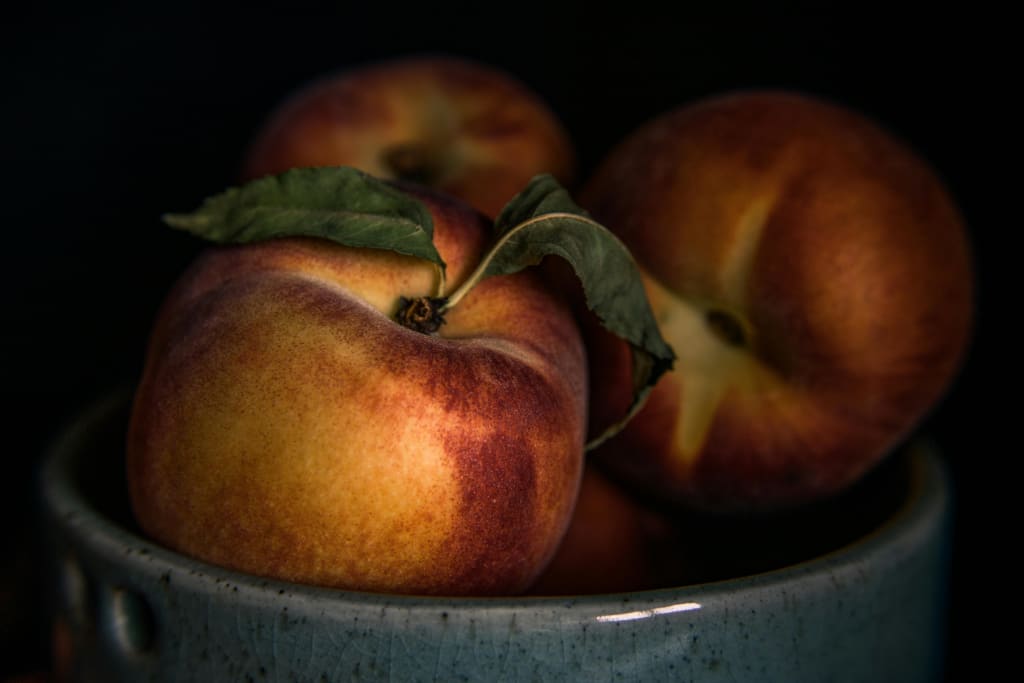
The peaches were wax.
One had a long split down its side, revealing pale plastic beneath the blush.
The swing chain jerked once in a breeze he couldn’t feel.
He paused at the bottom step. Sixteen years gone, and the house looked as though it had been waiting for this moment. Preserved. Curated. Like a memory framed too tightly to breathe.
Stephen took a breath and climbed the stairs, unsure whether the ache in his chest was nostalgia or warning.
Marsha Phillips had died two weeks ago in her sleep, according to the brief note from the nursing home. Congestive heart failure, likely. No drama. No funeral, per her instructions.
She’d left the house to Stephen, along with the antiques, the utility bills, and the silence they’d both kept for over a decade.
Now it was his.
He hadn’t spoken her name aloud since the call came. Hadn’t spoken at all, really. Just packed a bag, left the studio light on, and drove north toward the place he used to sketch in secret beneath the maple trees.
The porch felt like a photograph someone kept straightening—everything just so. The bowl hadn’t moved, though the dust had claimed it. A thin halo of grime traced its base, untouched for years.
He didn’t go inside. Not yet. Instead, he sat on the top step, the wood still warm from the sun. The air smelled like dry earth and fading summer. Memory buzzed faintly around him, like an insect he couldn’t quite swat away.
“She never let anything rot,” he said aloud, though no one was listening. “Not even fruit.”
He glanced toward the swing, remembering the way it used to groan beneath his father’s weight, how Charles would peel ripe peaches with his thumbnail, juice staining the porch like little sunbursts. The wax ones looked real from a distance, but up close, they were too perfect. Too still.
A wasp circled the bowl, confused, then flew off toward the ivy.
Stephen rubbed his hands on his jeans. He didn’t know what he’d expected. An echo, maybe. Some faint resistance in the air. But the house gave him nothing.
Just the curated hush of a stage set waiting for its final act.
He stood, pulled the key from his pocket, and turned toward the door.
The door opened smoothly, without protest—no groan, no drag—just a soft click and the sigh of stale, conditioned air.
Inside, the house was immaculate. Polished wood floors. Shelves dusted. A faint scent of lavender and lemon hung in the entryway, familiar enough to raise goosebumps. Marsha’s signature blend. Synthetic peace.
Stephen stepped inside slowly, as if the quiet might rupture.
The kitchen was pristine. No dishes in the sink. No mail on the counter. The fruit bowl there—empty but shining—rested beneath a window with white curtains drawn exactly even. No magnets on the fridge. No photographs.
He opened a drawer beside the sink. Inside: a stack of unused sympathy cards, all blank. In another drawer, carefully cut newspaper clippings—weddings, honor rolls, cheerful town announcements. Nothing sharp. No obituaries.
In the living room, the furniture stood in stiff formation. The air conditioner clicked on, and he flinched. Too loud. Too sudden. He clicked it back off and moved through the rooms slowly, like walking through someone else’s memory.
At the end of the hall, the sunroom door.
It was closed, not locked. The brass knob was cool under his hand.
He didn’t open it yet.
Instead, he turned down a narrow hallway—toward the room that used to be his father’s study. It had become a catchall space in later years, mostly forgotten. Dust bloomed along the crown molding, undisturbed. The air was heavier here. Older.
Propped against the far wall was a painting wrapped in waxed paper. He tugged the cover aside.
There they were: the porch steps, bathed in warm light. The swing. The ivy. The bowl of peaches. Shadows are soft and smudged like a memory fading at the edges.
At the bottom corner, Marsha’s looping script: Still Life, With Peaches – 2003
He stared at it for a long time. The composition was perfect. Balanced. Every line was calculated for comfort.
A lie, but a beautiful one.
He turned the painting face-down and leaned it against the wall. Something tugged at the edge of his vision. Outside, through the study window, the porch gleamed again in the late sun. The bowl of peaches still sat there—unchanged, unmoved.
But just behind it, something caught the light. A corner. A reflection. A sliver of white tucked flat against the wood slats.
Stephen stepped back, heart ticking.
He hadn’t seen it before.
He wasn’t supposed to.
Stephen stepped back onto the porch, the screen door hissing shut behind him.
The sun had dipped low, setting the whole yard ablaze with gold. His shoes felt too loud on the planks as he crossed to the bowl. The wax peaches sat in their perfect pyramid, unmoved even by time.
He reached out and gently lifted the bowl with both hands.
Underneath, tucked flat against the grain of the wood, was a photograph.
His breath stilled. He didn’t move for a moment—just stared at the edges of it, yellowed but clean as if someone had pulled it from an album just recently.
He slid it free.
It was a family picture—him at seventeen, all elbows and awkward height. Marsha beside him, hands folded just so, her smile porcelain-perfect. And on the far side, a clean slice where someone had once stood. The third figure was missing—cut away with surgical care.
But not completely.
The shadow remained. A shoulder. A sliver of a shoe. The curve of a hand that had once rested near Stephen’s own.
He didn’t need the rest of the image to know.
Charles.
His father had stood there once.
He sat down slowly, the bowl still in one hand, the photo in the other.
The cut was recent. The paper still curled slightly from the blade. Marsha had done this—years after his father’s death, maybe even after she’d started forgetting things. But not this. Not this.
Stephen traced the edge with his thumb, more carefully than he meant to be.
He remembered the day Charles came home from the hospital—quiet, steady, almost serene how he’d sat right here, on this porch, at the same time every evening, smiling faintly at nothing.
He remembered the feel of the sunroom door under his palm.
The silence behind it.
The sound the rope made when he turned his head and saw.
He hadn’t screamed. He’d simply gone back outside and sat on the porch until someone called him in for dinner. It took him years to say what he’d seen that day—and even then, he wasn’t sure anyone really heard.
Marsha had told the neighbors that Charles passed peacefully. That he died in his sleep. She’d removed every photo of him from the house and locked the sunroom. Bought a bowl of wax peaches to replace the real ones her husband used to eat every August.
“She couldn’t paint what happened,” Stephen murmured. “So she painted what didn’t.”
He looked at the photograph again. The missing shape. The empty space posed as peace.
This wasn’t memory. This was curation.
And yet—she kept it. Hid it, but didn’t destroy it.
Some part of her had wanted it found.
Or maybe she just couldn’t bring herself to finish the lie.
Stephen turned the photo over and set it gently beside him. For a while, he just sat there, bowl in his lap, the cracked peach resting against his wrist like a weight.
He picked it up.
It was lighter than it looked—dusty, hard, cool from the shade. He rolled it between his palms. Felt the seam with his thumb. A jagged split that had widened over time, like something straining to come apart.
He didn’t throw it.
Didn’t pocket it.
He just set it aside. Away from the bowl. Away from the illusion.
Then he stood.
The house was still. Not peaceful—just hollow. He walked through it again, slower this time, no longer searching. The kitchen, the quiet rooms, the clippings, and empty frames. He didn’t open closets. Didn’t sift through drawers. What he needed had already shown itself.
At the end of the hall, he paused at the sunroom door.
He turned the knob. Stepped through.
The air was different here—warmer, heavier. No furniture. Just an echo of light pooling across the floorboards. The windows had been scrubbed clean, but the room still held something. Not presence. Not absence either. Just dust and quiet and something he couldn’t name.
He walked to the center of the room.
Stood there for a long time.
There was no trace of what had happened. No rope. No shadow. Just a room that had once been sealed, now breathing again.
He exhaled and let it happen.
Let the silence settle in his ribs.
Let the lie leave the room with him.
When he stepped back onto the porch, the sky had gone lavender. The cracked peach still sat where he’d left it, catching the last of the light.
He put the photo back beneath the bowl, careful to press it flat against the wood.
Not to hide it.
Just to let it rest.
By the time Stephen reached the end of the gravel drive, the house glowed again.
From this distance, in the cool hush of twilight, it looked perfect—just like the painting. Porch bathed in gold. Bowl in place. Shadows are long but gentle.
A frame without motion. A memory without breath.
He rested one hand on the hood of the car and looked back once more.
The swing didn’t move.
He locked the front door before leaving. Not for safety—there was no one left to protect. Just closure. A line drawn between what was and what no longer had to be.
Inside the car, the cabin was dim. Quiet. He reached into his bag and pulled out the old sketchbook. Pages yellowed at the corners. The spine cracked with disuse.
He hadn’t opened it in months. Maybe longer.
He flipped to a blank page.
No photograph this time. No wax fruit. No curated light.
Just space.
Just honesty.
He didn’t look back again.
He didn’t need to.
She turned grief into still life. He didn’t.
About the Creator
Oula M.J. Michaels
When I'm not writing, I'm probably chasing my three dogs, tending to my chickens, or drinking too much coffee. You can connect with me @oulamjmichaels
Keep reading
More stories from Oula M.J. Michaels and writers in Fiction and other communities.
If You Love Me, You'll Do It
I met Jason when I was five years old. I could say that I loved him from the moment I saw him. He was so handsome to me and I felt in awe by his presence. When they introduced him as the new kid in school, I wanted to be his friend right away. I remember it like it was yesterday. I remember his smile and how he didn't seem shy. He appeared confident and ready to learn. I waved at him and said "hello," before anyone else could even say a word. He sat next to me, and I asked him if he wanted to be friends. He looked so happy as he said, "Yes!"
By Sidney Smith (Sid Smith)7 days ago in Fiction



Comments (1)
Well done! The whole effort felt like a painting in a museum where the docent is slowly pointing out the various subjects and the hidden meaning behind them.