

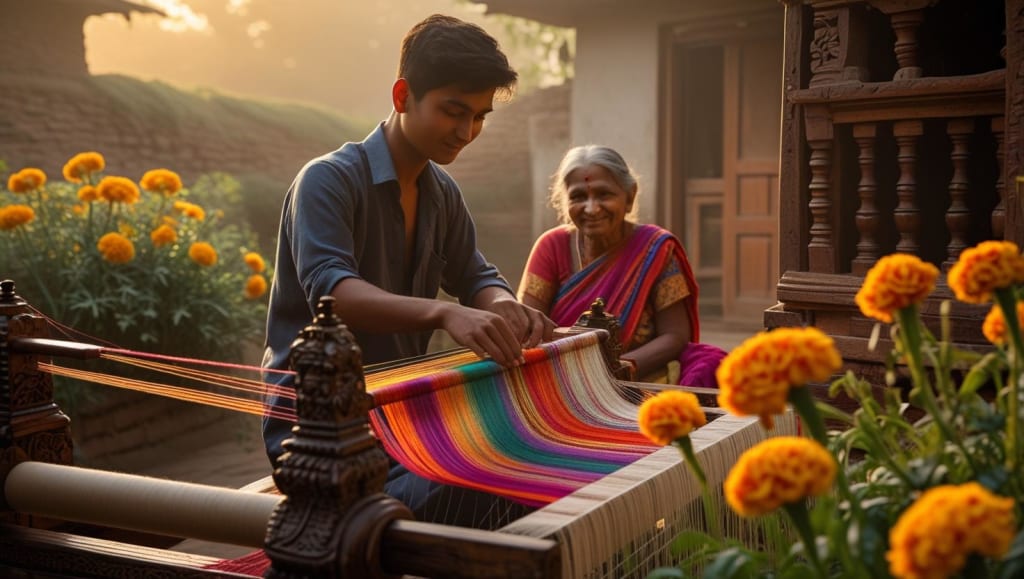
The morning sun spilled over the rooftops of Sylhet, casting golden streaks across Arif’s tiny apartment. At twenty-eight, he was a math teacher at a local school, known for his quiet demeanor and knack for making numbers feel like stories. But today, his mind wasn’t on equations. A letter lay open on his table, its edges creased from being read too many times. It was from his aunt in a village near Moulvibazar, a place he hadn’t visited since he was a boy.
“Arif,” the letter began in her neat handwriting, “your grandmother is fading. She asks for you. There’s something she wants you to know. Come soon.”
Arif’s heart tightened. His grandmother, Amma, had been a distant figure in his life. His parents had moved to the city when he was young, leaving behind the village and its traditions. Amma’s world of handwoven saris and late-night folk tales felt like a dream he could barely recall. But her name stirred a memory: her hands, rough yet gentle, guiding his tiny fingers over a loom’s threads. “You’ll weave one day,” she’d said, her voice like a melody. He hadn’t thought of it in years.
He packed a small bag and caught a bus that afternoon. The journey was a blur of tea gardens, rolling hills, and the scent of wet earth. By evening, he reached the village, a patchwork of mud houses and green fields. His aunt, Rehana, greeted him with a tired smile. “She’s waiting,” she said, leading him to a small room where Amma lay on a cot, her face like crumpled silk.
“Arif, my boy,” Amma whispered, her eyes bright despite her frailty. “You’ve grown.” He knelt beside her, his throat tight. They talked of small things—his job, the city, her garden—until her voice grew serious. “There’s a loom in the shed,” she said. “It’s yours now. And the songs… don’t let them fade.”
“Songs?” Arif asked, confused. But she only smiled and closed her eyes. That night, she slipped away, leaving him with a puzzle he didn’t understand.
The village gathered for Amma’s funeral, their prayers mingling with the rustle of leaves. Arif stayed on, helping Rehana sort through Amma’s belongings. In the shed, he found the loom—a sturdy wooden frame, its threads still taut, as if waiting. Beside it was a cloth-bound notebook, its pages filled with sketches of patterns and lyrics in Amma’s hand. The first page read: “The weaver’s song is the thread of the heart. Sing it, and the cloth will speak.”
Arif ran his fingers over the loom, feeling a strange pull. He’d never woven, yet the memory of Amma’s hands guiding his felt alive. That evening, he sat at the loom, the notebook open beside him. The first song was simple, a lullaby about a river and a star. As he hummed it, his hands moved clumsily, threading the shuttle. The rhythm of the loom—click, clack, slide—felt like a heartbeat. By midnight, he’d woven a strip of cloth, uneven but vibrant with blues and golds.
Rehana found him there, her eyes wide. “You’ve started,” she said softly. “She always said you had the gift.”
“What gift?” Arif asked.
“The songs,” Rehana replied. “They’re not just music. They’re stories—our family’s, the village’s. Amma wove them into her saris. Each pattern held a memory.”
Arif flipped through the notebook. The songs told of love, loss, harvests, and storms. Some were in his great-grandmother’s hand, others older still. He realized the loom was more than wood and thread—it was a keeper of legacy.
Over the next days, Arif returned to the loom. The village noticed. An old weaver, Babul, offered to teach him the basics: how to tension the warp, how to blend colors. “Your grandmother was the best,” Babul said. “Her saris were like poetry.” Arif practiced, his fingers growing surer. Each song he sang wove a new pattern—spirals for joy, waves for sorrow. The cloth began to tell stories he didn’t fully understand but felt in his bones.
One afternoon, a woman named Laila came to the shed. She was shy, her sari faded. “Amma wove my wedding sari,” she said. “When my husband died, she sang a song for him. Can you…?” Her voice trailed off. Arif hesitated, then opened the notebook. He found a song about a bird returning to the sky. As he sang and wove, Laila’s eyes filled with tears, but she smiled. The strip of cloth he gave her shimmered with soft grays and whites, like a dawn breaking.
Word spread. Villagers brought their stories—a farmer’s hope for rain, a mother’s fear for her sick child. Arif listened, chose a song, and wove. Each sari became a canvas for their lives. He wrote their stories in the notebook, adding to the family’s legacy. With every thread, he felt closer to Amma, as if she were guiding him still.
One evening, Rehana handed him a locked box. “She left this for you,” she said. Inside was a half-finished sari, its threads a deep crimson, and a letter. It was from Amma to Arif’s mother, confessing a regret: a quarrel that had driven them apart when Arif’s parents left the village. “I was wrong to judge,” Amma wrote. “Tell her I loved her always.”
Arif’s chest ached. He hadn’t known his mother carried that wound. He finished the sari, weaving in a song about forgiveness, its pattern a blend of crimson and gold, like a sunset meeting the earth. When he returned to Sylhet, he gave it to his mother. They sat together, the sari between them, and talked for the first time in years. Tears fell, but so did walls.
Back in the city, Arif brought the loom. He set it up in his apartment, weaving in the evenings. The songs became his refuge, a way to process his own doubts and dreams. He started a small online shop, selling the saris with anonymous stories from the notebook. Each piece came with a note: “Woven with a song, for a heart.” Orders came from across the world, from people who felt the stories in the threads.
A year later, Arif returned to the village for a festival. He brought a sari for the community, woven with every song from the notebook. As it was unfurled in the courtyard, the villagers gasped—its patterns told their story, from the floods of ’98 to the birth of a child last spring. They sang together, their voices rising like a tide.
Arif stood back, the loom quiet beside him. He felt Amma’s presence in the laughter, the threads, the songs. He was the weaver now, not just of cloth but of connections, stitching the past to the present. The morning mist lingered, and he smiled, knowing the songs would never fade.
About the Creator
Shohel Rana
As a professional article writer for Vocal Media, I craft engaging, high-quality content tailored to diverse audiences. My expertise ensures well-researched, compelling articles that inform, inspire, and captivate readers effectively.
Keep reading
More stories from Shohel Rana and writers in Fiction and other communities.
The Lantern’s Keeper
The rain tapped softly against the window, like a friend asking to be let in. Rhea sat in the corner of her small Dhaka apartment, cradling a cup of tea that had long gone cold. Her eyes held a distant gaze, as if she were searching for something just out of reach. Outside, the city’s chaos—honking rickshaws, vendors’ calls, and the hum of life—blended into a familiar hum. But to Rhea, it all felt muted, like a song played too far away.
By Shohel Rana7 months ago in Fiction



Comments
There are no comments for this story
Be the first to respond and start the conversation.