

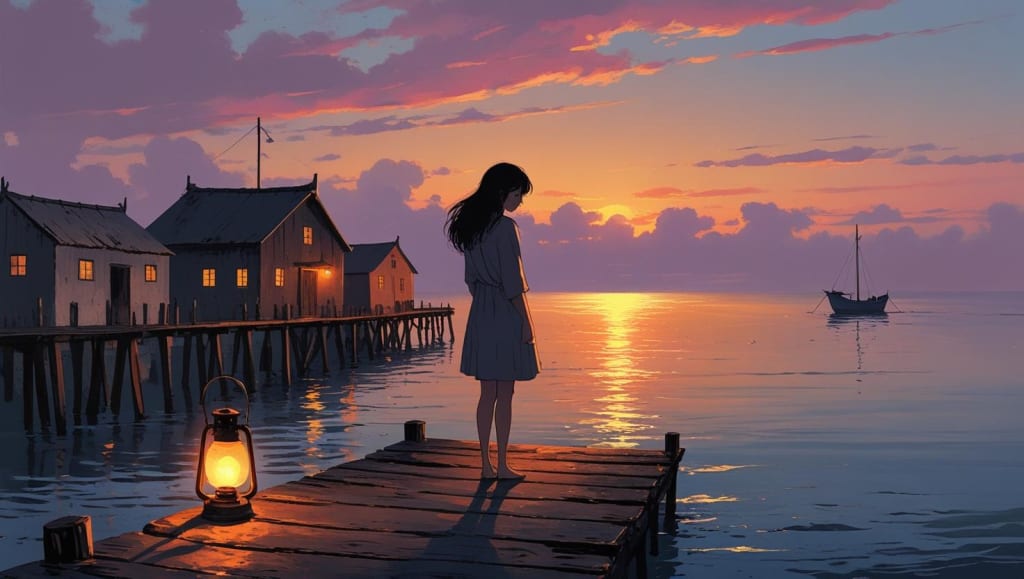
The rain tapped softly against the window, like a friend asking to be let in. Rhea sat in the corner of her small Dhaka apartment, cradling a cup of tea that had long gone cold. Her eyes held a distant gaze, as if she were searching for something just out of reach. Outside, the city’s chaos—honking rickshaws, vendors’ calls, and the hum of life—blended into a familiar hum. But to Rhea, it all felt muted, like a song played too far away.
At thirty, Rhea was a graphic designer with a life that seemed perfect from the outside: a steady job, a cozy flat, and a handful of friends who checked in now and then. Yet inside, she carried an invisible weight. Her parents’ divorce when she was ten, her father’s absence, and the growing distance from her mother had left scars she never spoke of. Her smiles hid a quiet ache, one she buried beneath deadlines and late-night sketches.
One morning, her phone buzzed with an unknown number. She hesitated but answered. A deep voice came through, warm but heavy. “Rhea? It’s your uncle Shafiq. Been a long time, hasn’t it?” Her mind flickered to Shafiq, her mother’s older brother, who had moved to a village near Cox’s Bazar a decade ago. They hadn’t spoken since.
“Uncle, how are you?” she asked, her voice tinged with unease.
“I’m alright, dear. But your grandfather… he’s very ill. He’s asking for you. Can you come to Cox’s Bazar?”
Rhea’s heart skipped. Her grandfather, Baba Jaan, had been her childhood refuge. He’d tell her tales of the sea, take her to the shore to watch fishermen haul in their nets, and gift her tiny shells she still kept in a box. But her mother’s falling out with him had pulled Rhea away, and over time, the visits stopped. Now, the thought of him frail and calling for her stirred something deep within.
“I’ll come,” she said, surprised by her own resolve.
The next day, Rhea boarded a bus to Cox’s Bazar. She sat by the window, watching green paddy fields and sleepy villages blur past. The rhythm of the road lulled her into memories: Baba Jaan’s laughter, the salty breeze, and the glow of a lantern he’d light each evening on his porch. “This keeps the lost souls safe,” he’d say with a wink. She hadn’t thought of that lantern in years.
By dusk, she reached the village, a cluster of tin-roofed homes nestled between palm trees and the sea. Shafiq greeted her with a bear hug, his face lined but kind. “He’s weak, but he’s stubborn,” he said, leading her to a small house by the beach. Inside, Baba Jaan lay on a cot, his once-strong frame now fragile. Yet his eyes lit up when he saw her.
“Rhea, my star,” he whispered, his voice like dry leaves. She knelt beside him, her throat tight. “I’m here, Baba Jaan.”
They talked for hours, her hand in his. He spoke of the sea, of his youth as a fisherman, and of a promise he’d made long ago. “There’s something I need you to do,” he said, his voice fading. “The lantern… it’s more than it seems. Find the keeper’s book. It’ll show you.”
Rhea frowned, unsure. “What book?” But his eyes fluttered shut, and he drifted into sleep. That night, he passed quietly, leaving her with a heart full of questions.
The village mourned Baba Jaan with simple rituals: prayers, shared meals, and stories of his kindness. Rhea stayed longer than she’d planned, helping Shafiq sort through his belongings. In a wooden chest, she found the lantern—rusted but sturdy, its glass still intact. Beside it was a leather-bound book, its pages yellowed and edges worn. The cover read, The Keeper’s Log, in faded ink.
Curious, she opened it. The first entry, dated decades ago, was in Baba Jaan’s handwriting:
“The lantern guides more than boats. It holds stories, dreams, regrets. To light it is to carry them, to set them free.”
The log was filled with entries—some his, some in other hands. Each told of people who’d come to the lantern with burdens: a mother grieving a lost child, a sailor haunted by a storm, a lover seeking forgiveness. The keeper’s role was to listen, light the lantern, and let the sea carry their pain away. Rhea’s breath caught. This was no ordinary tradition.
That evening, she took the lantern to the pier, as Baba Jaan had done. She lit it, watching its glow dance across the waves. The air felt heavier, as if waiting. To her surprise, a woman approached—an elderly villager named Ayesha. “I knew you’d light it,” Ayesha said softly. “Your grandfather said you would.”
Ayesha shared her story: years ago, she’d lost her son to the sea. Baba Jaan had listened, lit the lantern, and helped her find peace. “Now it’s your turn,” she said, touching Rhea’s hand. Rhea didn’t know what to say, but she nodded, feeling the weight of the moment.
Word spread that the lantern was lit again. Over the next days, villagers came to Rhea. A fisherman confessed his guilt over a friend’s death. A young girl spoke of her fear of leaving home. Each story was a thread, weaving Rhea into the village’s heart. She listened, lit the lantern, and wrote their tales in the keeper’s book, as Baba Jaan had done. With each entry, her own burdens—the pain of her parents’ divorce, her loneliness—felt lighter, as if the sea carried them too.
One night, a stranger arrived—a man in his fifties, weathered by life. He introduced himself as Karim, a former sailor. His story was different: he’d known Baba Jaan years ago and had left something behind. “He told me to come back when I was ready,” Karim said, his voice thick. “I wasn’t, until now.”
He handed Rhea a small, sealed envelope. Inside was a letter from Baba Jaan, addressed to her mother. It spoke of regret, of a fight that had torn them apart, and a wish to reconcile. “I was too proud,” it read. “Tell her I’m sorry.” Rhea’s eyes stung. She realized Baba Jaan had been a keeper not just for strangers, but for his own heart.
Rhea returned to Dhaka with the lantern, the book, and the letter. She met her mother, something she’d avoided for years. The letter opened old wounds but also a path to healing. They cried, talked, and began to rebuild what had been lost. Rhea felt a shift within her—a quiet strength she hadn’t known she had.
She kept the lantern in her apartment, lighting it on nights when memories weighed heavy. She wrote in the keeper’s book, not just others’ stories but her own. The act of writing, of letting go, became her anchor. She even started a blog, sharing anonymized tales from the book, calling it The Lantern’s Keeper. It resonated with readers, who saw their own struggles in the stories. Messages poured in from strangers, thanking her for giving voice to their pain.
Months later, Rhea returned to Cox’s Bazar. She stood on the pier, the lantern glowing beside her. The sea whispered, and she felt Baba Jaan’s presence in the breeze. She was no longer the woman who’d arrived here, lost and heavy-hearted. She was the keeper now, carrying light for others—and for herself.
The stars above mirrored the lantern’s glow, and Rhea smiled. The journey had begun with a call, but it had led her to a truth: sometimes, to find your way, you must hold space for others to find theirs.
About the Creator
Shohel Rana
As a professional article writer for Vocal Media, I craft engaging, high-quality content tailored to diverse audiences. My expertise ensures well-researched, compelling articles that inform, inspire, and captivate readers effectively.
Keep reading
More stories from Shohel Rana and writers in Fiction and other communities.
The Letter She Never Sent
The Letter She Never Sent Nora had always believed in writing things down. From grocery lists to unsent love letters, her life was inked in journals and forgotten scraps of paper. Words were safer that way—silent, controlled, trapped between margins where they couldn’t betray her. She had written hundreds of letters over the years, but there was one letter she could never bring herself to send.
By Shohel Rana7 months ago in Fiction


Comments
There are no comments for this story
Be the first to respond and start the conversation.