
The Vanished Village Beneath the Lake
The haunting true story of a town swallowed by water—and time.

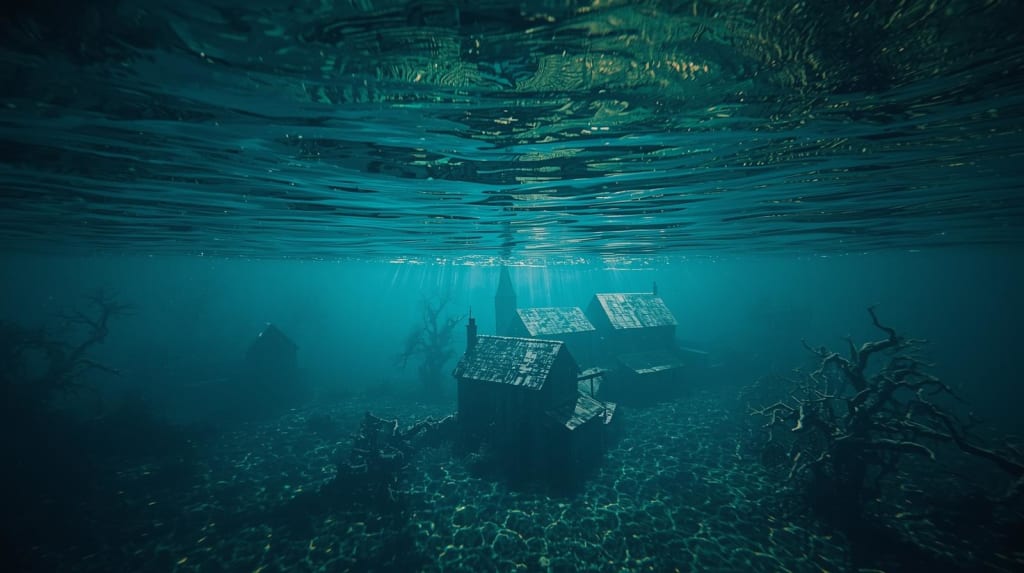
On a crisp autumn morning in 1950, the people of Dana, Massachusetts, gathered in silence as bulldozers rolled into their streets. Children clutched their mothers’ hands, old men leaned on canes, and the echo of church bells rang for the last time. Within weeks, their homes, schools, and memories would be gone—buried beneath a vast man-made lake. The government called it progress. The people called it betrayal.
This is the true story of how four entire towns in Massachusetts—Dana, Enfield, Greenwich, and Prescott—were wiped off the map to make way for the Quabbin Reservoir, one of the largest human-made bodies of water in the United States. But beneath its peaceful surface lies a lost world that once thrived, now trapped under fifty feet of water.
The plan began during the Great Depression, when Boston was rapidly expanding and desperate for fresh drinking water. City officials and engineers decided that the Swift River Valley, with its fertile farmlands and rolling hills, would be the perfect place to flood. The decision, made hundreds of miles away, sealed the fate of over 2,500 residents who had lived in the valley for generations.
They were told to leave—by law. Their homes would be demolished, their ancestors’ graves relocated, and their lands seized through eminent domain. The people resisted, of course. There were petitions, protests, and public outrage. But the state’s decision was final. Progress, they said, could not be stopped.
By 1938, the valley was emptying. Families loaded wagons with what they could carry, watching as demolition crews tore down everything else. Churches that had stood for centuries were dismantled brick by brick. Entire farms were burned so they wouldn’t float when the valley was flooded. And in a grim and haunting act, over 7,500 graves were dug up and moved to new cemeteries on higher ground.
When the dams were finally completed, water began to rise. Day by day, the valley disappeared. Trees were cut to stumps, roads were submerged, and within months, the four towns were gone. By 1946, the Quabbin Reservoir was full—412 billion gallons of water covering nearly 40 square miles.
At first glance, the reservoir looks serene—a blue expanse surrounded by lush forests, where eagles nest and deer wander. But beneath that calm surface lies the skeleton of a world lost to history. Divers who have explored the depths report seeing stone walls, rusted farm tools, even the faint outlines of roads leading nowhere. When the water is low, the tops of old foundations sometimes reappear like ghosts returning for air.
The tragedy of the Swift River Valley wasn’t just physical—it was emotional. Generations of families were uprooted from land their ancestors had farmed since the 1700s. Old-timers said they could still hear church bells ringing from beneath the waves on quiet nights. One former resident, interviewed years later, said, “We didn’t just lose our homes. We lost our history.”
Yet, the project did what it promised. The Quabbin Reservoir became the lifeline of modern Boston, providing clean water to over three million people across Massachusetts. Engineers hailed it as a marvel of modern planning, a symbol of human ingenuity and sacrifice. But for those who once lived there, it was a wound that never healed.
Even today, the memory of those towns lives on in whispers. Old photographs show a bustling community—farmers in wide hats, children by the river, church picnics under apple trees. All of it gone, yet preserved beneath the water like an accidental time capsule.
In recent decades, interest in the lost towns has grown. Historians and descendants of the displaced have worked to document the stories of the people who once called the valley home. A small museum near the reservoir displays relics—old signs, school desks, and faded letters retrieved before the flooding. Visitors often remark on the eerie stillness of the area, as if time itself pauses out of respect.
Sometimes, when the water level drops after a dry summer, the remnants of the past resurface. The cracked foundations of homes emerge briefly, moss-covered and silent, before vanishing again beneath the rising waters. It’s as if the past is reminding us that it’s still there—waiting, unseen, but never truly gone.
The story of Dana and the lost valley is more than just a tale of destruction. It’s a reflection of the American struggle between progress and preservation, between the dreams of the future and the memories of the past. It asks a haunting question: how much of our history are we willing to sacrifice for the promise of tomorrow?
For those who visit Quabbin today, the answer lies just beneath the surface—a quiet, endless lake shimmering under the sun, holding in its depths an entire world that once was.
About the Creator
Shohel Rana
As a professional article writer for Vocal Media, I craft engaging, high-quality content tailored to diverse audiences. My expertise ensures well-researched, compelling articles that inform, inspire, and captivate readers effectively.
Keep reading
More stories from Shohel Rana and writers in Fiction and other communities.
The Vanished Colony of Roanoke
It began as a dream — the dream of a new world, of English settlers carving out a home in the wilderness of North America. But by the time rescue ships arrived three years later, the dream had turned into one of history’s greatest enigmas. The colony of Roanoke had vanished — every man, woman, and child gone without a trace, leaving behind only a single word carved into a wooden post: CROATOAN.
By Shohel Rana5 months ago in Fiction


Comments
There are no comments for this story
Be the first to respond and start the conversation.