
The Vanished Colony of Roanoke
America’s Oldest Unsolved Mystery

It began as a dream — the dream of a new world, of English settlers carving out a home in the wilderness of North America. But by the time rescue ships arrived three years later, the dream had turned into one of history’s greatest enigmas. The colony of Roanoke had vanished — every man, woman, and child gone without a trace, leaving behind only a single word carved into a wooden post: CROATOAN.
(An eerie abandoned 16th-century English colony on the foggy coast of North Carolina, wooden huts in ruins, a single post with the word ‘CROATOAN’ carved into it, moonlight reflecting off the ocean, haunting atmosphere. a full-frame medieval-style scene without any borders, decorations, or ornamental framing. The image should be painted in the style of a 14th-century European historical artwork, using slightly flattened perspective and hand-painted brush textures. Avoid illuminated manuscript layouts or frames. Use aged, parchment-toned lighting with earthy colors like faded reds, ochre, moss green, and brown. The overall look should feel cinematic, ancient, and handcrafted — as if it’s a realistic frame from an old historical film or storybook brought to life.)
In 1587, over a hundred English settlers, men, women, and children, set sail across the Atlantic under the leadership of John White, an experienced artist and mapmaker. (A large 16th-century English sailing ship full of settlers, men, women, and children, departing a bustling English port, with a figure resembling John White at the helm, looking determined. a full-frame medieval-style scene without any borders, decorations, or ornamental framing. The image should be painted in the style of a 14th-century European historical artwork, using slightly flattened perspective and hand-painted brush textures. Avoid illuminated manuscript layouts or frames. Use aged, parchment-toned lighting with earthy colors like faded reds, ochre, moss green, and brown. The overall look should feel cinematic, ancient, and handcrafted — as if it’s a realistic frame from an old historical film or storybook brought to life.) They weren’t the first to attempt settlement in the New World — two previous expeditions had failed — but this one carried hope. Backed by Sir Walter Raleigh, an ambitious courtier favored by Queen Elizabeth I, the colony was meant to be England’s foothold in America. (Sir Walter Raleigh, dressed in opulent 16th-century English court attire, standing before Queen Elizabeth I, who is seated on her throne, discussing plans for the New World. a full-frame medieval-style scene without any borders, decorations, or ornamental framing. The image should be painted in the style of a 14th-century European historical artwork, using slightly flattened perspective and hand-painted brush textures. Avoid illuminated manuscript layouts or frames. Use aged, parchment-toned lighting with earthy colors like faded reds, ochre, moss green, and brown. The overall look should feel cinematic, ancient, and handcrafted — as if it’s a realistic frame from an old historical film or storybook brought to life.) They would land on Roanoke Island, off the coast of what is now North Carolina, and build the first permanent English colony. (An old, detailed map of the North Carolina coast with Roanoke Island prominently marked, showing early colonial settlements. a full-frame medieval-style scene without any borders, decorations, or ornamental framing. The image should be painted in the style of a 14th-century European historical artwork, using slightly flattened perspective and hand-painted brush textures. Avoid illuminated manuscript layouts or frames. Use aged, parchment-toned lighting with earthy colors like faded reds, ochre, moss green, and brown. The overall look should feel cinematic, ancient, and handcrafted — as if it’s a realistic frame from an old historical film or storybook brought to life.)
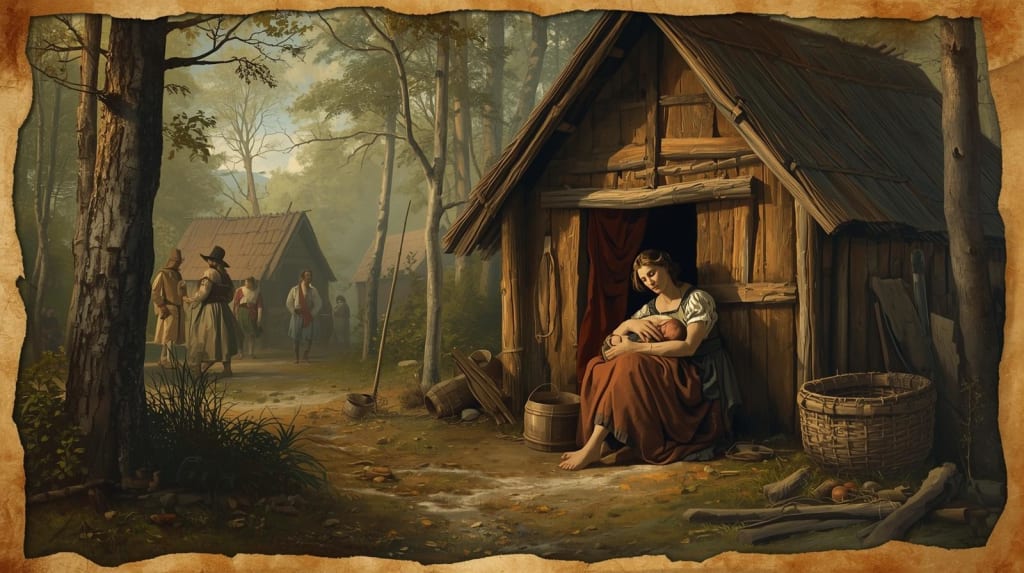
The journey was perilous. After months at sea, they arrived in the summer heat to find the earlier colony’s remains — decaying buildings, scattered bones, and unsettling silence. (A small group of English settlers, including John White, disembarking onto a wild, overgrown beach on Roanoke Island, discovering the decaying remains of a previous settlement – broken fences, a collapsed hut, and scattered, ominous bones. a full-frame medieval-style scene without any borders, decorations, or ornamental framing. The image should be painted in the style of a 14th-century European historical artwork, using slightly flattened perspective and hand-painted brush textures. Avoid illuminated manuscript layouts or frames. Use aged, parchment-toned lighting with earthy colors like faded reds, ochre, moss green, and brown. The overall look should feel cinematic, ancient, and handcrafted — as if it’s a realistic frame from an old historical film or storybook brought to life.) Despite the grim start, White encouraged his people to rebuild. The colonists began constructing houses, planting crops, and forming a fragile relationship with the local tribes. (English settlers and Native Americans interacting cautiously, perhaps trading or observing each other, against a backdrop of newly built wooden colonial houses and cleared farmland on Roanoke Island. a full-frame medieval-style scene without any borders, decorations, or ornamental framing. The image should be painted in the style of a 14th-century European historical artwork, using slightly flattened perspective and hand-painted brush textures. Avoid illuminated manuscript layouts or frames. Use aged, parchment-toned lighting with earthy colors like faded reds, ochre, moss green, and brown. The overall look should feel cinematic, ancient, and handcrafted — as if it’s a realistic frame from an old historical film or storybook brought to life.) Among them was White’s daughter, Eleanor Dare, who soon gave birth to the first English child born in the New World — Virginia Dare. Her birth filled the settlers with renewed hope. (Eleanor Dare, a young English woman, holding a newborn baby (Virginia Dare) in a simple wooden colonial home, surrounded by hopeful-looking settlers. a full-frame medieval-style scene without any borders, decorations, or ornamental framing. The image should be painted in the style of a 14th-century European historical artwork, using slightly flattened perspective and hand-painted brush textures. Avoid illuminated manuscript layouts or frames. Use aged, parchment-toned lighting with earthy colors like faded reds, ochre, moss green, and brown. The overall look should feel cinematic, ancient, and handcrafted — as if it’s a realistic frame from an old historical film or storybook brought to life.) For a brief moment, the colony seemed destined for success.
But trouble came quickly. Food supplies ran low. (A scene of growing desperation in the Roanoke colony: gaunt settlers looking at empty food stores, perhaps a lean hunter returning with little prey, reflecting scarcity. a full-frame medieval-style scene without any borders, decorations, or ornamental framing. The image should be painted in the style of a 14th-century European historical artwork, using slightly flattened perspective and hand-painted brush textures. Avoid illuminated manuscript layouts or frames. Use aged, parchment-toned lighting with earthy colors like faded reds, ochre, moss green, and brown. The overall look should feel cinematic, ancient, and handcrafted — as if it’s a realistic frame from an old historical film or storybook brought to life.) Relations with native tribes turned hostile. (A tense standoff between armed English settlers and a group of Native American warriors, in a clearing near the Roanoke colony, signifying escalating conflict. a full-frame medieval-style scene without any borders, decorations, or ornamental framing. The image should be painted in the style of a 14th-century European historical artwork, using slightly flattened perspective and hand-painted brush textures. Avoid illuminated manuscript layouts or frames. Use aged, parchment-toned lighting with earthy colors like faded reds, ochre, moss green, and brown. The overall look should feel cinematic, ancient, and handcrafted — as if it’s a realistic frame from an old historical film or storybook brought to life.) Disease and hunger spread. By August, the settlers urged John White to return to England to plead for supplies and reinforcements. (John White, looking distraught, being urged by a group of anxious and weary settlers to return to England for help, with Eleanor Dare and baby Virginia Dare visible in the background. a full-frame medieval-style scene without any borders, decorations, or ornamental framing. The image should be painted in the style of a 14th-century European historical artwork, using slightly flattened perspective and hand-painted brush textures. Avoid illuminated manuscript layouts or frames. Use aged, parchment-toned lighting with earthy colors like faded reds, ochre, moss green, and brown. The overall look should feel cinematic, ancient, and handcrafted — as if it’s a realistic frame from an old historical film or storybook brought to life.) He reluctantly agreed, leaving behind his family, promising to return within months.
He would not see them again. (John White's ship sailing away from Roanoke Island, leaving behind a small, isolated colonial settlement shrouded in a sense of foreboding. a full-frame medieval-style scene without any borders, decorations, or ornamental framing. The image should be painted in the style of a 14th-century European historical artwork, using slightly flattened perspective and hand-painted brush textures. Avoid illuminated manuscript layouts or frames. Use aged, parchment-toned lighting with earthy colors like faded reds, ochre, moss green, and brown. The overall look should feel cinematic, ancient, and handcrafted — as if it’s a realistic frame from an old historical film or storybook brought to life.)
When White returned to England, the country was preparing for war. The Spanish Armada loomed over the English Channel, and every available ship was seized for defense. (A dramatic scene of the Spanish Armada, a vast fleet of galleons, sailing menacingly towards the English coast, with smaller English ships preparing for defense. a full-frame medieval-style scene without any borders, decorations, or ornamental framing. The image should be painted in the style of a 14th-century European historical artwork, using slightly flattened perspective and hand-painted brush textures. Avoid illuminated manuscript layouts or frames. Use aged, parchment-toned lighting with earthy colors like faded reds, ochre, moss green, and brown. The overall look should feel cinematic, ancient, and handcrafted — as if it’s a realistic frame from an old historical film or storybook brought to life.) White begged, argued, and pleaded, but his return was delayed again and again. Three long years passed before he could finally set sail back to Roanoke in 1590. (John White, now visibly older and more weary, standing frustrated in an English port, watching warships being prepared for battle instead of ships for his return to Roanoke. a full-frame medieval-style scene without any borders, decorations, or ornamental framing. The image should be painted in the style of a 14th-century European historical artwork, using slightly flattened perspective and hand-painted brush textures. Avoid illuminated manuscript layouts or frames. Use aged, parchment-toned lighting with earthy colors like faded reds, ochre, moss green, and brown. The overall look should feel cinematic, ancient, and handcrafted — as if it’s a realistic frame from an old historical film or storybook brought to life.)
When his ship anchored off the coast and he stepped onto the island, the sight that greeted him chilled his blood. The colony was empty — houses dismantled, fortifications removed as if carefully taken apart. There were no bodies, no signs of battle or disease. The settlement looked as if its inhabitants had simply walked away. The only clue was a single word carved into a wooden post near the entrance: CROATOAN.
(John White, standing alone and devastated in the desolate, empty Roanoke colony, the dismantled wooden structures around him, his gaze fixed on the single wooden post with "CROATOAN" carved into it. a full-frame medieval-style scene without any borders, decorations, or ornamental framing. The image should be painted in the style of a 14th-century European historical artwork, using slightly flattened perspective and hand-painted brush textures. Avoid illuminated manuscript layouts or frames. Use aged, parchment-toned lighting with earthy colors like faded reds, ochre, moss green, and brown. The overall look should feel cinematic, ancient, and handcrafted — as if it’s a realistic frame from an old historical film or storybook brought to life.)
White had agreed with the colonists before leaving that if they ever moved, they would carve the name of their new location somewhere visible. If they were in danger, they would add a cross symbol. There was no cross. It was the only sign of life he could find. (A close-up of the "CROATOAN" carving on a weathered wooden post, with emphasis on the absence of a cross symbol, suggesting no distress. a full-frame medieval-style scene without any borders, decorations, or ornamental framing. The image should be painted in the style of a 14th-century European historical artwork, using slightly flattened perspective and hand-painted brush textures. Avoid illuminated manuscript layouts or frames. Use aged, parchment-toned lighting with earthy colors like faded reds, ochre, moss green, and brown. The overall look should feel cinematic, ancient, and handcrafted — as if it’s a realistic frame from an old historical film or storybook brought to life.)
White believed the settlers had moved to Croatoan Island, home to a friendly Native American tribe (today known as Hatteras Island). (An overhead map view showing Roanoke Island and Croatoan Island (Hatteras Island) connected by a presumed route or journey line, with an illustration of a peaceful Native American village on Croatoan. a full-frame medieval-style scene without any borders, decorations, or ornamental framing. The image should be painted in the style of a 14th-century European historical artwork, using slightly flattened perspective and hand-painted brush textures. Avoid illuminated manuscript layouts or frames. Use aged, parchment-toned lighting with earthy colors like faded reds, ochre, moss green, and brown. The overall look should feel cinematic, ancient, and handcrafted — as if it’s a realistic frame from an old historical film or storybook brought to life.) But a storm approached, and his crew refused to continue. (John White, on his ship, desperately pointing towards Croatoan Island as a severe storm brews on the horizon, with his crew members shaking their heads in refusal, indicating their fear of the weather. a full-frame medieval-style scene without any borders, decorations, or ornamental framing. The image should be painted in the style of a 14th-century European historical artwork, using slightly flattened perspective and hand-painted brush textures. Avoid illuminated manuscript layouts or frames. Use aged, parchment-toned lighting with earthy colors like faded reds, ochre, moss green, and brown. The overall look should feel cinematic, ancient, and handcrafted — as if it’s a realistic frame from an old historical film or storybook brought to life.) Forced to abandon the search, White returned to England — heartbroken, helpless, and forever haunted by the mystery of his lost colony. (A heartbroken John White on his ship, sailing away from the North American coast, looking back at the vanishing shoreline with profound sadness and regret. a full-frame medieval-style scene without any borders, decorations, or ornamental framing. The image should be painted in the style of a 14th-century European historical artwork, using slightly flattened perspective and hand-painted brush textures. Avoid illuminated manuscript layouts or frames. Use aged, parchment-toned lighting with earthy colors like faded reds, ochre, moss green, and brown. The overall look should feel cinematic, ancient, and handcrafted — as if it’s a realistic frame from an old historical film or storybook brought to life.)
What truly happened to the settlers of Roanoke remains one of America’s oldest unsolved mysteries. (A metaphorical image of a question mark looming over a stylized silhouette of Roanoke Island, shrouded in mist, representing the enduring mystery. a full-frame medieval-style scene without any borders, decorations, or ornamental framing. The image should be painted in the style of a 14th-century European historical artwork, using slightly flattened perspective and hand-painted brush textures. Avoid illuminated manuscript layouts or frames. Use aged, parchment-toned lighting with earthy colors like faded reds, ochre, moss green, and brown. The overall look should feel cinematic, ancient, and handcrafted — as if it’s a realistic frame from an old historical film or storybook brought to life.)
Some historians believe the colonists assimilated with the Croatoan tribe. There are accounts of later English explorers reporting sightings of “light-skinned, gray-eyed natives” who spoke English words and claimed descent from “white ancestors.” (A scene depicting a Native American village in the 17th century, where some individuals have distinctly European features like lighter skin and gray eyes, interacting with a later English explorer, hinting at assimilation. a full-frame medieval-style scene without any borders, decorations, or ornamental framing. The image should be painted in the style of a 14th-century European historical artwork, using slightly flattened perspective and hand-painted brush textures. Avoid illuminated manuscript layouts or frames. Use aged, parchment-toned lighting with earthy colors like faded reds, ochre, moss green, and brown. The overall look should feel cinematic, ancient, and handcrafted — as if it’s a realistic frame from an old historical film or storybook brought to life.) In the early 1600s, John Lawson, another explorer, recorded meeting members of the Hatteras tribe who said that their forefathers “could talk in a book” — suggesting literacy, something only Europeans possessed. (John Lawson, a 17th-century explorer, conversing with members of the Hatteras tribe, one of whom gestures towards an open book, implying their ancestors' literacy, with a backdrop of a tranquil Native American settlement. a full-frame medieval-style scene without any borders, decorations, or ornamental framing. The image should be painted in the style of a 14th-century European historical artwork, using slightly flattened perspective and hand-painted brush textures. Avoid illuminated manuscript layouts or frames. Use aged, parchment-toned lighting with earthy colors like faded reds, ochre, moss green, and brown. The overall look should feel cinematic, ancient, and handcrafted — as if it’s a realistic frame from an old historical film or storybook brought to life.)
Others propose darker theories — that the colonists perished in the wilderness, died of starvation, or were massacred by rival tribes. (A dark, foreboding forest scene with subtle hints of colonial presence – perhaps a broken tool or a torn piece of English cloth – suggesting hardship and demise in the wilderness. a full-frame medieval-style scene without any borders, decorations, or ornamental framing. The image should be painted in the style of a 14th-century European historical artwork, using slightly flattened perspective and hand-painted brush textures. Avoid illuminated manuscript layouts or frames. Use aged, parchment-toned lighting with earthy colors like faded reds, ochre, moss green, and brown. The overall look should feel cinematic, ancient, and handcrafted — as if it’s a realistic frame from an old historical film or storybook brought to life.) Archaeological digs have uncovered hints — shards of European pottery, tools, and metal artifacts found miles inland — but never enough to prove a definitive answer. (Archaeologists carefully excavating a dig site, uncovering fragments of 16th-century European pottery and rusted metal tools from the soil, deep within the North Carolina wilderness. a full-frame medieval-style scene without any borders, decorations, or ornamental framing. The image should be painted in the style of a 14th-century European historical artwork, using slightly flattened perspective and hand-painted brush textures. Avoid illuminated manuscript layouts or frames. Use aged, parchment-toned lighting with earthy colors like faded reds, ochre, moss green, and brown. The overall look should feel cinematic, ancient, and handcrafted — as if it’s a realistic frame from an old historical film or storybook brought to life.) In recent decades, DNA testing and advanced mapping have added new clues but still no certainty. (A modern-day image showing archaeological tools alongside digital maps and DNA analysis equipment, symbolizing contemporary efforts to solve the Roanoke mystery, with an overlay of historical maps. a full-frame medieval-style scene without any borders, decorations, or ornamental framing. The image should be painted in the style of a 14th-century European historical artwork, using slightly flattened perspective and hand-painted brush textures. Avoid illuminated manuscript layouts or frames. Use aged, parchment-toned lighting with earthy colors like faded reds, ochre, moss green, and brown. The overall look should feel cinematic, ancient, and handcrafted — as if it’s a realistic frame from an old historical film or storybook brought to life.)
In 2012, researchers discovered something intriguing on one of John White’s original maps, now preserved in the British Museum. (A close-up of an aged, intricate map, possibly John White's, with a subtle, almost hidden red-and-blue star symbol visible beneath a carefully applied patch or correction. a full-frame medieval-style scene without any borders, decorations, or ornamental framing. The image should be painted in the style of a 14th-century European historical artwork, using slightly flattened perspective and hand-painted brush textures. Avoid illuminated manuscript layouts or frames. Use aged, parchment-toned lighting with earthy colors like faded reds, ochre, moss green, and brown. The overall look should feel cinematic, ancient, and handcrafted — as if it’s a realistic frame from an old historical film or storybook brought to life.) Beneath a patch carefully glued over the map, they found a faint symbol — a small red-and-blue star, marking a hidden location roughly fifty miles west of Roanoke Island. (An even closer, digitally enhanced view of the faint red-and-blue star on John White's map, highlighting its mysterious placement west of Roanoke Island. a full-frame medieval-style scene without any borders, decorations, or ornamental framing. The image should be painted in the style of a 14th-century European historical artwork, using slightly flattened perspective and hand-painted brush textures. Avoid illuminated manuscript layouts or frames. Use aged, parchment-toned lighting with earthy colors like faded reds, ochre, moss green, and brown. The overall look should feel cinematic, ancient, and handcrafted — as if it’s a realistic frame from an old historical film or storybook brought to life.) Was this the settlers’ new home? Did White know more than he admitted? No one can say for sure. (A thoughtful John White, depicted with a knowing yet secretive expression, perhaps looking at a map, hinting at hidden knowledge. a full-frame medieval-style scene without any borders, decorations, or ornamental framing. The image should be painted in the style of a 14th-century European historical artwork, using slightly flattened perspective and hand-painted brush textures. Avoid illuminated manuscript layouts or frames. Use aged, parchment-toned lighting with earthy colors like faded reds, ochre, moss green, and brown. The overall look should feel cinematic, ancient, and handcrafted — as if it’s a realistic frame from an old historical film or storybook brought to life.)
The legend of Virginia Dare adds a haunting, almost mythical layer to the story. Folklore says she grew up among the native tribes, and some tales claim she was transformed into a white deer by a jealous witch — a poetic symbol of innocence lost and the fragile hope of the colony. (A ethereal depiction of a young Virginia Dare, with European features, partially fading or transforming into a majestic white deer in a mystical forest, watched by a shadowy, envious witch. a full-frame medieval-style scene without any borders, decorations, or ornamental framing. The image should be painted in the style of a 14th-century European historical artwork, using slightly flattened perspective and hand-painted brush textures. Avoid illuminated manuscript layouts or frames. Use aged, parchment-toned lighting with earthy colors like faded reds, ochre, moss green, and brown. The overall look should feel cinematic, ancient, and handcrafted — as if it’s a realistic frame from an old historical film or storybook brought to life.) Whether myth or truth, her name lives on as a symbol of mystery and endurance. (A stylized representation of Virginia Dare's name carved into an ancient tree, with a white deer silhouette nearby, symbolizing enduring legend. a full-frame medieval-style scene without any borders, decorations, or ornamental framing. The image should be painted in the style of a 14th-century European historical artwork, using slightly flattened perspective and hand-painted brush textures. Avoid illuminated manuscript layouts or frames. Use aged, parchment-toned lighting with earthy colors like faded reds, ochre, moss green, and brown. The overall look should feel cinematic, ancient, and handcrafted — as if it’s a realistic frame from an old historical film or storybook brought to life.)
Modern archaeologists continue to dig across the region, using satellite imagery and ground-penetrating radar. Every shard of pottery, every fragment of metal reignites the debate. (Modern archaeologists in khaki vests and hats, using advanced equipment like ground-penetrating radar, scanning a lush, overgrown landscape in North Carolina, with a satellite image projected subtly in the background. a full-frame medieval-style scene without any borders, decorations, or ornamental framing. The image should be painted in the style of a 14th-century European historical artwork, using slightly flattened perspective and hand-painted brush textures. Avoid illuminated manuscript layouts or frames. Use aged, parchment-toned lighting with earthy colors like faded reds, ochre, moss green, and brown. The overall look should feel cinematic, ancient, and handcrafted — as if it’s a realistic frame from an old historical film or storybook brought to life.) Were the colonists rescued by friendly tribes, or did they vanish into the swamps, victims of disease and hunger? Could they have sailed for another land and perished at sea? (A split image: one side showing a friendly Native American hand reaching out to a distressed colonist, the other side showing settlers lost and suffering in a dark, murky swamp, under a stormy sky, and a third subtle element of a ship sinking at sea in the distance. a full-frame medieval-style scene without any borders, decorations, or ornamental framing. The image should be painted in the style of a 14th-century European historical artwork, using slightly flattened perspective and hand-painted brush textures. Avoid illuminated manuscript layouts or frames. Use aged, parchment-toned lighting with earthy colors like faded reds, ochre, moss green, and brown. The overall look should feel cinematic, ancient, and handcrafted — as if it’s a realistic frame from an old historical film or storybook brought to life.)
Even after centuries of searching, Roanoke refuses to give up its secrets. The mystery cures — a ghost of America’s earliest colonial dreams, whispering across the coastal winds of the Carolinas. (A ghostly, semi-transparent image of a 16th-century colonial family, appearing as an apparition in a misty North Carolina coastal landscape, symbolizing the enduring mystery. a full-frame medieval-style scene without any borders, decorations, or ornamental framing. The image should be painted in the style of a 14th-century European historical artwork, using slightly flattened perspective and hand-painted brush textures. Avoid illuminated manuscript layouts or frames. Use aged, parchment-toned lighting with earthy colors like faded reds, ochre, moss green, and brown. The overall look should feel cinematic, ancient, and handcrafted — as if it’s a realistic frame from an old historical film or storybook brought to life.)
The lost colony remains a reminder of both human courage and fragility. They were pioneers — ordinary men and women who dared to build a new world across an ocean, guided by little more than hope and faith. Their disappearance may never be fully explained, but their story marks the beginning of the American experiment — a mix of ambition, tragedy, and resilience that still defines the nation today. (A symbolic image of a delicate, yet strong, sapling growing from barren ground, with a faded English flag in the background, representing the fragile beginnings and resilience of the American experiment. a full-frame medieval-style scene without any borders, decorations, or ornamental framing. The image should be painted in the style of a 14th-century European historical artwork, using slightly flattened perspective and hand-painted brush textures. Avoid illuminated manuscript layouts or frames. Use aged, parchment-toned lighting with earthy colors like faded reds, ochre, moss green, and brown. The overall look should feel cinematic, ancient, and handcrafted — as if it’s a realistic frame from an old historical film or storybook brought to life.)
Perhaps that is why the story of Roanoke continues to captivate historians, writers, and dreamers alike. It’s not just a mystery; it’s a mirror — reflecting our endless quest to understand the past, and ourselves. (A stylized image of an antique mirror, reflecting a blurred, evocative scene of 16th-century colonial life, hinting at the introspection and timelessness of the Roanoke mystery. a full-frame medieval-style scene without any borders, decorations, or ornamental framing. The image should be painted in the style of a 14th-century European historical artwork, using slightly flattened perspective and hand-painted brush textures. Avoid illuminated manuscript layouts or frames. Use aged, parchment-toned lighting with earthy colors like faded reds, ochre, moss green, and brown. The overall look should feel cinematic, ancient, and handcrafted — as if it’s a realistic frame from an old historical film or storybook brought to life.)
Even now, on dark coastal nights, locals say the winds carry faint whispers through the dunes — the echo of laughter, the cry of a baby, and the word carved in weathered wood, fading but eternal:
About the Creator
Shohel Rana
As a professional article writer for Vocal Media, I craft engaging, high-quality content tailored to diverse audiences. My expertise ensures well-researched, compelling articles that inform, inspire, and captivate readers effectively.
Keep reading
More stories from Shohel Rana and writers in Fiction and other communities.
The Lost Art of Thinking Deeply
We live in a time when our phones vibrate more than our thoughts do. Notifications, videos, updates — they all arrive faster than we can process them. We scroll, we react, we move on. But somewhere along the way, we’ve forgotten how to think deeply.
By Shohel Rana5 months ago in Fiction
Becca
"Everything is so... flat." Denille said stupidly as she looked around her new neighborhood. She looked around at the muted desert where even the smallest sign of life seemed to have given up. The plant life was shrubs that were half cooked by the heat and where there should have been a lawn, a mess of white rocks laid glistening in the sun. Even the sky looked stretched thin, like the sun had ironed it smooth. She’d moved from Riverside, where at least there were hills, but here in Barstow, everything felt baked and brittle.
By Sara Wilson7 days ago in Fiction
The Synaptic Scalpel
Metal moaned and splintered. The impact came without warning. The car slammed against the guardrail, then twisted, crumpled, and rolled. Tires screamed. Glass exploded like miniature stars. The final blow was internal—bone crushed, ribs punctured lungs, and a jagged fragment tore through his skull. Pain surged and vanished as consciousness faltered, leaving a hollow, fading awareness.
By Mark Stigers 7 days ago in Fiction



Comments
There are no comments for this story
Be the first to respond and start the conversation.