
*The Unstoppable Conqueror: Alexander the Great*
*"A Legacy of Courage and Ambition
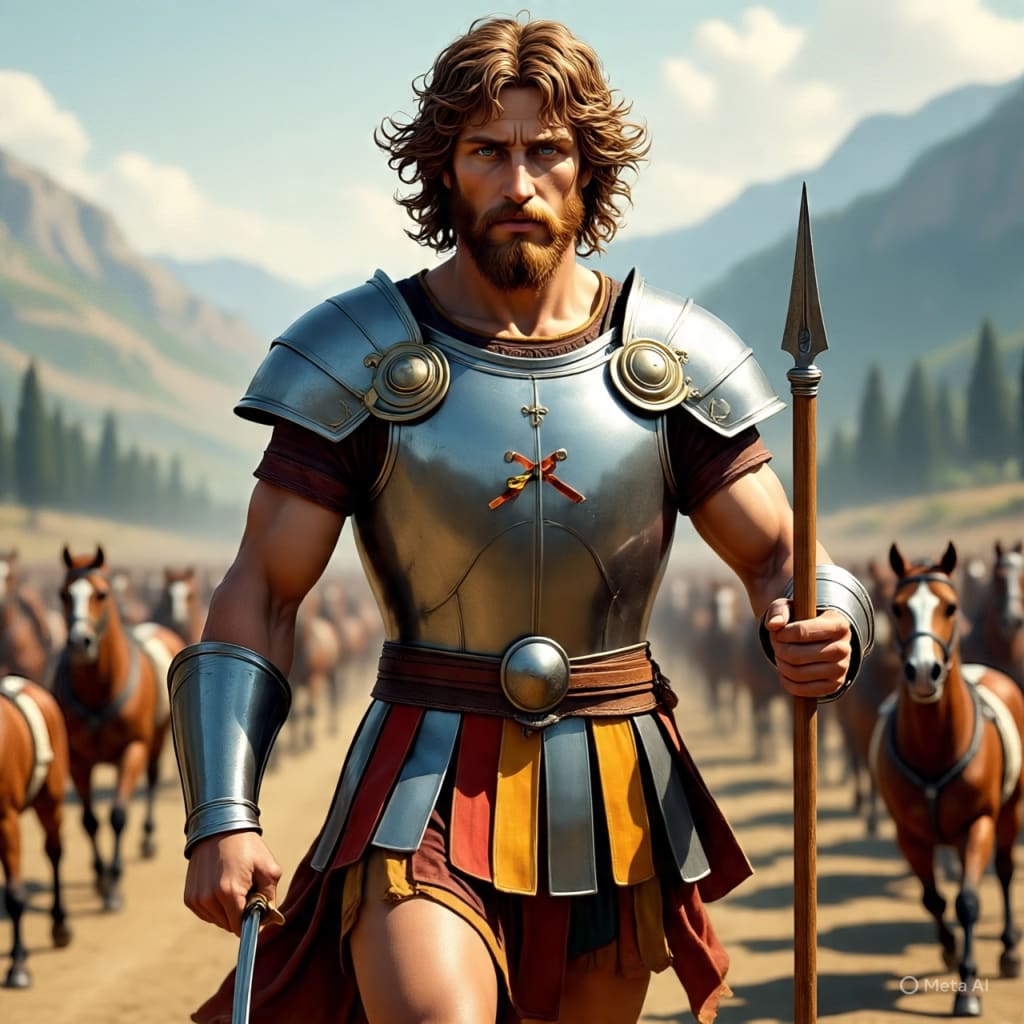
In the ancient world, where empires rose and fell like the tides, one man stood tall, leaving an indelible mark on history. Alexander III of Macedon, commonly known as Alexander the Great, was a king, a warrior, and a legend in his own time. Born in 356 BC, Alexander would go on to create one of the largest empires the world had ever seen, stretching from Greece to India, and leaving a lasting legacy that would inspire generations to come.
*The Early Years*
Alexander's journey to greatness began in the kingdom of Macedon, where his father, King Philip II, ruled with an iron fist. Philip II was a skilled military leader who united the fractious city-states of Greece under his rule, paving the way for Alexander's future conquests. Alexander's mother, Queen Olympias, was a member of the royal family of Epirus, and her influence can be seen in Alexander's early fascination with the arts and literature.
As a young prince, Alexander was tutored by the great philosopher Aristotle, who instilled in him a love of learning and a passion for the arts. Alexander's relationship with Aristotle would have a profound impact on his life, shaping his worldview and informing his decisions as a leader.
*The Conquests*
When King Philip II was assassinated in 336 BC, Alexander succeeded him at the age of 20. With his kingdom secure, Alexander set his sights on the Persian Empire, which had long been a thorn in the side of the Greeks. The Persian Empire, under the rule of Darius III, was vast and powerful, but Alexander was undaunted.
Alexander's military campaigns were marked by their speed, strategy, and brutality. He led his army across the Hellespont into Asia Minor, defeating the Persians at the Battle of Granicus in 334 BC. From there, he marched south, capturing the city of Tyre after a long and brutal siege.
*The Siege of Tyre*
The siege of Tyre was a pivotal moment in Alexander's campaign. The city, located on an island off the coast of modern-day Lebanon, was a key stronghold of the Persian Empire. Alexander's engineers built a causeway to the island, and after months of fighting, the city fell to the Macedonians.
*The Conquest of Egypt*
In 332 BC, Alexander entered Egypt, which was then a satrapy of the Persian Empire. The Egyptians, who had long been oppressed by the Persians, welcomed Alexander as a liberator. He founded the city of Alexandria, which would become a major center of culture and learning.
*The Battle of Gaugamela*
The Battle of Gaugamela, fought in 331 BC, was a decisive victory for Alexander. Darius III, determined to stop Alexander's advance, assembled a massive army, but Alexander's tactics and the bravery of his soldiers proved too much for the Persians. The battle marked the end of the Persian Empire, and Alexander's dominance over the ancient world was secured.
*The Legacy*
Alexander's legacy extends far beyond his military conquests. He spread Greek culture and language throughout his empire, establishing cities and trade routes that would last for centuries. He was a patron of the arts and sciences, and his court attracted scholars, philosophers, and poets from all over the ancient world.
*The End of an Era*
Alexander's death in 323 BC marked the end of an era. His empire was divided among his generals, who would go on to found their own kingdoms. Despite the fragmentation of his empire, Alexander's legacy endured, inspiring future generations of leaders, warriors, and scholars.
In conclusion, Alexander the Great was a complex figure, driven by a combination of ambition, courage, and a desire to leave a lasting legacy. His conquests reshaped the ancient world, spreading Greek culture and language throughout the Mediterranean. His legacy continues to inspire and fascinate us today, offering valuable lessons in leadership, strategy, and the human condition ¹ ².
*Key Accomplishments:*
- *Conquest of the Persian Empire*: Alexander defeated the Persians in a series of battles, including the Battle of Granicus, the Battle of Issus, and the Battle of Gaugamela.
- *Foundation of Alexandria*: Alexander founded the city of Alexandria in Egypt, which would become a major center of culture and learning.
- *Spread of Greek Culture*: Alexander spread Greek culture and language throughout his empire, establishing cities and trade routes that would last for centuries.
- *Military Innovations*: Alexander was a skilled military leader who introduced new tactics and strategies, including the use of phalanx formations and lightning-fast cavalry attacks ²
About the Creator
Keep reading
More stories from Ismail khan and writers in Fiction and other communities.
"The Weight of Justice, The Heart of Humanity"
📖 Full Story (Justice and Humanity – Beautiful Version): In a quiet village surrounded by golden hills, lived a man whose name was not widely known, but whose actions became a symbol of justice and humanity for generations. He was not wealthy, nor did he hold any position of power — yet he carried within him a heart richer than kings and a soul more powerful than armies.
By Ismail khan 7 months ago in Fiction
This Is What I Do When People Throw Rocks At Me
Rocks have been thrown at me for a greater part of my life. Some have been small and missed hitting me. When people don't get a reaction from me, they throw bigger rocks with a better aim. Many have been hurled at me with precision over the years. For a long time, I thought my only options were to dodge them or be crushed by them.
By Margaret Minnicks6 days ago in Confessions




Comments
There are no comments for this story
Be the first to respond and start the conversation.