
The Tyrant's Shadows of Ambition
How Power Corrupted, and Justice Erupted

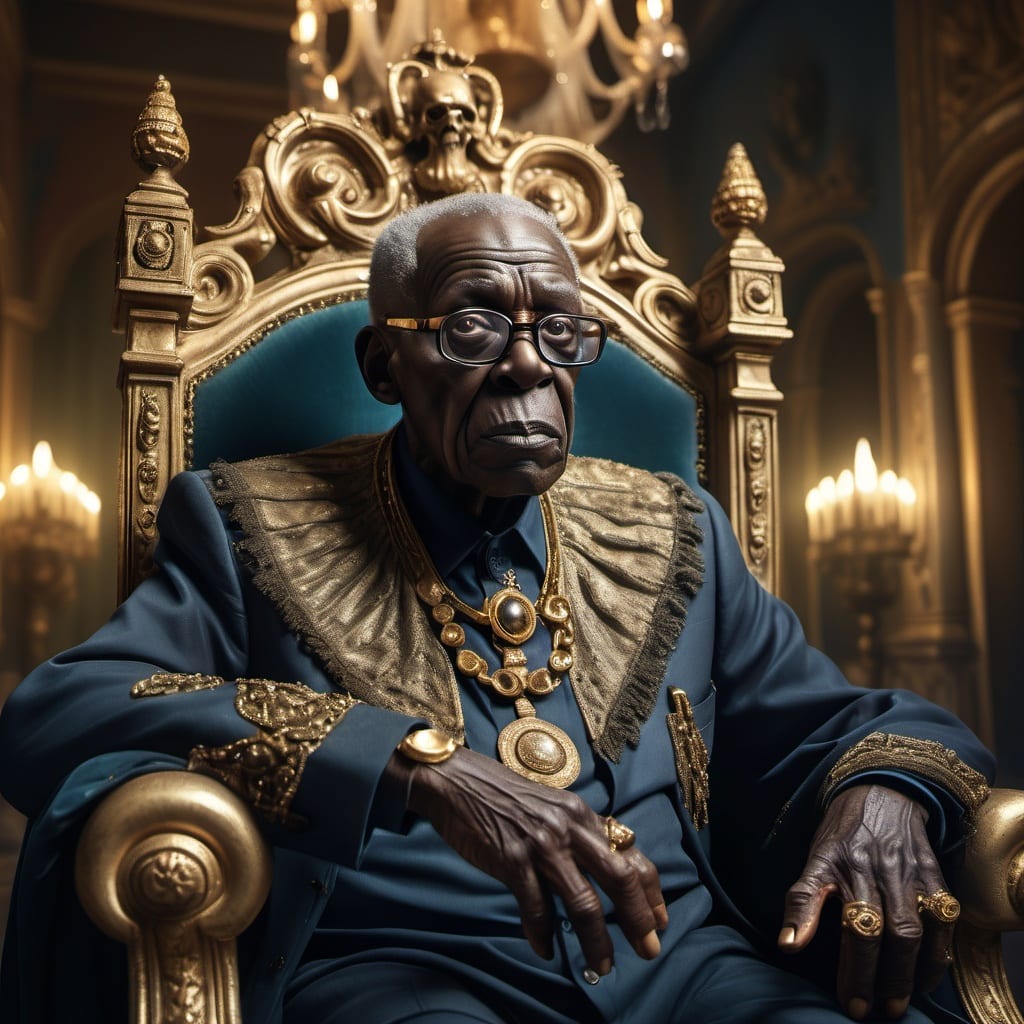
Tunde Bullock’s frailty was a cruel illusion. Beneath his trembling hands and hollowed cheeks lay a mind sharp and relentless—driven by a single, all-consuming hunger: to rule Neverland. His past was a tangled web of whispered rumors—shady deals, a rise to wealth steeped in mystery, con artistry, and ties to criminal forces as dark as the secrets he kept. But one thing remained undeniable: nothing would stand between him and his ambition, not even his failing body.
At eighty-three, Tunde Bullock was more shadow than man, his brittle form a cage for a mind burning with power. His hands shook so violently he could barely sign a decree, yet those same hands grasped an entire nation in a vice of fear and control. His life was a labyrinth of secrets, alliances built on fear, and a past so murky that even those closest to him were too terrified to ask the questions that might unravel it.
But in Neverland—a land teeming with untapped potential and fragile hope—Tunde Bullock was not seen as a relic. He was a reckoning, a force to be reckoned with. Ascending to power through judicial manipulation and legislative puppetry, he took the nation by storm. The people whispered, “How could this sick old man steal a whole country?” What they didn’t know was that Tunde Bullock was far more than his frail appearance. He was a maestro of manipulation, pulling strings of fear, greed, and desperation to orchestrate his reign.
And as his fingers tightened around the nation’s throat, Neverland began to unravel—a descent into chaos so profound that it would take more than a revolution to restore the country to its former glory. It would take an awakening.
Chapter 1: The Election of Chaos
Shadows at the Podium
The crowd outside Neverland’s central square was a sea of emotion—anger, despair, disbelief. Under the searing glare of television cameras, Tunde Bullock approached the podium, each step deliberate yet uncertain. His cane tapped against the platform as his frail body quivered with the effort.
His voice, a raspy whisper amplified by state-of-the-art microphones, broke the charged silence. “The people have spoken,” he declared, his words swallowed by the jeers of an audience that felt betrayed. But behind the trembling facade lay the cunning architect of a nation’s despair, a man whose ambition had turned the country’s greatest hope into its darkest hour.
A Land of Contrasts
Neverland was a country divided. In the capital, Eldorado, gleaming skyscrapers kissed the heavens, bustling tech hubs and luxury malls teeming with life. But venture outwards, and the veneer of prosperity crumbled. In the hinterlands, barren farmlands stretched endlessly, while villages, their mud-brick houses barely standing, struggled for access to clean water.
The election was meant to bridge this divide—a promise of unity and renewal. For the people, it was a chance to choose progress over stagnation, hope over despair. For Tunde Bullock, however, it was something else entirely: the final act of a lifetime of manipulation and secrecy.
The Opponent
Across Neverland, another man sat in quiet contemplation. Daniel Umoru, the opposition candidate, was everything Tunde Bullock was not—young, vibrant, and full of dreams for a united Neverland. Months before the election, his rallies drew millions, his vision resonating deeply with a populace desperate for change.
Yet, as his popularity soared, so too did the threats. Anonymous calls, shadowy figures trailing him in the streets, and legal summons began to erode his campaign. He suspected Tunde Bullock’s hand in the chaos but could never prove it.
The Mastermind's Game
Months before the election, in a dimly lit room hidden beneath Eldorado’s grandest hotel, Tunde Bullock met with his closest confidants. The room smelled of cigar smoke and old leather, the air thick with the weight of conspiracies.
“We must not leave anything to chance,” Tunde rasped, his voice as brittle as his body. “Replace the electoral commission. Bribe the chiefs. And as for Umoru…” His sentence trailed off, but his meaning was clear.
His most trusted advisor, Victor Lemba, nodded, producing a dossier filled with disinformation campaigns, bribes, and covert operations. The judiciary would be flooded with lawsuits against Umoru, accusing him of everything from tax evasion to treason. Loyalists would infiltrate key election offices, ensuring results could be altered at will.
The Chaos Unfolds
Election day dawned with a deceptive calm. In Eldorado, lines of hopeful voters snaked around blocks, their chatter filled with cautious optimism. In rural Neverland, however, polling stations failed to open, their gates padlocked and guarded by armed men who offered no explanations.
By midday, reports of ballot box thefts, voter intimidation, and mysterious power outages flooded the airwaves. Opposition polling agents were arrested en masse, and in some districts, turnout inexplicably exceeded 200%.
As night fell, a subdued silence gripped the nation. Then, the announcement came: Tunde Bullock had won by a landslide.
A Puppet Crowned
Hours before the official announcement, the head of the legislative arm, Philip Gideon, received a private call from Tunde Bullock. Gideon, a man with a perpetually nervous smile and a spine as pliable as wet paper, had long been a pawn in Bull’s game.
“You’ll ensure my decrees pass without delay,” Tunde instructed, his tone as icy as it was authoritative. Gideon could only stammer his agreement, knowing refusal meant political and personal obliteration.
The People's Perspective
Mariam Oba, a mother of three, had walked ten miles to cast her vote, her youngest child strapped to her back. When she heard the results, she felt a wave of nausea. Her vote, her voice, had been stolen. Across Neverland, millions shared her despair.
In the capital, university students organized an impromptu protest. They chanted, “We demand justice!” until tear gas and riot police silenced them. In rural villages, farmers mourned their dashed hopes in silence, knowing the system had once again failed them.
A Nation Silenced
Back at the podium, Tunde Bullock raised his frail hand, silencing the jeers momentarily. His eyes, watery yet sharp, scanned the crowd. “This is a victory for democracy,” he lied, his voice dripping with mock sincerity.
But even as he spoke, his carefully constructed facade began to crack. For the people knew the truth: their voices had not been heard, their dreams had been trampled, and their future had been stolen.
And so, the election of chaos marked the beginning of Neverland’s darkest chapter—a chapter written by a man whose frailty belied the monstrous force of his ambition.
Chapter 2: The Decay
A Nation Crumbles
The once-proud streets of Eldorado, Neverland’s capital, were now lined with desperation. Vendors had disappeared, replaced by makeshift stalls selling anything to survive. Broken streetlights flickered ominously, casting shadows on graffiti-streaked walls. The words scrawled in bold red paint said it all: “Bullock Must Fall.”
Inside the presidential palace, the decay of the nation was a distant echo. Tunde Bullock, dressed in a tailored silk suit, reclined in his grandiose study. A faint smile played on his lips as he sipped a vintage wine, oblivious to the storm brewing beyond the palace gates.
The Warning Signs
The decay had begun long before the protests. Hospitals were the first to falter. Dr. Amaka Duru, a senior physician, recalled the moment her hospital ran out of essential supplies. She had been treating a child with a treatable infection. The antibiotics weren’t available. The child died in her arms.
“It’s not the disease killing us,” Dr. Duru told a journalist in a hushed interview. “It’s the system.” That interview never aired. The journalist was arrested, and the hospital was shut down a week later for “violating national directives.”
The Educators’ Exodus
Far from the capital, in the village of Omumba, a young teacher named Aisha struggled to keep her classroom running. When the government stopped paying teachers, Aisha relied on the villagers for food and shelter.
One rainy morning, she arrived at school to find it abandoned. Her students, hungry and disillusioned, had stopped coming. She stood in the empty classroom, tears streaming down her face as she stared at the broken chalkboard, the last lesson still scrawled across it: “Hope.”
The Market Meltdown
Neverland’s once-thriving markets became eerie graveyards of economic ruin. Vendors who once sold goods with pride now begged for scraps. Lydia, a former trader, described the descent.
“Everything changed overnight. One day, the currency lost its value. We couldn’t buy bread. We couldn’t pay for transport. It was like the ground disappeared beneath our feet.”
As inflation skyrocketed, bartering became the norm. A bag of rice was worth a gold bracelet; a few liters of fuel cost a week’s worth of wages. And yet, even in the darkest markets, whispers of rebellion grew louder.
A Media Gagged
The once-vibrant Neverland News Network, famous for holding leaders accountable, now aired nothing but state-approved propaganda. Journalists like Emmanuel Bako, who dared to report on the nation’s decay, were arrested and labeled enemies of the state.
In a cold prison cell, Emmanuel sat on the floor, his fingers tracing the words he had scratched into the wall: “The pen is mightier than the sword.” He knew the price of speaking the truth, but he also knew that silence would cost the nation even more.
The Children’s Voices
Amidst the chaos, a group of children organized a silent protest. Led by 12-year-old Kemi, they marched through the streets with placards that read, “We Want a Future.” The image of these young protesters captured global attention, but the regime acted swiftly.
The children were rounded up and dragged into courtrooms. Kemi stood before the judge, her small frame dwarfed by the imposing courtroom. “Why are you afraid of us?” she asked, her voice steady. The judge said nothing, but her words echoed in the chambers long after she was taken away.
The Rotten Fruit
The decayed streets surrounding the presidential palace bore a quiet rage. One fateful day, amidst the crowd of protesters gathered at the gates, an older woman named Mama Ebube slipped through an opening in the barricades.
Clad in rags, she hurled a rotten fruit at Tunde Bullock’s passing limousine. It splattered against the windshield, its stench filling the air. The crowd roared as guards seized her, but Mama Ebube stood tall, her voice unwavering.
“This fruit is your legacy!” she shouted. Her words and defiance sparked something deeper—a realization that the people no longer feared the regime.
The Palace of Excess
Inside the palace, opulence reigned supreme. Lavish parties filled the halls, each more extravagant than the last. Tunde Bullock entertained foreign dignitaries with feasts that could have fed entire villages. His advisors assured him all was well, their reassurances as hollow as his promises.
But in private moments, when the music faded and the wine turned sour, Tunde Bullock would sit alone, staring at his reflection in the gilded mirrors. Somewhere deep within, the frailty of his own position gnawed at him, though he’d never admit it.
The Tipping Point
The streets of Eldorado now roared with defiance. Protests erupted daily, fueled by the decay that had gripped every corner of Neverland. The air was heavy with tear gas and chants of resistance.
Inside the palace, Tunde Bullock watched from his balcony, his expression unreadable. His iron grip on the nation seemed secure, but even he couldn’t ignore the cracks forming in the foundation.
The people were no longer afraid. The decay of Neverland had set the stage for something greater—a reckoning that would either shatter the nation or give it a chance to rebuild.
Chapter 3: The Puppet Master
A Reign of Strings
In the opulent chambers of the Presidential Palace, Tunde Bullock sat in his leather armchair, his frail frame dwarfed by the grandeur of his surroundings. The air smelled of expensive cigars and aged whiskey. Around him gathered his inner circle, a collection of morally bankrupt advisors, security chiefs loyal to his bribes, and international opportunists drawn to Neverland’s chaos.
Tunde Bullock’s raspy voice cut through the room like a blade. "Control the legislature, and you control the nation," he said. His words, though whispered, carried the weight of a commandment. His audience nodded, their faces masks of compliance, their greed the only thing rivaling their loyalty.
The Rise of a Puppet
Months before the election, Tunde Bullock orchestrated his most cunning move—installing Philip Gideon as the Speaker of the House. Philip was a man of perpetual smiles, shaking hands, and hollow speeches. Behind closed doors, he was nothing more than Tunde Bullock’s marionette.
“I’m honored to serve the nation,” Philip had said during his swearing-in ceremony, though he had practiced those words more in front of a mirror than from conviction. The truth was simpler: Philip owed everything to Tunde Bullock, from his position to his very survival.
Foreign Exploitation
While Tunde Bullock’s manipulation spread within Neverland, foreign powers circled like vultures. Diplomatic meetings with ambassadors turned into backdoor deals, with natural resources traded for weapons and silent support.
In the bustling streets of Geneva, a lobbyist named Pierre DuPont made a name for himself as Tunde Bullock’s international broker. Pierre’s task was to paint a picture of “economic development” to the world while ensuring the siphoning of funds into secret accounts.
Borrowing Beneath the Mask
In the name of “infrastructure development,” Tunde Bullock embarked on an international borrowing spree. At ribbon-cutting ceremonies, he posed for photographs beside half-built bridges and incomplete railway lines, but the reality was far grimmer.
The loans financed private jets, sprawling estates, and parties where champagne flowed like water. A leaked document from the Ministry of Finance exposed the scale of corruption, sparking outrage. However, Tunde Bullock dismissed it as a fabrication by his enemies.
Cracks in the Regime
Though his power seemed absolute, the cracks in Tunde Bullock’s empire began to grow. The puppet legislature, once loyal, started to show signs of rebellion. Some legislators demanded transparency, emboldened by whispers of resistance from the people.
Chief among the dissenters was a young legislator named Anita Eko. A fiery orator with a sharp mind, Anita stood on the floor of the legislature one fateful day and delivered a speech that would ripple across Neverland.
“Are we leaders or pawns?” she asked, her voice clear and defiant. “Are we here to serve our people or to serve the whims of one man?”
Her speech went viral, sparking a wave of hope among the people. It was a moment of defiance that Tunde Bullock couldn’t ignore.
The Web of Scandals
Tunde Bullock’s genius wasn’t just in controlling his puppets; it was in destroying his enemies. He thrived on chaos, ensuring opposition leaders were mired in scandal—some real, most fabricated.
One such victim was Alhaji Musa, a respected opposition figure accused of embezzling public funds. The scandal was carefully planted by Tunde Bullock’s spies, who infiltrated Musa’s team and sowed discord.
In a darkened interrogation room, Musa sat across from a government operative. “Confess, and this ends quickly,” the operative said. Musa, battered but unbroken, replied, “The truth doesn’t die, even in darkness.”
Anita’s Stand
As Anita’s popularity grew, she became a beacon of hope for Neverland’s oppressed citizens. Her speeches united people across ethnic and social divides. In villages and cities alike, the chant of “Stand with Anita!” echoed through the streets.
But hope was dangerous under Tunde Bullock’s regime. One night, Anita returned home to find an unmarked envelope on her doorstep. Inside was a photograph of her family, taken that very day. Scrawled across it were the words: “Stay silent, or pay the price.”
The Spy in the Shadows
Unbeknownst to Anita, her closest advisor, Paul Kachi, was a double agent. Paul had been planted by Tunde Bullock months earlier, his mission to gain Anita’s trust and report back on her every move.
In a dimly lit bar, Paul met with one of Tunde Bullock’s operatives. “She’s planning a rally in Eldorado,” Paul whispered, sliding an envelope across the table. Inside were detailed plans of Anita’s next steps.
But Paul’s loyalty began to waver. Watching Anita’s courage inspired something in him—a flicker of guilt, a question of whether he could continue betraying her.
The Puppet Strings Tighten
In a secret meeting with his inner circle, Tunde Bullock outlined his plan to silence Anita. “She’s a threat,” he said, his voice cold. “Make her disappear, but make it look like an accident.”
As his advisors scrambled to execute his orders, Tunde Bullock leaned back in his chair, a sinister smile playing on his lips. He had played this game for decades, and he was determined to win, no matter the cost.
The Defiance Grows
Despite the looming threats, Anita pressed on. She organized a massive rally in Eldorado, where thousands gathered to hear her speak. The energy was electric, the hope palpable.
But in the crowd, Paul stood torn between his orders and his growing loyalty to Anita. As her speech reached its crescendo, he made a decision that would change the course of Neverland’s history.
Would Paul betray Anita, or would he defy the Puppet Master himself?
Chapter 4: The People’s Resistance
The Sparks of Defiance
Eldorado’s central square, once a bustling hub of commerce, now bore the scars of rebellion. Broken windows and graffiti-covered walls testified to the unrest brewing in Neverland. A banner fluttered above the square, boldly proclaiming: “Freedom or Nothing.”
Among the crowd, a young teacher named Samuel Kuro rallied his fellow citizens. His voice, though strained from days of shouting, carried an unyielding determination. “This isn’t just about Tunde Bullock,” he declared. “This is about the soul of Neverland!”
The crowd roared in agreement, their chants reverberating like thunder through the streets. For Samuel, this wasn’t just a fight for freedom—it was personal.
Samuel’s Breaking Point
Weeks earlier, Samuel had been a quiet man, dedicated to his students and his modest life. But when the regime shut down schools, labeling education as a “threat to stability,” Samuel’s world crumbled.
One morning, as he sat in his empty classroom, he saw a child digging through trash outside. The boy, one of his brightest students, looked up at him with tear-filled eyes. “Is school over forever, sir?” he asked.
Samuel didn’t have an answer. But that moment became the spark that ignited his resistance.
The Mothers’ March
While Samuel led protests in the capital, another movement quietly gained momentum. In the village of Malomo, a group of women who had lost their children to the regime’s violence organized the Mothers’ March.
Led by Aisha Bala, a widowed seamstress, the march became a symbol of defiance. The women wore black veils and carried photographs of their lost loved ones. Their silent procession through the streets of Malomo drew international attention, forcing even Tunde Bullock’s regime to acknowledge their pain.
Underground Networks
As the regime’s oppression intensified, underground networks sprang up to support the resistance. In hidden basements and abandoned warehouses, young hackers worked tirelessly to expose Tunde Bullock’s corruption.
One such hacker, a prodigy named Lara “CodeRed” Ifeanyi, became a legend among the resistance. Her most daring act was hacking into the state broadcaster during a national address. For thirty seconds, the screen displayed Tunde Bullock’s lavish lifestyle juxtaposed with images of starving children.
The broadcast ended with a single line: “The people see you, Tunde Bullock.”
The Million-Man March
The resistance reached its peak with the Million-Man March in Eldorado. Citizens from every corner of Neverland descended upon the capital, their chants shaking the city to its core.
In the crowd, Samuel stood shoulder-to-shoulder with Aisha, their determination mirrored in the faces around them. They marched to the gates of the Presidential Palace, knowing full well the risks.
Inside the palace, Tunde Bullock watched the scene unfold on a massive screen. “Crush them,” he ordered, his voice icy.
Tunde Bullock’s First Rebellion
Years before his rise to power, Tunde Bullock had been a rebel himself. As a young man, he had led a failed uprising against a corrupt regime. The scars from that time were etched into his body and his psyche.
But where his rebellion had failed, the current resistance seemed poised to succeed. The irony wasn’t lost on him. “They think they’re heroes,” he muttered to himself, “but they’ll fall just like I did.”
The Artists’ Revolution
As protests filled the streets, artists and musicians turned their work into weapons of resistance. In underground clubs and secret gatherings, songs of freedom inspired the masses.
One such artist was Dami Ade, a street performer who became an unlikely icon. Her ballad, “Neverland’s Heart,” was smuggled across borders, its haunting melody stirring emotions far beyond the country’s borders.
Dami’s performances were acts of defiance. Armed with nothing but her voice and a guitar, she sang in the face of armed soldiers, her music echoing long after she was dragged away.
The Projected Message
The resistance’s most audacious act came one fateful night. As Tunde Bullock hosted a lavish gala in the Presidential Palace, a group of tech-savvy protesters projected a massive image onto a nearby skyscraper.
It was Tunde Bullock’s face, grotesquely distorted into a caricature, accompanied by the words: “Your Time Is Up.” The image drew gasps from the attendees and cheers from the streets below.
Inside the palace, Tunde Bullock erupted in rage. “Find them!” he bellowed, his voice trembling with fury. “I want their heads on spikes!”
The Tipping Point
As the protests reached a fever pitch, the regime’s brutal response only fueled the resistance. International sanctions tightened, and global leaders condemned Tunde Bullock’s actions.
But in a secret meeting room, Samuel, Aisha, and Lara planned their next move—a daring operation that could change everything.
Would their gamble succeed, or would Tunde Bullock’s iron fist crush the resistance once and for all?
Chapter 5: The Final Gambit
The Rise of Tunde Bullock’s Judiciary
Years before Neverland descended into chaos, Tunde Bullock had understood one thing clearly: power rested in the hands of those who controlled the law. As a young politician, he had studied the judiciary like a chessboard, placing loyalists in key positions over decades. By the time he rose to power, the courts were his personal weapons, wielded with ruthless precision.
But as he unleashed his ultimate gambit—weaponizing the judiciary against his own people—he discovered that the very system he had manipulated for so long might now be his undoing.
Children in Chains
Amid the chaos, one case captured the world's attention. A group of children, arrested for holding placards during a peaceful protest, stood trial in a dilapidated courtroom. Their leader was ten-year-old Timi Adewale, whose small frame and resolute gaze became symbols of Neverland’s suffering.
The prosecutor called for harsh sentences, claiming the children were “threats to national security.” But when a hidden camera captured Timi’s tearful testimony—“We just want to go to school”—the footage went viral.
In foreign capitals, diplomats and activists demanded their release. Celebrities tweeted #FreeNeverland, and aid organizations flooded Neverland’s borders with supplies.
The Coup Plotters
In a hidden bunker beneath the capital, General Marcus Obinna met with three of his most trusted officers. Each man bore the scars of Tunde Bullock’s purges—friends lost, families torn apart, and a nation in ruins.
“This isn’t about power,” Marcus said, his voice low but firm. “It’s about survival. If we don’t act now, Neverland will collapse.”
The plan was simple yet daring: neutralize Tunde Bullock’s most loyal forces, secure the Presidential Palace, and hold emergency negotiations with the resistance. But even as they plotted, spies from Tunde Bullock’s inner circle listened, ready to report back to their master.
Martial Law Declared
Tunde Bullock’s declaration of martial law came with brutal efficiency. Armed soldiers patrolled the streets, enforcing curfews and raiding homes. Activists disappeared overnight, their names added to a growing list of “traitors.”
In one chilling broadcast, Tunde Bullock appeared on national television, his trembling hands gripping the podium as he declared: “Neverland will not fall. I am your leader, and I will save this nation!”
But the cracks were already visible. His trembling voice betrayed his fear, and even his most loyal supporters began to question his grip on reality.
The Puppet Breaks Free
Philip Gideon, the puppet speaker of the legislature, had spent years rubber-stamping Tunde Bullock’s decrees. But as martial law tore through Neverland, Gideon found himself under house arrest, accused of “insufficient loyalty.”
In his gilded cage, Gideon began to reflect on his complicity. One night, he penned a letter to the resistance, detailing the regime’s corruption and offering his cooperation. The letter was smuggled out by his housemaid, a young woman who risked everything to deliver it to Samuel Kuro.
For the first time, the resistance had an insider—a man who knew the regime’s secrets and was ready to bring them down.
The Fall of a General
General Marcus Obinna hadn’t always been a traitor in Tunde Bullock’s eyes. Once, he had been the regime’s fiercest defender, leading brutal crackdowns with precision. But the turning point came during a raid on a village where protesters had taken refuge.
Amid the chaos, Marcus found himself face-to-face with a young woman clutching a baby. Her eyes, filled with terror and defiance, pierced his soul. For the first time, he saw the regime’s victims as human beings—not enemies.
That moment haunted him, pushing him to reconsider his loyalty. Now, as he plotted against Tunde Bullock, Marcus carried the memory of that woman and her child, vowing to atone for his sins.
The Gambit Backfires
The images of children in courtrooms and journalists in chains proved to be Tunde Bullock’s undoing. International sanctions crippled Neverland’s economy, and foreign leaders called for his immediate resignation.
Even his own generals began to waver. In secret meetings, they debated whether to arrest their leader or flee the country before the resistance took over.
Tunde Bullock, increasingly paranoid, doubled down on his tactics. He ordered mass arrests, purged his inner circle, and even attempted to censor the internet. But each move only deepened the people’s resolve.
Climactic Showdown: The Coup in Motion
On a stormy night in Eldorado, General Marcus Obinna and his loyal officers launched their coup. Soldiers loyal to the regime clashed with the rebels, gunfire echoing through the city.
Inside the Presidential Palace, Tunde Bullock barricaded himself in his opulent chambers. As the walls shook from explosions, he scribbled frantic orders, demanding reinforcements that would never come.
In the chaos, Samuel Kuro and Aisha Bala led a march to the palace gates, their chants merging with the sounds of battle. “This is our moment!” Samuel shouted, his voice rising above the storm.
The Final Confrontation
As dawn broke over Eldorado, the city was unrecognizable. Smoke rose from the palace, and soldiers roamed the streets. In the palace courtyard, Marcus Obinna confronted Tunde Bullock, his gun drawn.
But before he could pull the trigger, a sudden noise made them both turn. A crowd of protesters had entered the palace grounds, their chants filling the air.
Would the people finally seize their freedom, or would Tunde Bullock have one last card to play?
Chapter 6: The Fall of the Tyrant
The Rise of Fear
In the golden days of his reign, Tunde Bullock stood tall, projecting an image of invulnerability. His speeches were fiery, his decrees ironclad, and his enemies nonexistent—or so it seemed. Behind the scenes, he was a man consumed by fear.
In private moments, Tunde Bullock replayed the tales of fallen tyrants: kings deposed by revolutions, dictators assassinated in their palaces. He surrounded himself with opulence not as a luxury but as a shield against the inevitability of his downfall. Even his most loyal aides whispered of his growing paranoia, a madness that began to unravel his once-impeccable schemes.
Whispers in the Palace
As the protests grew louder, cracks spread through the palace walls—metaphorically and literally. Servants began to talk in hushed tones, their fear mingling with suppressed glee. The cooks no longer served his meals with the same precision, and even his guards exchanged uneasy glances.
In one particularly chilling moment, Tunde Bullock discovered his personal physician had fled the country. The note left behind was short but damning: "Even rats abandon a sinking ship."
The once-loyal Speaker Philip Gideon, now a prisoner in his own home, was smuggled a hidden recording device. His final act of defiance was capturing Tunde Bullock’s increasingly erratic rants, which would later spark the fall of the regime.
The Viral Video
The video began with static, a grainy glimpse into the madness of a broken man. Tunde Bullock, disheveled and trembling, stared into the camera. His words, slurred and barely coherent, were a mix of delusion and desperation:
“They can’t touch me. I am Neverland! I built this country, and I will bury it before I let them take it from me!”
Within hours, the video went viral. The image of a frail, delusional tyrant shattered the last vestiges of his power. Supporters distanced themselves, allies disappeared, and even his most loyal generals began whispering of surrender.
The Day the Gates Opened
In the capital city of Eldorado, the protestors gathered by the millions. Samuel Kuro stood at the forefront, holding a megaphone and flanked by Aisha Bala and Anita Eko. Their voices became a rallying cry, a beacon for the oppressed.
“Today, we end this tyranny!” Samuel declared as the crowd surged forward. Soldiers guarding the presidential palace hesitated, their loyalty wavering in the face of an unstoppable tide.
One soldier, barely out of his teens, lowered his weapon and opened the gates. It was a moment that would be immortalized in history books—the day the people walked into the palace without a single shot fired.
The Capture
Inside his lavish bedroom, Tunde Bullock sat in silence, a half-empty glass of whiskey trembling in his hand. He could hear the chants growing louder, the walls vibrating with the collective rage of a nation.
When the soldiers stormed his chambers, they found a man unrecognizable from the towering figure he once was. He was cowering, surrounded by pill bottles and crumpled papers. On his desk was an unfinished letter, addressed to no one:
"They will never understand. Everything I did was for Neverland."
The Fall
As soldiers escorted him through the palace gates, the air was electric with emotion. Some protestors screamed in fury, others wept at the sight of their oppressor brought low. Fireworks lit up the night sky, their bright colors contrasting with the grim figure of Tunde Bullock, now shackled and surrounded by armed guards.
In that moment, a single protester stepped forward—a young girl holding a placard that read: “We Will Rebuild.” She placed a single flower on the ground before him. It wasn’t forgiveness; it was a statement of hope.
The Tyrant’s Last Days
Tunde Bullock’s prison cell was a far cry from the gilded halls of his palace. The once-feared dictator spent his days muttering to himself, replaying old speeches and scribbling incoherent notes. His cell walls were covered in crude drawings of a country he could no longer control.
Visitors were rare, but one day, a journalist managed to smuggle out his final words:
“They betrayed me. I was their savior, and they betrayed me.”
The Aftermath
With Tunde Bullock dethroned, the nation of Neverland faced its greatest challenge: rebuilding. The scars of his regime ran deep—economically, socially, and emotionally. Samuel Kuro and Aisha Bala, now part of the transitional government, worked tirelessly to unite the fractured nation.
Anita Eko spearheaded a truth and reconciliation commission, uncovering the atrocities committed under Tunde Bullock’s rule. She believed that only by facing the past could the nation move forward.
But the road was not easy. Corruption lingered, and old wounds threatened to reopen. Yet for the first time in decades, the people had hope.
The Cycle of Power
As the people celebrated, a shadowy figure watched from the sidelines—a young politician with ambition in their eyes. Power, like history, has a way of repeating itself. Would Neverland break free from its cycle, or would it fall into the hands of a new tyrant?
The answer, as always, lay in the hands of its people.
Neverland Reborn
The Seeds of Change
The first signs of change came quietly, almost imperceptibly. It was not in grand speeches or sweeping reforms, but in small acts of defiance. A teacher returned to a school that had long been abandoned. A young farmer resumed cultivating land that had once been sold to foreign investors. The first whispers of hope came from the smallest acts of rebellion, as the people of Neverland found their will to rebuild.
Yet the memory of Tunde Bullock’s reign was still fresh—scars etched deeply into the collective soul of the nation. His empire of corruption was no longer a shadow over Neverland; it was a reminder that power, when unchecked, could dismantle entire societies.
The Rise of New Leaders
As the dust of revolution settled, the people turned their gaze to the future. In Eldorado, a new government was formed, not by those who had once sought power, but by those who had fought to tear it down. Samuel Kuro, now a member of the transitional council, found himself faced with a bitter reality: the process of rebuilding would be neither quick nor easy.
His thoughts often drifted back to the day Tunde Bullock was arrested—the image of the dictator, broken and shackled, still haunted him. But it was that very moment that sparked something deeper within him: the realization that the true fight was not just for the removal of tyranny, but for the soul of the nation itself.
Across the country, leaders rose from all walks of life. Anita Eko, whose speeches had ignited a fire of defiance, became the face of the new government. She led the charge in uniting the fractured social and political systems. But her task was immense—Neverland had not just been broken; it had been torn apart by years of manipulation and fear.
Reconciliation and Reckoning
In the small town of Korah, an old man named Jomo sat on his porch, staring at the horizon. He had once fought in the resistance, leading a group of guerilla fighters against Tunde Bullock’s forces. His hands were rough, calloused by years of battle and loss. But today, he held a letter in his hand. It was a letter of pardon, an official recognition of his contributions to the resistance.
Jomo's eyes glistened as he read the words: "Your efforts will be honored. Together, we will rebuild." He folded the letter carefully and tucked it into his pocket. His heart swelled with pride, but a part of him still ached. The scars of war and loss were not easily healed. His village, like so many others, still bore the marks of Tunde Bullock’s reign.
Yet, as Jomo stood up and walked toward the town square, he knew that rebuilding was not just about restoring what was lost—it was about creating something better. Something that would never again be consumed by the ambition of a single man.
Tunde Bullock’s Final Days
As the new leaders of Neverland forged ahead with their plans for reform, Tunde Bullock languished in a dark cell, forgotten by all but the few who still clung to the illusion of his power. His name, once feared across the nation, became synonymous with corruption, manipulation, and greed.
In his prison, Tunde Bullock was a shadow of the man he had been. His mind, once sharp and calculating, had frayed into incoherent ramblings. His body, ravaged by years of indulgence and excess, had withered. He spent his days staring at the cold stone walls, muttering about revenge, about reclaiming what he had lost. But the world outside had moved on.
The people of Neverland, having witnessed the rise and fall of their tyrant, now saw his final days as nothing more than a footnote in the long story of their country’s rebirth.
The Wounds Left Behind
Yet for all the promises of change, the scars of Tunde Bullock’s regime could not be so easily erased. In the poorest districts, where families had been torn apart by political imprisonment and economic collapse, the wounds ran deep. Children born during the darkest days of his reign grew up without knowing the stability of a normal life. They would carry the weight of their nation’s past, their eyes filled with questions of how the country had come to this point.
As families gathered to remember those lost during Tunde Bullock’s reign, a sense of unity began to form. It was not a unity born from blind patriotism, but from a collective understanding of the pain they had endured—and the commitment to never let such a nightmare happen again.
The Long Road to Accountability
Aisha Bala, now a key figure in the new government, often sat in long meetings with international diplomats, trying to restore Neverland’s place in the world. The sanctions had been harsh, and the scars on the nation’s reputation would take years to heal. But Aisha was undeterred. She knew that true accountability would not come from appeasing foreign powers or ignoring the crimes of the past—it would come from confronting those crimes head-on.
The Truth and Reconciliation Commission, spearheaded by Anita Eko, began to uncover the full extent of Tunde Bullock’s corruption. What had once seemed like a chaotic mess of illegal dealings, fraudulent elections, and human rights violations was revealed as a carefully orchestrated system of oppression. But even as the truth came to light, the new government was faced with the question of justice. Should the perpetrators of Tunde Bullock’s regime be brought to trial, or was it enough to ensure that such a regime could never rise again?
A Legacy Left Behind
As the rebuilding process continued, a shadow loomed on the horizon. In the capital city, a group of disgruntled ex-officials, former supporters of Tunde Bullock, gathered in secret. They were not ready to give up on their vision of power. And though Tunde Bullock was gone, his influence had left behind a dangerous precedent.
Among them was a figure who had been quietly gaining influence—an ambitious young politician, well-connected and charismatic, who believed that Neverland needed a strong leader to restore order. They whispered of a return to power, a return to strength. And as they looked towards the future, they were prepared to do whatever it took to reclaim what had been lost.
The Resilience of the People
Despite the threats that still lingered, the people of Neverland had learned an invaluable lesson: power, when abused, will always crumble under its own weight. And in the rubble of that crumbling power, they had discovered something even stronger: their unity.
Neverland, though battered and scarred, had found a new sense of purpose. The country had not been rebuilt by the promises of its leaders, but by the resilience of its people—the same people who had marched, fought, and endured through the darkest days. And as the years passed, the scars left by Tunde Bullock’s regime began to fade, not with the passage of time, but with the strength of a nation that had learned to rebuild itself, piece by piece.
Tunde Bullock’s name became a cautionary tale, a dark chapter in Neverland’s history that would never be forgotten but would serve as a reminder of the cost of unchecked ambition. And as the country moved forward, there was only one certainty: Neverland would never be the same again.
About the Creator
Keep reading
More stories from Honsby Orji and writers in Fiction and other communities.
Inflation Stole Christmas
The snow fell relentlessly that Christmas Eve, each flake a delicate whisper against the frozen air, drifting through the streets like the last vestiges of a season we all once knew. From my window, the city below seemed swallowed by its own stillness—a pristine world untouched by the relentless march of time. Yet, beneath the serene white blanket, a deeper truth pulsed: the silence was not peace; it was a hollow echo of a year spent in quiet suffering.
By Honsby Orjiabout a year ago in Fiction
Affection and Healing for Yourself
During the night of the last quarter moon, I gathered my ritual supplies. I carefully handled the chunk of black tourmaline that would protect me from your overall negative and narcissistic energy. I carefully walked the house with my stick of selenite in hand, asking the universe to cleanse our working space.
By Alisha Wilkins ✒️🦋🖋️a day ago in Fiction


Comments (1)
I can't wait to come back and read the whole story! It sounds amazing!