
Inflation Stole Christmas
Fragments of Hope and Survival

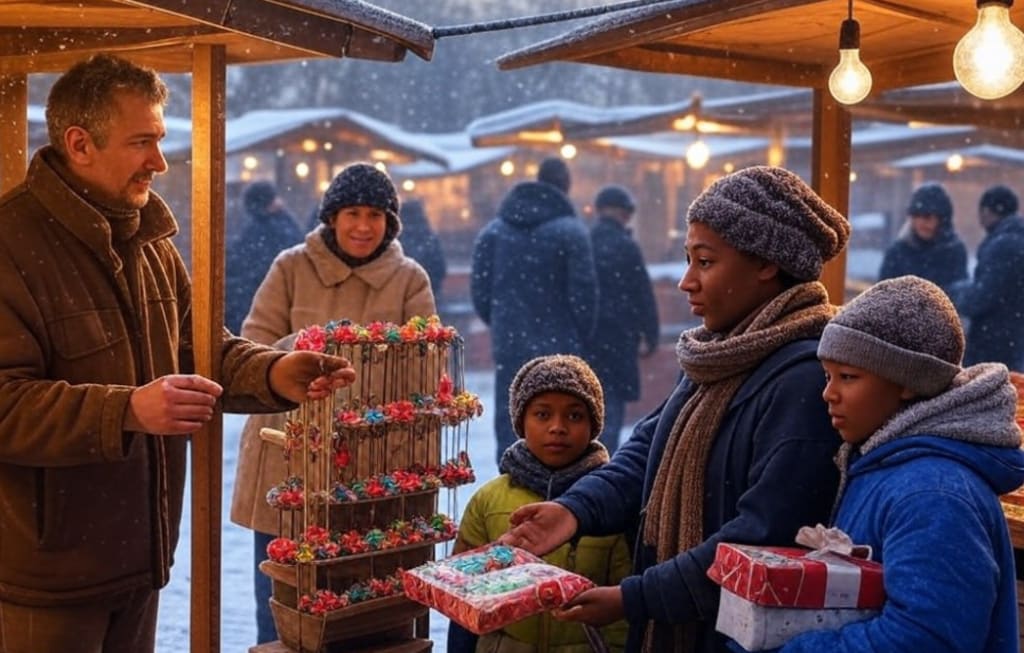
The snow fell relentlessly that Christmas Eve, each flake a delicate whisper against the frozen air, drifting through the streets like the last vestiges of a season we all once knew. From my window, the city below seemed swallowed by its own stillness—a pristine world untouched by the relentless march of time. Yet, beneath the serene white blanket, a deeper truth pulsed: the silence was not peace; it was a hollow echo of a year spent in quiet suffering.
I sat at my desk, pen trembling in my hand, unsure how to begin. How could I possibly capture the depth of what had been lost? How could I frame the faces that had haunted me for months—the father whose heart carried the weight of impossible choices, the street vendor whose dreams had been wrapped in the thinnest threads of hope, the farmer whose harvest had withered before it could be sold, the retiree whose loneliness gnawed at him like a shadow never far enough away, and the young activist whose faith in change was tested by a world that seemed determined to tear apart at its seams?
It wasn’t the cold statistics that haunted me—the numbers of inflation rising higher, of wages stretched thin, of dreams shattered by forces far beyond the control of any individual. It was the faces. The people who had carried their burdens with quiet dignity, their voices barely a murmur beneath the weight of a global crisis. But in their eyes, I had seen something more—a spark that refused to be extinguished, no matter how fiercely the winds of hardship blew.
This was not the story of an economic collapse—it was the story of lives fractured by forces they could neither predict nor control. It was the story of how, in the most unlikely places, people found ways to fight for something more. It was a tale of resilience, of redemption, of small moments where hope flickered like a candle in the dark, refusing to be snuffed out. It was about how, even when everything else was taken, we still had the power to reclaim what mattered most.
This year, inflation didn’t just rob people of material possessions; it stole something far more precious. It stole the traditions that bound us together—the shared joy of a family gathered around a table, the joy of giving and receiving without the weight of calculation, the simple act of a child waking to find presents under the tree. Yet, as the snow continued its descent, I knew this wasn’t the end of the story. It was merely the beginning.
For those whose voices filled these pages, Christmas had not been stolen—it had simply been hidden, buried beneath the rubble of a world that had forgotten the true meaning of the season. But as the frost settled on the streets outside, I knew their fight was far from over. The year inflation tried to steal Christmas was the same year these individuals fought to take it back.
This is their story. And, in the telling of it, we will remember that even in the face of loss, there is always room for hope to be found again.
The Breadwinner
Samuel Johnson once carried the quiet pride of a man whose hard work kept his family’s world turning. A logistics manager with a steady paycheck, he was the architect of Christmases filled with joy—twinkling lights, carefully wrapped presents, and the warmth of his wife Clara’s baking filling their modest home. Yet this year, the magic that once seemed so effortless now felt like a cruel memory.
The company’s cost-cutting measures had slashed his holiday bonus, a lifeline he had come to rely on. Essentials like eggs and milk had morphed into luxuries, their prices climbing higher each week. The thought of a Christmas roast was no longer a dream but a cruel joke.
As Samuel stared at the bare Christmas tree standing awkwardly in the corner of their living room, his mind drifted to the past. In a vivid flashback, he saw his children, Lily and Jacob, tearing open presents under the tree, their faces lit with unrestrained joy. Clara’s voice echoed through the memory, soft and steady as she hummed a carol while baking cookies, the scent of cinnamon wafting through the air. That Christmas, the tree had been adorned with baubles that caught the light just so, their reflections shimmering like tiny stars. This year, the tree stood stripped of its grandeur, its skeletal branches a reflection of their struggle. Clara had done her best, baking with flour substitutes and stretching every dollar, but the cracks in their tradition were undeniable.
One bitterly cold evening, Samuel walked home from yet another long day at work, his shoulders hunched under the weight of failure. As he turned a corner, he caught sight of a street vendor's stall, a modest array of colorful ornaments displayed under the flickering glow of a streetlamp. A small boy stood beside the vendor, clutching a tattered Santa hat and gazing longingly at a shining star ornament. He couldn’t have been much older than Jacob.
Samuel’s heart clenched. He reached instinctively for his wallet, only to remember the emptiness inside. He tightened his grip on his coat and walked on, his chest heavy with the ache of unfulfilled promises. That star, so close and yet so far, became the embodiment of all he could no longer give—not just to his children, but to himself.
Yet, even in that moment, something lingered. A seed of determination planted itself in his heart, fragile but stubborn. The magic of Christmas might have felt like a distant memory, but memories, Samuel told himself, could be rekindled. Perhaps not in the same way—but somehow.
The Street Vendor
Maria Perez tightened her scarf, bracing herself against the sharp bite of the winter wind. The city’s festive lights blinked in the distance, but on this quiet corner under a flickering streetlamp, her small stall seemed invisible. Rows of delicate Christmas ornaments sparkled faintly, their colors muted by the cold, indifferent night.
Passersby hurried past, their faces shadowed by worry. Few stopped to glance at her work, and even fewer reached into their pockets. Maria’s lips pressed into a thin line as she considered raising her prices—just a little, enough to help cover her son’s overdue school fees. But the thought felt like a betrayal, as if she were profiting from the very joy she wanted to share.
Her fingers grazed the edge of a handmade angel ornament, her favorite. Its wings were exquisitely woven with golden thread, each stitch imbued with silent prayers for a brighter future. As she turned it over in her hand, memories of her own childhood drifted in.
In a vivid flashback, Maria stood barefoot in her family’s small rural village, the air filled with the scent of roasting maize and the sound of neighbors singing carols. Christmas back then wasn’t about money. It was about community—the warmth of shared meals, the exchange of handmade gifts, and the laughter of children running through the dirt roads. Her mother had once fashioned an angel out of straw and tied it to their tree with a scrap of red ribbon. It wasn’t perfect, but to Maria, it was magic.
The sharp contrast of her present life made her throat tighten. She had left that village years ago, chasing the promise of opportunity in the city. Yet now, even as she fought to give her son a life of stability, the simple joys of the past felt as distant as the stars.
Her gaze lingered on a little boy who had stopped in front of her stall. He couldn’t have been more than six or seven, his jacket too thin for the weather. Clutching a worn Santa hat, he stared at the angel ornament with wide, unblinking eyes. For a moment, Maria hesitated, her hand moving toward the angel as if to offer it to him. But then, the memory of unpaid bills and her son’s needs pulled her back.
The boy’s mother tugged him away, murmuring something Maria couldn’t hear. The ache in her chest deepened as the boy glanced back one last time before disappearing into the crowd.
Maria exhaled, her breath a soft cloud in the freezing air. The angel in her hand felt heavier now, as though it carried the weight of her choices. Somewhere deep inside, a quiet rebellion stirred—a determination to hold onto the spirit of the season, even if it meant giving away more than she could afford.
In the cold and the quiet, Maria resolved that no matter how inflation tightened its grip, she would find a way to share the joy of Christmas—not through numbers, but through the fragile beauty of what she could create with her hands.
The Farmer
Miles from the bustling city, where winter’s chill seeped into the earth, Emmanuel Okeke stood at the edge of his fields. Rows of yams and vegetables stretched out before him, their abundance mocking him with their uselessness. The crops, once a symbol of hope and hard work, now lay rotting in storage. The cost of transporting them to the city had become insurmountable, and local buyers could barely afford a fraction of their worth.
He tightened his grip on the worn handle of his machete, frustration bubbling beneath his stoic exterior. The fields had always been his sanctuary, a place where sweat and soil yielded sustenance and pride. But now, they felt like a cruel reminder of his helplessness.
In the dim light of their small kitchen, his wife, Nneka, suggested what Emmanuel had been dreading to hear. "Why not share what we can with the village?" she asked softly, her voice carrying a quiet strength. "It wouldn’t be the first time."
Her words pulled him back to a memory long buried—a Christmas from years ago when their harvest had been meager, yet they had fed nearly every family in the village. The image was vivid: neighbors huddled together under a makeshift canopy, children laughing despite the biting cold, and the warm glow of gratitude in every pair of eyes.
But that had been a different time, Emmanuel thought bitterly. Back then, their own children had been younger, their needs simpler. Now, every tuber of yam, every head of cabbage, represented the school fees, clothing, and future of his family. Giving to others meant taking away from his own.
One morning, as the snow blanketed the ground in silence, Emmanuel sat sharpening his tools, his mind weighed down by indecision. His youngest daughter, Ada, bounded toward him, her tiny boots crunching in the frost. She held a worn Christmas card in her small hands, its edges frayed and faded from years of handling.
“Look, Papa,” she said, her eyes alight with the innocence only a child could possess. “It’s from the city family we helped that Christmas! Remember? They sent this to thank us.”
Emmanuel stared at the card, its cheerful image of a bustling holiday market sharply contrasting with his current reality. The words written inside came back to him: "Your kindness gave us hope when we had none. We will never forget."
Ada’s voice broke through his thoughts, her tone soft yet insistent. “Maybe they need us again, Papa. Maybe someone else does.”
Her words hung in the air, as heavy as the snow-laden sky. Emmanuel’s heart wavered, caught between fear and hope. Could he find the courage to give again, despite their struggles?
As he gazed at his daughter, her bright eyes filled with unshakable belief, a flicker of resolve began to form. Perhaps the strength of a community wasn’t in what it could keep but in what it could share.
And perhaps, Emmanuel thought, the act of giving could be the seed of a different kind of abundance—one that no inflation could take away.
The Retiree
The mansion stood vast and imposing, its grand façade masking the chill within. Gregory Sinclair sat alone in the study, a glass of scotch swirling lazily in his hand. The fire crackled weakly, unable to chase away the cold that seemed to emanate from the walls themselves. Once, this house had been filled with life, the air thick with the scent of pine and cinnamon during the holidays. Now, it felt more like a monument to what had been—a relic of a man who had built his life around numbers that no longer held their power.
Gregory’s wealth had been his armor, his portfolio a fortress against the uncertainties of the world. He’d prided himself on his foresight, his ability to weather any storm. But inflation, that creeping, insidious force, had found the cracks in his defenses. Stocks faltered, assets devalued, and what had once seemed limitless now felt precariously finite.
Yet it wasn’t the loss of wealth that gnawed at him most. It was the silence. His children, scattered across the globe, rarely called. Their excuses—work commitments, travel delays, the time difference—were variations on a theme he had come to know too well: he wasn’t a priority. The laughter and music of past Christmases echoed in his mind, cruel ghosts reminding him of what he had lost. He saw his younger self, hosting lavish holiday parties where the halls were decked with garlands and lights, the tables groaning under the weight of feasts. Those memories, once a source of pride, now left an ache he couldn’t soothe.
One evening, Gregory sat staring at his phone, the glow of the screen casting shadows across his lined face. Headlines about economic hardship scrolled past—factory closures, skyrocketing costs, families struggling to make ends meet. He felt detached from it all, his isolation a shield against the chaos. But then, something caught his eye: a community initiative in the city center.
The project was a Christmas market aimed at supporting struggling vendors and families. People could trade goods and services or receive donations for essentials like food and school fees. The simplicity of it struck him—a kind of bartering system reminiscent of a time when people relied on each other, not markets or algorithms.
He clicked on the link without fully understanding why. The donation page appeared, modest in design, and listed the needs of various families: school fees for children, medical bills, heating for the elderly. Gregory hesitated, his thumb hovering over the screen. A voice in his mind—the old, pragmatic Gregory—urged him to move on. But another part of him, quieter yet insistent, asked: *What else are you saving for?*
He entered an amount large enough to cover a dozen children’s school fees and pressed submit. The confirmation message appeared, and for a moment, the weight on his chest eased. It wasn’t much in the grand scheme of things, but it felt significant in a way he hadn’t anticipated.
As the fire dimmed and the scotch warmed his veins, Gregory leaned back and closed his eyes. The mansion around him was still cold, and his children were still far away, but something had shifted. The act of giving, small as it was, had reminded him of a truth he had long forgotten: wealth, stripped of connection and purpose, was nothing more than numbers on a page.
Perhaps, he thought, this Christmas wouldn’t be about reclaiming what he’d lost. Perhaps it could be about creating something new—however small, however fleeting. And for the first time in years, Gregory felt the faintest glimmer of warmth that didn’t come from the fire.
The Activist
Aisha Malik, at just 21, had a spark that ignited everything she touched. To her, Christmas wasn’t about the glitz of fairy lights or the piles of expensive gifts—it was about connection, something she felt her generation had forgotten. In her college circles, the holiday season had become little more than a race for luxury: canceled ski trips and missing designer bags were the tragedies her peers lamented. But Aisha saw beyond these shallow grievances.
She walked the same streets every day, observing the quiet struggles of her community. The corner grocer who now closed early because customers couldn’t afford his goods. The elderly woman in her apartment complex who spent long hours by the radiator, conserving every bit of heat. The children playing in hand-me-down jackets that barely held back the cold. Inflation had carved deep grooves into the lives of the people around her, and Aisha couldn’t stand idly by.
Late one evening, sitting cross-legged in her cramped dorm room, she scribbled ideas in her notebook. Her thoughts drifted back to her childhood in a tight-knit immigrant neighborhood. Back then, her parents had taught her that true wealth wasn’t measured in possessions but in generosity. She remembered her mother trading freshly baked bread for the neighbor’s homemade pickles, her father fixing a friend's broken heater in exchange for a simple thank-you. It was a community built on giving, a concept that now seemed almost alien in the face of modern consumerism.
It started as a simple idea. Aisha called it the "Gift of Giving" exchange. The rules were straightforward: participants could offer their time, skills, or handmade gifts—anything that could bring value without requiring money. It began with her closest friends, who were reluctant at first. "Who’s going to want a knitted scarf or a free tutoring session?" one of them scoffed. But Aisha’s determination was infectious.
The first exchange was held in a modest community center, its walls decorated with string lights donated by a local café. Aisha had no idea what to expect, but as people arrived, she saw the magic unfold. A single mother offered to babysit in exchange for a neighbor fixing her broken window. A retired musician played Christmas carols while children crowded around, wide-eyed and delighted. A teenager traded handmade bracelets for lessons in baking.
Word spread quickly. By the second week, the small room couldn’t contain the crowds. The event moved outdoors, turning into a vibrant hub of creativity and compassion. People from all walks of life came together, each offering what they could and receiving what they needed.
Aisha walked through the growing crowd one evening, her heart swelling with pride. She overheard snippets of conversation—stories of resilience, gratitude, and hope. In a city fractured by economic strain, the exchange had become more than an event; it was a lifeline, a reminder that even in the hardest times, people could rely on one another.
Later, as she watched a young boy excitedly present his mother with a hand-painted ornament he’d bartered for, Aisha felt a lump in her throat. This wasn’t the Christmas she’d grown up resenting. This was something real, something alive.
The Gift of Giving exchange grew far beyond what Aisha had envisioned, its impact rippling across the city. But it was never about the scale or the numbers. For her, it was about proving that, even when inflation had stripped away so much, there was one thing it couldn’t take: the human spirit's capacity to give.
The Christmas Market
The Christmas market came alive in the heart of the city, a patchwork of stalls lit by flickering strings of colored lights. The air was thick with the scent of spiced cider, roasted chestnuts, and the hope of something beyond the reach of inflation. For a single night, the fractured lives of the city converged, weaving a tapestry of resilience and connection.
Samuel Johnson arrived with heavy steps, his pockets nearly empty but his heart burdened with a father's determination. He wandered through the market, past stalls brimming with handmade trinkets and holiday cheer. His gaze landed on Maria’s modest setup—a table adorned with ornaments so vibrant they seemed to defy the gloom of the season. He lingered, unsure, until Maria called out.
“Looking for something special?” she asked with a warm smile that belied her own struggles.
Samuel hesitated, then offered to help her manage the growing crowd around her stall. His years of logistical work made him a natural, and soon, Maria’s once-overlooked ornaments were selling faster than she’d ever imagined. When the last customer left, Maria handed Samuel the angel ornament she had held onto for so long, her favorite creation.
“This is for your children,” she said softly. “A little hope for your home.”
Meanwhile, Emmanuel Okeke arrived at the market with his youngest daughter. They carried baskets overflowing with fresh yams, greens, and tomatoes. Initially, Emmanuel had planned to sell the produce to recoup the transportation costs, but the sight of hungry faces changed his mind. His wife’s words echoed in his heart: *“Giving isn’t losing; it’s sharing what we have.”* He began handing out the food, turning the market into a feast.
Gregory Sinclair stood at the edge of the crowd, his coat collar turned up against the chill. No one recognized him, and that was how he wanted it. From his vantage point, he saw Maria laughing as she counted her earnings, enough to pay her son’s overdue school fees. He saw Samuel clutching the angel ornament, a flicker of joy breaking through his exhaustion. He watched Aisha moving through the crowd, organizing donations and helping strangers connect. Gregory’s anonymous contribution had enabled much of this, but it was the people themselves who made it come alive.
Laughter and music filled the market, weaving a symphony of defiance against the hardships of the year. Strangers shared meals at makeshift tables. Children played, their shrieks of delight rising above the murmur of conversation. Stories unfolded between bites of food and sips of warm cider—stories of loss, resilience, and unexpected generosity.
As the evening stretched on, the market became more than a place to trade goods. It became a sanctuary, a space where everyone’s contributions—be it a skill, a song, or a smile—were valued. For Samuel, Maria, Emmanuel, Gregory, and Aisha, it was a moment of reprieve, a reminder that even amidst scarcity, there could be abundance in human connection.
The angel ornament found its place at the top of Samuel’s Christmas tree that year, its stitched wings a testament to hope. Emmanuel’s daughter wrote a thank-you letter to the market organizers, promising to pay forward the kindness they had received. Maria framed her son’s first report card of the year, the overdue fees finally settled. Gregory, still alone in his mansion, found himself smiling—a small, genuine smile—as he thought of the lives he had quietly touched.
And Aisha? She looked around the market, the culmination of her efforts, and felt a warmth deeper than any holiday could bring. She knew this was just the beginning.
For a fleeting moment, the harsh realities of inflation faded. In their place was the simple, enduring truth that Christmas wasn’t stolen after all. It had just been reimagined.
Closing Thoughts
The snow had finally stopped falling that night, leaving a quiet stillness over the city. Each flake that had descended seemed to carry a message, soft and fleeting, and yet somehow enduring. As I sat back in my chair, my notebook closed, I looked out at the snow-covered streets, watching the world through a lens of reflection. The cold was palpable, but so was the warmth that lingered in the hearts of those whose stories I had followed.
Inflation had taken so much. It had taken the grand displays of wealth, the lavish feasts, the shiny wrapping paper, and the glittering ornaments that defined the holidays for many. Yet, it had not claimed what truly mattered. Not this year. The material trappings of Christmas had vanished, but the resilience of the human spirit had risen, unbroken.
I thought of Samuel, clutching that simple angel ornament Maria had gifted him, his children eagerly hanging it atop their tree, the symbol of a hope that transcended the absence of presents. I imagined Emmanuel, standing at the market, watching the faces of the people he had fed, feeling his heart swell with a pride he hadn’t known in years. I envisioned Gregory, watching from a distance, his donation making a ripple of difference, his isolation softened for the first time in ages by the quiet connection to something greater. And then Aisha—her initiative, which had started with a simple idea, now thriving beyond the confines of the market, a testament to what could be achieved when people were willing to give, even when they had little to offer.
Somewhere out there, Samuel’s children were laughing, their faces lit by the glow of a modest tree. Emmanuel’s baskets had filled bellies, warming the spirits of his village in ways money could not. Gregory, for the first time in years, had felt needed, and Aisha’s vision was blossoming into something far beyond a seasonal gesture—it was an ongoing movement.
As I watched the snow fall softly on the streets, it occurred to me that perhaps inflation hadn’t stolen Christmas after all. Maybe, in its harshness, it had only stripped away the distractions, leaving us to rediscover what was truly important. The heart of the season. The quiet acts of kindness. The way we rise when we have nothing left to give but ourselves.
And maybe, just maybe, it was in that absence, in that loss, that we found the true meaning of Christmas once again.
About the Creator
Keep reading
More stories from Honsby Orji and writers in Fiction and other communities.
The Tyrant's Shadows of Ambition
Tunde Bullock’s frailty was a cruel illusion. Beneath his trembling hands and hollowed cheeks lay a mind sharp and relentless—driven by a single, all-consuming hunger: to rule Neverland. His past was a tangled web of whispered rumors—shady deals, a rise to wealth steeped in mystery, con artistry, and ties to criminal forces as dark as the secrets he kept. But one thing remained undeniable: nothing would stand between him and his ambition, not even his failing body.
By Honsby Orjiabout a year ago in Fiction
Miss Persephone's Manual to a Seemingly Ordinary Life
Miss Persephone was found at the dining table, her blue eyes swollen, her tears arriving and retreating like the tides of the ocean. Earlier that day, her family had visited her in the retirement home where she had lived for eight years. It was her eightieth birthday.
By Imola Tóth6 days ago in Fiction
The CEO of Everything
They say "jack of all trades, master of none," but they forgot to mention the part where the jack of all trades is also the camera woman, the makeup artist, and the person currently yelling at a tangled Wii microphone cable in a her own bathroom while recording herself singing and trying to make it look realistic and professional. (As professional as you can make it with nothing but a cell phone camera and a mic that doesn't work)
By Sara Wilson4 days ago in Humans



Comments
There are no comments for this story
Be the first to respond and start the conversation.