
The Town Where People Disappear After 30
A haunting metaphorical story where everyone vanishes after turning 30 — until one woman refuses to go quietly. Theme: Aging, societal pressure, invisibility.

The Town Where People Disappear After 30
Genre: Surreal Fiction / Social Commentary
Theme: Aging, Societal Pressure, Invisibility
Word Count: ~950
No one knew exactly how it happened—only that it always did.
In the town of Veilridge, everyone disappeared after they turned thirty. Not died. Not left. Simply vanished.
At first, it was subtle. A person would miss work. Neighbors would say they’d moved out overnight. A few photos removed from the walls, the names fading from memory like smoke on a cold morning. It was all very polite, very tidy. The town continued on, unbothered, as if nothing strange had occurred.
Children were warned from a young age: “Do what you want before thirty. After that… well, there’s no after that.”
The town didn’t ask questions. Questions were considered impolite. And besides, if you ignored something hard enough, it became normal.
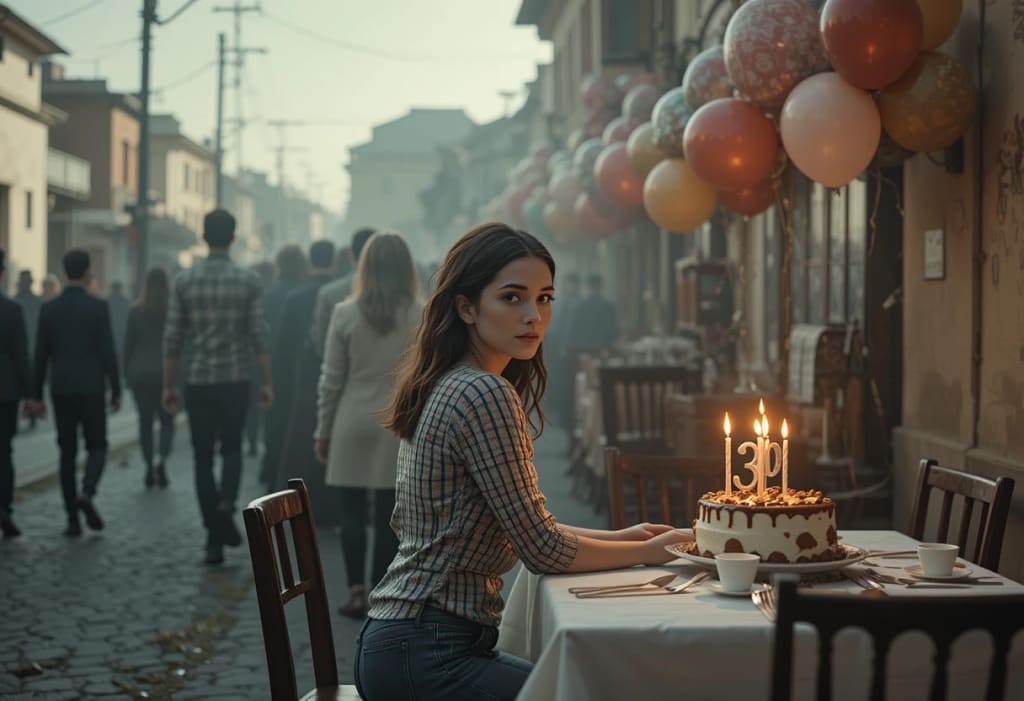
People threw extravagant 29th birthday parties like farewell galas. Friends clinked glasses with tight smiles, whispering to each other, “I wonder where she’ll go…”
But no one knew.
And nobody ever dared to turn thirty.
Except June.
June was twenty-nine and eleven months. She lived in a small apartment above the bakery, painted her own walls yellow, and read books that no one else in town seemed to own.
While others rushed to complete “before thirty” bucket lists—skydiving, whirlwind romances, messy rebellions—June sat in the library, researching history that wasn’t in the schoolbooks. She sketched symbols that looked suspiciously like the ones hidden in the town square’s oldest stones. She whispered to herself when she thought no one was listening:
“Where do they go?”
Her mother had disappeared when June was six. One moment tucking her into bed with a lullaby, the next morning… nothing. Not even her scent left on the pillow.
When June asked her father, he’d replied in a tone cold as chipped porcelain:
“She turned thirty.”
On the night before her thirtieth birthday, Veilridge held a party for June. That was the custom—everyone got one last celebration.
There were paper lanterns, fizzy drinks, awkward toasts. Her friends hugged her too tightly, avoiding eye contact. They knew this was goodbye.
She looked around and realized how many people were gone. Friends from school, the old librarian, the man who fixed bicycles—thirty came, and they evaporated. No funerals. No grief. Just… erasure.
June didn’t cry. She just asked one question aloud, into the quiet clinking of glasses:
“Why are we pretending this is normal?”
No one answered.
That night, she didn’t go to sleep. She sat on her balcony under the moon and waited. Her heart raced.
Then, at exactly 3:03 a.m.—the time it always happened—there was a soft hum in the air. The walls of her room shimmered like heat off a summer road. The lightbulbs flickered. Shadows stretched too long across the floor. A wind she couldn’t feel blew her curtains inward.
And from the corner of her vision, she saw it:
A figure cloaked in colorless light. Not man, not beast. Faceless. Soundless. Watching.
June stood.
“I’m not going,” she said. Her voice trembled but did not break.
The figure tilted. A soundless question hung in the air, like a string waiting to be pulled.
“I refuse,” she said. “I want to stay. I want to be, even if it means being thirty.”
The figure did not move. But the room did. It twisted, warped, reality curling like burned paper.
Still, she did not move.
And then… silence.
The figure vanished.
And June did not.
The next morning, the town woke up to something unthinkable: a thirty-year-old walking the streets.
Children stared. Adults whispered behind curtains. The mayor tried to speak with her, but found his throat dry and useless. June smiled kindly, bought a loaf of bread, and walked home as if nothing had changed.
But everything had.
Because she hadn’t disappeared.
And that meant maybe—just maybe—they didn’t have to either.
The change wasn’t immediate. Veilridge was slow to accept the abnormal. The coffee shop refused to serve her at first. The postman left her letters in the trash. Her closest friend, Annie, cried and said, “You should’ve just gone. Now I have to think about it.”
But one by one, people began to talk to June again. Secretly at first, in quiet corners and back alleys.
“What’s it like?” they asked. “To still be here?”
June would smile and say, “It’s just life. It’s more of the same… but deeper. Braver.”
And then came the second.
A boy named Marlow refused to vanish on his birthday.
Then a teacher.
Then the baker’s wife.
And suddenly, Veilridge had people in their thirties. Their forties. Grey hair began to appear in town. Laughter sounded richer. Fewer people rushed. More people asked why.
Some couldn't handle it. They begged for the quiet fade. The shimmering figure still came, offering oblivion. Some accepted. Some didn’t.
But June—June stayed.
She taught people how to remember.
Years later, when June was sixty-three, a child asked her, “Weren’t you scared? When you stayed?”
June laughed, lines curling around her eyes like tiny stories.
“Yes. Terrified. But I was more afraid of disappearing than of being seen.”
The child nodded. “Will I have to choose, too?”
June looked toward the horizon, where a town once frozen in youth was now alive with people of every age.
“No,” she said. “You already did.”
Author’s Note:
In a world obsessed with youth, we forget that aging is not a curse—it’s a testament to survival. The town of Veilridge is fiction. But how many of us have disappeared after thirty, not in body, but in spirit, in visibility, in value?
June didn’t just resist vanishing. She reminded us that staying is a form of revolution.
Even if the world forgets you—don’t forget yourself.
About the Creator
Keep reading
More stories from waseem khan and writers in Fiction and other communities.
The Library of Regrets
The Library of Regrets The night had fallen thick and silent, draping the world in shadows that felt too heavy to bear. Clara awoke to find herself not in her small, cluttered bedroom, but standing before an enormous, ancient wooden door, etched with twisting vines and glowing letters that whispered secrets she could almost understand.
By waseem khan6 months ago in Fiction
Ludacris and Nelly draw backlash over bookings at MAGA-coded music festival
Ludacris and Nelly headlining a mostly right-wing event is good for them. It’s also great for the genre of hip hop. The two rap veterans have showcased their talents on other stages. Why can’t they perform for mostly MAGA folks and grab that bag?
By Skyler Saunders5 days ago in Beat



Comments
There are no comments for this story
Be the first to respond and start the conversation.