
THE TAIL OF TWO LIES: WHY IS THE HIGH-RES DATA FROM 3I/ATLAS BEING DELAYED?
ESA’s spacecraft captured the clearest images of the visitor yet. But you aren’t allowed to see them until 2026. What are they scrubbing from the files?

The "Official" Leaks
As the calendar creeps toward December 19—the date the interstellar object 3I/ATLAS makes its closest and most critical pass by Earth—the frantic activity at the world’s space agencies has reached a fever pitch. NASA and the European Space Agency (ESA) have just released a fresh batch of images. On the surface, these photos are presented as triumphs of science, confirming the object’s trajectory as it speeds through our celestial neighborhood.
But for those of us who have been tracking the anomalies, the timing of these releases feels less like transparency and more like damage control.
3I/ATLAS, the third known visitor from outside our solar system, has been described by officials as an "intriguing comet." Yet, the resources being poured into tracking it suggest it is much more than a ball of ice. We are talking about a prioritized diversion of billion-dollar assets. And the latest "findings" from the Juice mission have just handed us the smoking gun we’ve been waiting for.
The Juice Deception
The European Space Agency’s Juice (Jupiter Icy Moons Explorer) mission was launched to find life on the moons of Jupiter. It is one of the most sophisticated pieces of technology humanity has ever built. In early November, Juice found itself in a "prime position"—just 41 million miles away from 3I/ATLAS. This is significantly closer than Hubble. It was the perfect opportunity to see the true face of the visitor.
Juice used five powerful scientific instruments and its Navigation Camera to scan the object. It saw things Hubble couldn't. It saw details that could rewrite history.
But here is the catch: You won’t see that data until February 2026.
The official excuse is almost laughable in its convenience. ESA claims that because the spacecraft is currently on a long journey to Jupiter, it has to use its main high-gain antenna as a "heat shield" to protect it from the Sun. Therefore, they claim, they can only transmit data back to Earth through a smaller, slower antenna at a trickle.
Think about that. We have the clearest, closest, most high-definition scans of an alien object ever taken, and we are being told that a "bad Wi-Fi connection" is the reason we have to wait 14 months to see them?
In the world of intelligence and cover-ups, 14 months is an eternity. It is exactly enough time to analyze the images, identify artificial structures or non-natural propulsion signatures, and scrub them from the public dataset before the "official" release. They aren’t waiting for the antenna; they are waiting for the censors.
The Mystery of the Dual Tails
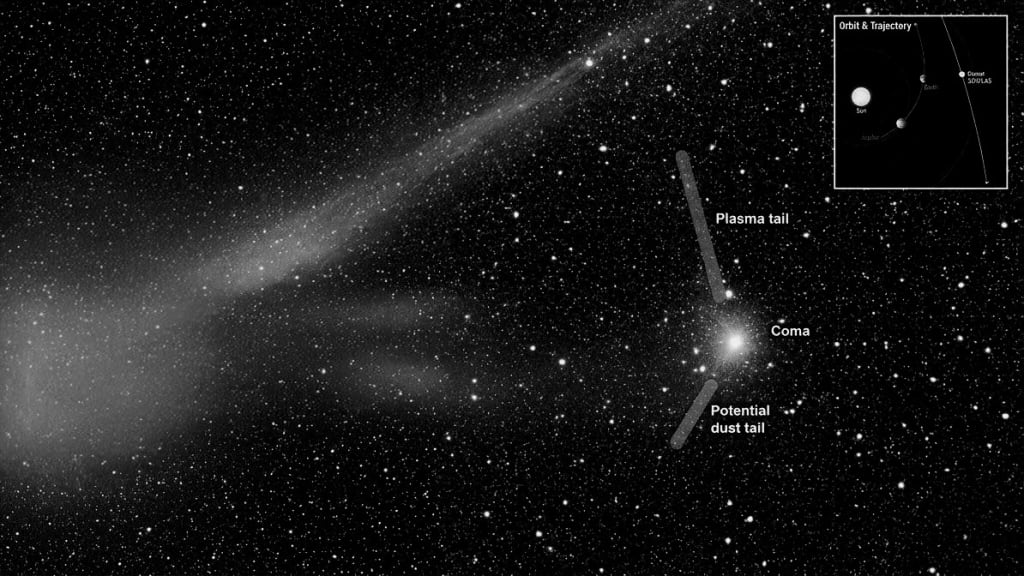
Despite the blackout on the high-res data, the Juice team "couldn't wait" and downloaded a quarter of a single navigation image. Even this low-quality teaser is explosive.
The image reveals that 3I/ATLAS doesn't just have a coma (the halo of gas). It has two distinct tails.
A Plasma Tail: Made of electrically charged gas.
A Dust Tail: Made of solid particles.
In standard cometary science, this happens when solar wind interacts with ions. But in the context of an interstellar object that has shown erratic movement and "cryovolcanic" eruptions, a plasma tail takes on a different meaning. Plasma is ionized matter. In theoretical physics, a plasma wake is the signature of high-energy ion propulsion.
Is it possible that what ESA describes as a "tail of electrically charged gas" is actually the exhaust plume of an engine accelerating away from the Sun? The presence of a second, heavier "dust" tail could be the venting of waste material or coolant—the "ice volcanoes" we discussed in our previous report.
Hubble’s Stretched Truth
Meanwhile, NASA’s Hubble Space Telescope took another look on November 30. The image is crisp, showing the object’s nucleus glowing with intense brightness. But look at the background. The stars are stretched into long, blurred streaks.
This happens when a camera locks onto a target that is moving at extreme velocities. 3I/ATLAS is traveling at 130,000 mph. It is moving so fast and with such stability that Hubble had to ignore the rest of the universe just to keep it in frame. The object is screaming out of our solar system, heading back into the deep void.
The December 19 Milestone
We are told not to worry. Officials repeat the mantra: "It will pass 167 million miles from Earth. It poses no risk."
But risk is relative. If 3I/ATLAS is a natural rock, there is no risk. But if it is a probe, the risk isn't a collision—it’s surveillance. The object’s closest approach on December 19 is the final window for data collection. It is the moment the "handshake" happens.
The Juice spacecraft saw something on November 2 that was significant enough to warrant a complete lockdown on the full dataset. The Hubble telescope is tracking it like a missile. And we are left with low-res teasers and excuses about heat shields.
As 3I/ATLAS fires its "plasma tail" and races toward the exit door of our solar system, ask yourself: Why are they working so hard to make sure we don't see the full picture until the visitor is long gone?
The truth is on a hard drive, millions of miles away, waiting to be sanitized.
About the Creator
Wellova
I am [Wellova], a horror writer who finds fear in silence and shadows. My stories reveal unseen presences, whispers in the dark, and secrets buried deep—reminding readers that fear is never far, sometimes just behind a door left unopened.




Comments
There are no comments for this story
Be the first to respond and start the conversation.