
THE INTERSTELLAR VISITOR IS "ERUPTING": NEW IMAGES SHOW ICE VOLCANOES ON 3I/ATLAS
Scientists claim it's natural cryovolcanism. But could these massive jets of gas be evidence of something else entirely?

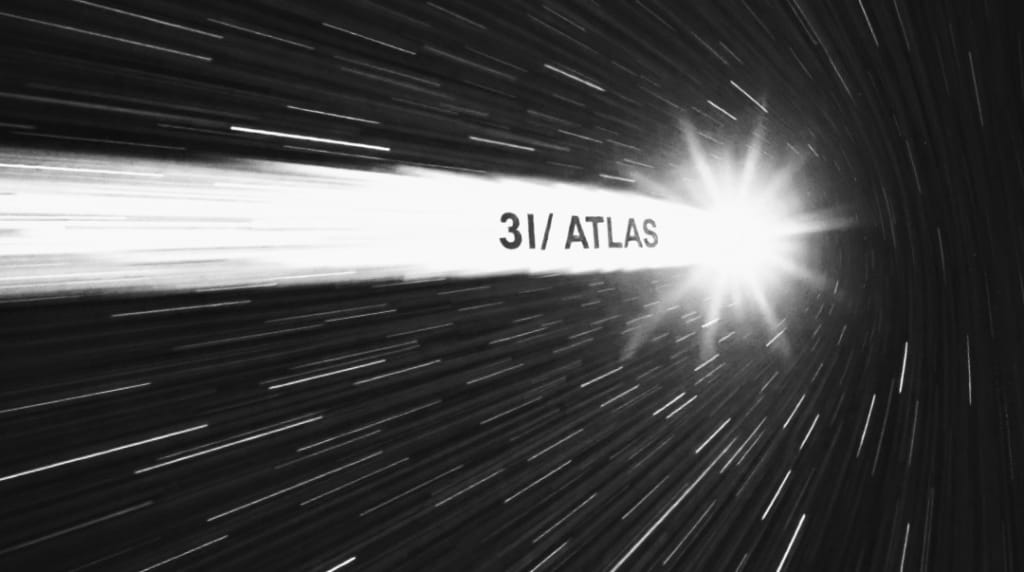
A "Dead" Rock Comes to Life: The Awakening of 3I/ATLAS
Just when the global scientific community thought they had 3I/ATLAS figured out, the interstellar visitor has thrown another massive curveball. We were told it was just a quiet, tumbling ball of ice speeding through our solar system—a ghost form a distant star. But it turns out, it isn’t quiet at all. It is actively erupting.
New, high-resolution images captured by the Joan Oró Telescope in Spain have revealed a stunning and violent phenomenon: the surface of 3I/ATLAS is covered in what scientists are calling "ice volcanoes" or cryovolcanoes. To be clear, these aren't like the molten lava volcanoes we see in Hawaii or Iceland. Instead, they are explosive, high-pressure jets blasting frozen gas, crushed ice, and dust miles out into the freezing vacuum of space.
The sudden activity has ignited a firestorm of debate. The question that has the internet buzzing, and even some astronomers scratching their heads, is simple: Is this just geology, or is it a sign of internal machinery coming online?
The Official Explanation: A Cosmic Coincidence?
The study, led by researcher Josep Trigo-Rodríguez, suggests a fascinating but purely natural explanation. They propose a "pressure cooker" theory. They believe that as 3I/ATLAS approached our sun, the intense solar heat penetrated its thick, frozen shell for the first time in eons. This thermal shock caused solid carbon dioxide (dry ice) and other volatiles deep inside the core to violently sublimate—turning instantly from solid to gas. This created pockets of massive pressure, essentially "pressure bombs," that eventually burst through the surface crust.
Interestingly, their chemical analysis shows that this composition is shockingly similar to objects found in our own solar system's outer reaches, beyond Neptune.
“We were all surprised,” Trigo-Rodríguez admitted in a recent statement. “Being a comet formed in a remote planetary system, it is remarkable that [it resembles] bodies belonging to our planetary system.”
It is a convenient, comforting scientific explanation. It tells us that this visitor from an unknown star is actually quite familiar to us. It suggests that star systems across the galaxy are built from the same basic blocks. The underlying message is: Move along, nothing strange to see here.
The Alternative Theory: Venting the Engines
But here is where the official narrative hits a snag, and where the mystery deepens.
If 3I/ATLAS is just a simple, ancient comet—potentially billions of years older than our own solar system—why is it so violently active now? And why in such a specific way?
Online sleuths, amateur astronomers, and even some open-minded experts are pointing to the specific structure of these jets. These aren't just random, chaotic bursts of gas you might expect from a cracking rock. Images and data suggest "spiral jets" shooting off the surface in a controlled, repeating pattern.
This distinction is crucial. In nature, explosions are messy. But this organized venting looks less like a random rupture and more like a functional system. To the imaginative eye, this resembles:
A Propulsion System: Jets firing to adjust trajectory.
Heat Regulation: A mechanism venting excess thermal energy to cool down internal systems as it gets too close to the sun.
Stabilization: Thrusters firing to stabilize the object's spin.
Is it possible that what scientists are calling "cryovolcanism" is actually the exhaust of a massive, alien engine waking up after a long, interstellar slumber? It brings to mind the concept of a "von Neumann probe"—a dormant machine that travels the stars, only activating when it detects the heat and gravity of a viable star system.
The Race Against Time
The tragedy of this encounter is that we may never know the whole truth. 3I/ATLAS is not staying for a chat. It is moving at a blistering 137,000 mph, on a strict one-way ticket out of our solar system. It is currently plunging toward its perihelion (its closest point to Earth) in December, before it slingshots around the sun and disappears into the darkness forever next year.
Researchers are racing to gather every scrap of data they can, calling it a priceless "space capsule" of information from another galaxy. But as the object continues to defy expectations—first with its unusually metallic composition, then its strange, flat trajectory, and now with these active, spiral eruptions—one has to wonder about the nature of our observation.
Are we simply studying a rock? Or are we being studied by a traveler that just turned its systems on to take a look at us?
The universe is vast, and coincidences happen. But when a "dead" rock starts spiraling exhaust in our direction, it forces us to ask the big questions.
What do you think? Are these natural ice volcanoes, or is 3I/ATLAS preparing for something else?
Would you like me to analyze the specific "spiral" patterns mentioned in the text to see how they compare to known cometary physics?
About the Creator
Wellova
I am [Wellova], a horror writer who finds fear in silence and shadows. My stories reveal unseen presences, whispers in the dark, and secrets buried deep—reminding readers that fear is never far, sometimes just behind a door left unopened.
So You Decided To Become a Nurse Practitioner:
So you decided to become an "Advanced Practice" nurse. Congratulations!... is what I would say if this was a good idea. Grad school? In this economy? What were you thinking? Likely it was something along the lines of either 1) “I've seen these other chucklefucks do it— Why can't I?” or even 2) “I've got a nice career, I should shake it up. I miss feeling like I have no clue what I'm doing.”
By Sandor Szabo4 days ago in Fiction


Comments
There are no comments for this story
Be the first to respond and start the conversation.