
The Summer Villain
One night to cut the cord, and see what’s left by dawn


By the time the sun goes down, the apartment has the temperature and moral ambiguity of a sauna. The living room window is propped open with a paperback Bible and a cracked sandal, but the air barely moves. The fly strips dangle like sad party streamers for a party that never ends and never gets fun.
I stand in the doorway of my room holding a black trash bag like a parachute, deciding what to throw out and what to save if the night goes the way I think it will. Roaches do an interpretive dance near the baseboard. I pretend we’re not roommates. We all pretend things here.
From the kitchen: “Can you bring me your card?” my mother calls. “I found a real prophet this time. He said if I sow a seed tonight, God will return it sevenfold by morning.”
The sentence lands like a fist at the back of my neck. My card. My summer budget. My plan to move out before the cold finds excuses to make me stay.
I look down at my sneakers—the black-and-purple ones with the little goose on the heels—and I imagine walking out the door and not turning around. In the religion of this apartment, there are two sacraments: delay and depletion. I’ve been devout for years.
“Ma,” I say, stepping into the doorway. She sits at the rickety kitchen table with her phone tilted toward the light, face bathed in algorithmic beatitude. A smile plays at her mouth like she’s falling in love with a person who doesn’t even have hands. “Let’s not tonight.”
She blinks at me, not hearing or refusing to hear. “He’s live right now. He’s speaking *to me.* He said a faithful mother, a stubborn child—”
“I’m not stubborn,” I say. “I’m leaving.”
“Leaving where?” she says, in the voice you use for people who can’t possibly mean what they just said.
I take a breath and put the black bag on the chair between us. It makes a sound like thunder in miniature. “Out. By morning.”
There is a very long, very holy silence. Outside, a siren passes, dragging its sound like a long piece of red ribbon through the block.
“You would do this,” she says, finally, not crying yet, not angry yet, not anything yet. “You would be the villain of the summer.”
“I guess,” I say, because I’ve learned that the only way to move is to stop arguing about the roles in someone else’s story. “I guess I would.”
She looks back down at the prophet. On his screen, graphics tumble across the border like slot machine cherries: *SOW NOW, 77.77, RELEASE YOUR MIRACLE*. Somewhere in the apartment, the bathroom light buzzes with the conviction of a thousand gnats.
“It’s just one more time,” she says. “Then God will help with the rent.”
“We had money for the rent,” I say. “You gave it to the last guy who said God had Zelle.”
And there it is—the flicker to anger, the old choreography. “You’re mocking faith. It’s no wonder you’re lost.”
“No,” I say softly. “I’ve been too sure. That was the problem.”
I go back to my room before the argument can flower into the shape it always takes. I close the door gently, like you put a lid on a pot that’s about to boil over, and start packing for real. Two shirts, two pants, a hoodie that doesn’t smell like the apartment, the notebook where I write lists and futures and sometimes lies. A toothbrush, a charger, the little envelope with my new bank card—activated but unused, floating like a silver key to a door I haven’t found.
The phone rings at 9:34. It’s Manny, the super.
“You still want me to come by? I can check the leak in the bedroom, but it’s late.”
“It’s fine,” I say. “Don’t worry about it.”
“Your mom said you were short on rent,” he says, lowering his voice like a conspirator. “Listen, I can give you until the fifteenth.”
“I’m paying my half,” I tell him. “I’m not paying hers.”
He is quiet long enough that I imagine him leaning against a wall covered in peeling paint, looking at a clipboard that already knows how this ends. “You sure, kid?”
“I’m becoming the villain tonight,” I say. “Apparently.”
He barks a soft laugh. “Everybody’s somebody’s villain. Be a good one.”
After we hang up, I pull the little plastic bin from under my bed and dig out the folder with receipts: the autopays I set up when I thought love could be automated if you just connected the right accounts. I log into the utilities and unhook my card with hands that shake worse than I expect. I freeze the card that’s in her Apple Wallet. Delete the recurring transfers. I feel like I’m cutting lines on a sinking boat while the person I love tells me they know a guy who can teach water to behave.
At 10:11, the prophet calls. Not his office. Not a bot. Him, or someone trained in his voice, asking for me by name.
“Is your mother present?” the voice says. The tone has the greasy, warm bravado of late-night commercials. “She is a woman of faith. The seed must be planted tonight.”
I swallow. “We can plant basil in the window tomorrow,” I say. “That has a better return.”
“Son,” he says, with three hundred years of paternal disappointment. “You are in rebellion.”
I am not brave, but I am tired. “No,” I say. “I’m in Brooklyn.”
I hang up. I block the number. I stare at the door and wait for it to open like it does in all the bad nights, but it doesn’t, not yet. I hear a spoon clink against a mug in the kitchen. The apartment smells faintly like a candle trying to cover a crime scene.
By 11, the heat breaks the way a promise breaks—suddenly, a little cruel. Rain starts. Fat drops slap the fire escape in a tempo that says: start moving.
I write my mother a note because text messages feel like weapons and I want, if not mercy, then something that looks like clarity. I keep it simple: *I love you. I can’t pay your bills anymore. I’m not punishing you. I’m protecting me. If you want help making a plan, I will help. But not with my card.* I put a second note under Manny’s door with my forwarding address: my friend Danny’s couch on the 86th Street line. I drop my keys in an envelope with the landlord’s address, one key left for the next eight hours, the way you keep one slice of cake in the fridge so you won’t be totally earnest.
At midnight, I take the trash out. The hallway smells like hot dust and old febreze. Mrs. Alvarez in 2B opens her door a crack when she hears me, eye like a star in the dark. “You leaving?” she whispers, in a tone people use at hospital beds.
“Just taking out the trash,” I whisper back, and we both let the sentence hold all its meanings.
Down on the street, the rain is steady. The summer has turned a good corner; for a second the block feels like a movie set—shiny asphalt, reflections, neon from the bodega swimming on the puddles. The teenager next door is smoking with one hand and playing chess on his phone with the other. He nods at me like he knows. Maybe he does. Maybe everybody knows on a night like this.
I buy iced coffee at midnight because I want a cliché to hold, and because I need to do something besides think. The bodega cat is sprawled across the shelf where the powdered donuts live, looking like he owns real estate. The guy behind the counter asks, “You good?” in a voice that could mean anything from *you look like hell* to *do you want a banana on the house.* I nod and say yes, and he gives me exactly one extra napkin. A small blessing. A receipt that says: someone noticed.
At 1:07 a.m., my mother knocks. Not a fight knock; a doorbell knock.
“I read your note,” she says through wood.
“Okay.”
“You would leave me alone.”
“I would leave you with you,” I say, as gently as I can. “You’re not alone unless you choose it.”
“I can’t sleep when you do this.”
“I haven’t slept in years,” I say, and immediately wish I hadn’t.
Silence. Then a sound that might be a laugh or might be bravery breaking. “You think you’re strong,” she says. “But you’ll be back. The city will spit you out, and you’ll crawl home.”
“I don’t have a home,” I say. “I have a launchpad and a landing strip and a timeshare in guilt. I’m going to try to buy a room with a door.”
When she goes, I stand at the little window and watch the rain bruise the street. On the screen of the building opposite, someone’s TV flickers with a reality show where people scream about kitchen islands and paint color like they discovered fire. I imagine a place where I can put my stuff in a cabinet and it stays there, like a child might imagine a dragon and then go build a pillow fort just in case.
At 2:15, the lights go out. The building sighs like a tired horse. I sit on the floor with the iced coffee sweating between my knees and feel a sudden, hysterical urge to laugh. Of course the power goes. Of course the night wants to audition for tragedy.
I find the emergency flashlight with the bite marks on the handle and turn it on. The beam cuts across the room and finds the wall where I stuck a postcard of the Queensboro Bridge, the way it laces light across water. I put the flashlight on its base and let it be a fake moon.
In the fake moon I sign into my bank and set hard limits. I change passwords. For security questions I write answers I can’t accidentally share in conversation. (*Where were you born?* Gooseplanet. *Mother’s maiden name?* Noneya.) I text Danny: *Still good to crash tonight?* A minute later: *Always, bro. Bring the goose shoes.
At 3, I start doing the useless cleaning, the small final kindness you do to places you’re about to betray. I wipe the dust from my dresser. I toss drawers of ancient chargers. I put my mother’s pile of envelopes into a neat stack, even as I know the stack is a lie that says there is a system here. I scrub the circle where my fan once stood like I could polish heat into obedience.
The rain eases at 3:42. The air changes. You can feel the sky making decisions above you. I sit on my suitcase and think about villains.
Villains have clarity. That’s their terrible power. They say the quiet part out loud, and then they do it. They don’t ask the audience for permission to leave the stage. They just bow and go.
At 4:11, I slide the last envelope under the landlord’s door and take the stairs down with my suitcase the way you descend a ladder into water: one rung at a time, eyes forward. The street is empty except for the person who sells empanadas out of a cooler even at this hour because the night shift has to eat too. I buy one for the train. I do not cry. I gave the night enough.
Down into the station: wet concrete, the sweet metallic tang like pennies in the mouth, the moment you and your suitcase become the only people in a huge tiled room built for crowds. The M train arrives with more screech than dignity. I get on. I find a seat where no one will try to sell me forgiveness.
The train rocks through the dark like a lullaby written by a city that does not love you but will carry you if you learn its rhythm. At Myrtle, a man gets on with a bouquet of plastic roses and no shirt. He announces that love is free if you don’t add shipping and handling. At Delancey, a girl falls asleep on her friend’s shoulder, his hand hovering near her head like a landing helicopter. We are all villains in someone’s story, and we are all extras in the one where the city is the main character and it kills without noticing and saves without trying
I change at Essex for the Q because sometimes the universe likes a pun. The Q takes me over the bridge at 4:53, sky just beginning to consider a color besides night. The river holds the last of the rain like it doesn’t want to lose it. I eat my empanada. It tastes like late decisions.
At 86th, I climb back into the world and it smells different. There’s rain and concrete and something clean. The Upper East Side at this hour is a well-behaved dog with wet fur. Danny buzzes me in wearing pajama shorts and the grin of a person who loves without invoices. He hugs me with his whole arms, not the polite kind where you pretend not to be breakable.
“You okay?” he asks.
“No,” I say. “But I’m moving.”
He laughs into my shoulder. “That’s my migratory bird.”
His couch is a simple dignity: a space you can call yours without arguing with a screen. He tosses me a clean towel that smells like detergent and not like throw-up-and-faith. We sit for a minute with our feet on the coffee table and the sound of someone else’s neighbor’s air conditioner rattling through the wall
“You did it,” he says. “You committed to an outcome.”
“I committed to uncertainty,” I say. “The outcome will have to get back to me.”
We watch the window slowly change. We’re not saying much. The night is almost over and the day is trying to get a turn at the microphone.
Around 5:37, my phone buzzes. My mother, a voice message.
I stare at it like it’s a snake. Danny says nothing, just passes me a mug of water, the chalice of new covenants. I press play.
Her voice is small, like she has put it in a pocket for safekeeping. “I woke up and the lights were off and you were gone. I thought you took the lights with you.” A pause. “I read your note again. If you’re not answering, it’s because you’re stubborn. Or because you are sleeping. Or because you finally fell off the earth like a coin through a hole in the couch.”
She breathes. You can hear the apartment sounds inside her phone: the tap drip, the old fridge’s stutter, the gospel station playing two doors down. “I wanted to call you selfish,” she says. “I wanted to call you cruel. When you were a baby, I told God I’d keep you safe. I didn’t know safe would mean letting you go into a world that tells you you’re on your own. I chose wrong too many times. I don’t know how to stop choosing wrong.”
Another breath. “If you won’t give me your card, then maybe you can give me numbers. For a class. For a person who can…help me look at the bills without closing my eyes. I hate asking you. I hate needing you, and I hate that you know it.” Her voice breaks like a twig with too many winters in it. Then steadies. “You are still my son. Even if you are the villain of the summer.”
I press the phone to my chest like it’s hot. I don’t cry—but I let the feeling do a lap around the block inside me and then come back and sit on the stoop.
When the sky finally opens—real light, not the city’s pretend—we walk to the river. The breeze smells like metal and hope. We lean on the railing and watch the Queensboro Bridge lighten itself from the inside out, the way bridges do when they are fulfilling their purpose.
My plan isn’t a plan so much as a posture. I will find a room and paint a wall and hang a cheap print and make rice at midnight and know that if I put a towel on a rack, it will be there tomorrow. I will call Manny on Tuesday and tell him I will not be paying for the light in a room I no longer live in. I will text my mother three times a week, and if she answers I will send her numbers for classes at the library and the clinic where they help you stand up without charging interest. I will not pick up the phone when prophets call, even if they learn to say my name like a promise.
We stand there, Danny and me, and the sky finds its day skin. Somewhere behind me, inside a building I cannot see, a baby starts to cry—lonely sound, new sound. The river moves like it has decided not to remember night. I feel, for the first time in a long time, like I am standing on something and not just stepping through air and hoping it holds.
“I’m not a villain,” I say.
“You’re a boundary,” Danny says. “They just haven’t cast the right hero.”
Across the water, the city exhales. Morning swallows what’s left of summer night—its heat, its tremors, its promises and lies. On my heel, the tiny goose looks east like he’s ready to fly, and for once I believe him.
About the Creator
The Kind Quill
The Kind Quill serves as a writer's blog to entertain, humor, and/or educate readers and viewers alike on the stories that move us and might feed our inner child
Keep reading
More stories from The Kind Quill and writers in Fiction and other communities.
Flower Bloom 369
FLOWER Bloom 2/25/26 Wednesday By Mariann Carroll Karen had been with Tony for 7 years. Tony started acting strangely after her surgery. He would mow the lawn in the rain and be on his cellphone. He started pushing Karen away. Tony came clean about seeing someone. Karen moved out two months later. Karen moved in with a friend. She felt betrayed.
By Mariann Carroll6 days ago in Fiction
THE EXTRA CHAIR
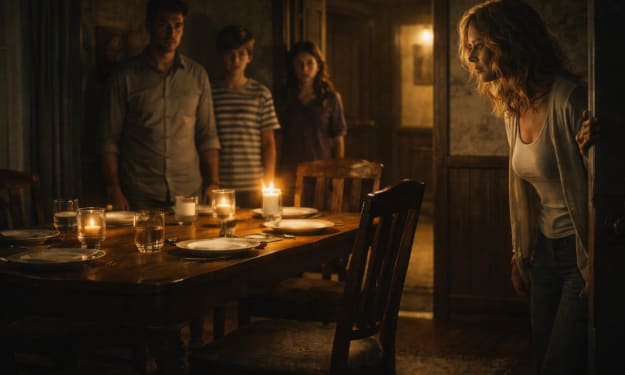
The first time the chair appeared, it was already set for dinner. Marianne noticed it when she brought the pot roast to the table. There were five place settings instead of four. Five forks aligned like silver ribs. Five water glasses catching the yellow light.
By Lori A. A.3 days ago in Fiction
When the Shelter Closes
Across the street from my house, a man slept under a tree, his dog by his side. My first, naive thought: he must be traveling through. But he kept coming back, often sleeping there during the day. Then it hit me—that person might not have a home.
By Bride of Sound6 days ago in Humans



Comments
There are no comments for this story
Be the first to respond and start the conversation.